The Algarve is best known for its beaches and golden cliffs, but the region also boasts a remarkable defensive heritage. Moorish fortresses, medieval castles, and coastal forts here tell the story of eight centuries of history, spanning the Christian Reconquista, pirate raids, and the great maritime discoveries.
Here is our selection of the most beautiful forts and castles in the Algarve, along with our helpful tips illustrated with photos!
This opinion is completely independent, based on our experiences. We visited the region anonymously, making our own choices and paying our bills in full.
The Forts and Castles of the Algarve: Map + Introduction
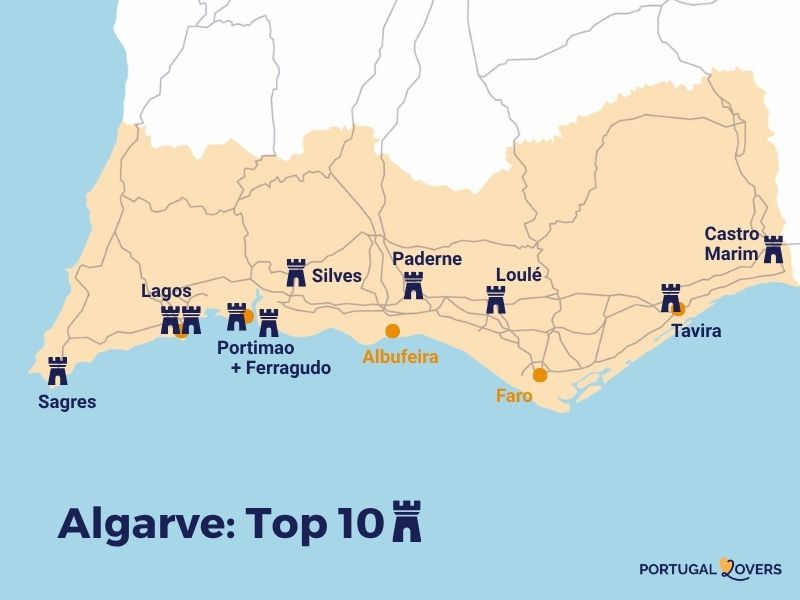
The Algarve region has long served as a strategic frontier, first between Portugal and the Muslim kingdom of Al-Gharb, and later against incursions by pirates and privateers coming from the sea. This turbulent history has left behind some fifteen fortified sites, ranging from a large Moorish castle to a small coastal fort built to guard the mouth of a river.
Here is a menu from our selection:
Some are best explored in depth, while others are best appreciated from the outside, for their panoramic views or their architecture.
If you can only see two, we recommend:
- Silves Castle, the best-preserved Moorish fortress in the region
- Sagres Fortress, for its exceptional setting and its connection to the Age of Discovery
1. Sagres Fortress

Why visit? Our review
The Sagres Fortress stands at the southwestern tip of Europe, on a windswept headland. Built in the 15th century at the behest of Prince Henry the Navigator, it is traditionally associated with the early days of Portugal’s great maritime expeditions. We found the site to be rather sparse architecturally, as most of the original buildings were destroyed in the 1755 earthquake.
But we were captivated by the atmosphere of the place: a walk of about 1.5 km runs along the cliffs to the lighthouse, passing by the huge compass rose marked on the ground.
Don’t miss “Voz do Mar,” a contemporary sound installation that amplifies the roar of the ocean as the swell rushes through a natural fissure.

Practical advice
- In Sagres, in the municipality of Vila do Bispo
- Tour duration: 30min to 1h
- Outdoor parking on site
- Flat trails, easy access
- Full adult price: 10 euros
- Hours: 9:30 a.m. to 5:30 p.m. from November through March; 9:30 a.m. to 8:00 p.m. from April through October
- Closed on January 1, May 1, and December 25
- Buy your ticket, save time
WHERE TO STAY IN THE Algarve
Our independent picks for the accommodation of your dreams:
- Where to stay in the Algarve
- Our favorite: Hotel Palmares Signature Apartments
Select by hotel type:
Select by city:

2. Silves Castle

Why visit? Our review
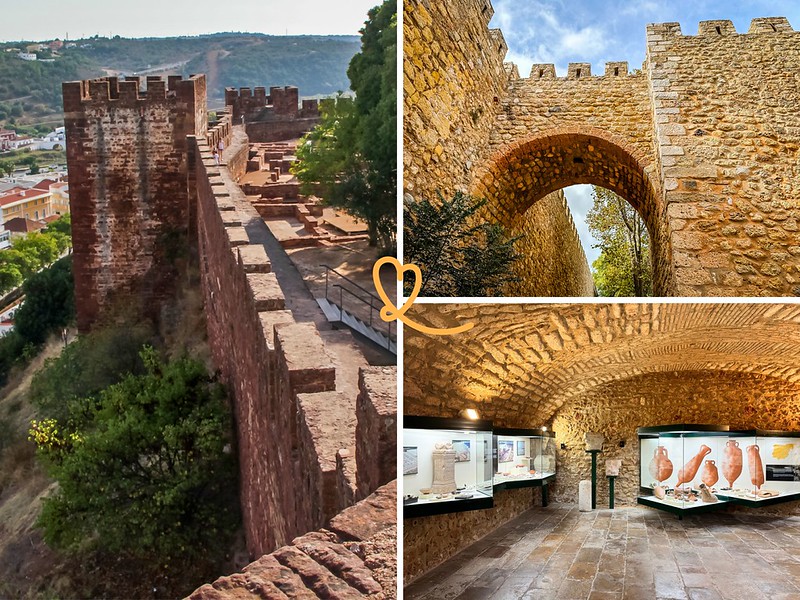
Silves Castle overlooks the town from the top of the hill and is instantly recognizable thanks to the local red sandstone used to build its walls. Built between the 8th and 13th centuries, it was the heart of Al-Gharb when Silves was the capital of the Algarve under Muslim rule, a region renowned at the time for its poetry and scholarship.
We consider this castle to be the best-preserved fortification in the region, featuring eleven towers and ramparts that visitors can walk along their entire length. And we love its color!
Inside, the enormous underground cistern, which supplied the city with water until the 1990s, made a particularly strong impression on us.
There are also gardens and a small café on the grounds, where it’s nice to take a break after the climb.

Practical advice
- In the town of Silves
- Tour duration: 1h to 1h30
- Walk uphill from downtown along a sloping cobblestone street
- Full-price adult admission: 2.80 euros; combined ticket with the nearby archaeological museum: 3.90 euros
- Hours: 9:00 a.m. to 5:30 p.m. in winter, 9:00 a.m. to 8:00 p.m. in summer
- Latest news on the official website here
- Book a guided tour
3. Lagos Castle

Why visit? Our review
The origins of Lagos Castle date back to Roman times, but it was the Muslim conquerors who expanded and fortified it over the centuries. It then served as the residence of the governors of the Algarve until 1755, when the Lisbon earthquake severely damaged it.
It was later rebuilt and designated a national monument. We appreciated that it is an integral part of the ancient walls of Lagos, several sections and gates of which still stand around the old town.
This tour is a great way to combine a stroll through the historic center with a visit to the nearby Fort Ponta da Bandeira.
See our full article on the tour of Lagos Castle.

Practical advice
- In the Old Town of Lagos
- One advantage of exploring the ruins of Lagos Castle is that it requires neither a reservation nor an admission ticket. In fact, this is a self-guided tour of the city, with no set schedule or admission fees.
- Book a guided tour of Lagos
OUR ADVICE FOR RENTING A CAR IN THE Algarve
- Compare prices on our preferred platform: DiscoverCars – one of the best rated sites.
- Don’t take a car that’s too wide, as old towns have narrow streets and small parking spaces.
- For more choice, book early.

4. Ponta da Bandeira Fort (Lagos)

Why visit? Our review
Built in the late 17th century at the entrance to the port of Lagos, Ponta da Bandeira Fort was part of the defensive system protecting the former military headquarters of the Algarve. To reach the inner courtyard, you must cross a drawbridge spanning the moat, which sets the tone right away.
We found the small chapel dedicated to Saint Barbara, adorned with 18th-century azulejos, which was particularly well-maintained for a building that was primarily military in nature. Today, the galleries host temporary exhibitions as well as a space dedicated to Portuguese discoveries.
The terrace also offers a beautiful view of Lagos Bay and the surrounding beaches.
See our full article on the tour of Fort Ponta da Bandeira.

Practical advice
- In the city of Lagos, a few minutes’ walk from Infant D. Henrique Square
- Visit duration: 15min to 30min
- Closed on Monday
- Full adult price: free
- Hours: Tuesday through Sunday from 10 a.m. to 1 p.m. and from 2 p.m. to 6 p.m. Closed on January 1st, Easter Sunday, April 25th, May 1st, December 1st, 24th and 25th.
5. Loulé Castle

Why visit? Our review
Loulé Castle overlooks the heart of the old town, on the site of the former Muslim medina of Al-Ulya. Built in the 13th century following the Christian reconquest led by Dom Paio Peres Correia, only three towers remain today, connected by a section of the wall that once surrounded the entire city.
We enjoyed walking along the rampart walk, which offers an unobstructed view of the rooftops of Loulé and the surrounding countryside. The site is also home to the municipal museum, located within the castle grounds themselves.
The main tower, formerly the minaret of the Great Mosque of Al-Ulya, is one of the few remaining structures of its kind still visible in Portugal.

Practical advice
- In the Old Town of Loulé
- Duration of visit: 30 minutes to 1 hour, including the municipal museum
- Free admission to the outdoor courtyard; admission to the castle and tower requires a ticket
- Full adult price: €1.62
- Hours: Tuesday through Saturday, 10:00 a.m. to 1:30 p.m. and 2:30 p.m. to 6:00 p.m.
- Closed on Sunday and Monday
- Latest news on the official website here
A LITTLE MORE patience
All the photos, maps, information and addresses you need to make your stay in Portugal a success will soon be available in a single ebook!
If you would like to be informed when our guide to Portugal is published, please register:
6. Paderne Castle

Why visit? Our review
Built in the 12th century by the Almohads, Paderne Castle is notable for its rammed-earth construction technique—a mixture of earth, lime, and gravel typical of Muslim military architecture. In fact, it is one of the seven castles symbolically depicted on the Portuguese flag.
We found the site to be more modest than other fortresses in the region—largely in ruins and sometimes closed for restoration—but its setting on the banks of the Quarteira River makes it worth a visit. An old medieval church also stands within its walls.

Practical advice
- In the municipality ofAlbufeira, near the Quarteira River
- Duration of visit: 20 to 30 minutes
- Often closed for renovations; please check whether it’s open before you go
- Free admission
FUN in the Algarve: activities
Caves and Cliffs by Boat
Kayak Tours
Dolphin watching
Jeep Tour

7. Fortaleza Santa Catarina (Portimão)

Why visit? Our review
Built in 1621 by the Italian architect Alexandre Massai, the Fortaleza Santa Catarina stood guard over the mouth of the Arade River, facing the Fort of São João do Arade on the opposite bank. Its mission was to protect Silves and Portimão from attacks by pirates and privateers coming from the sea.
What stood out most to us was the view from its terrace, which overlooks the Portimão marina and Praia da Rocha. The small chapel dedicated to Saint Catherine, which predates the fortress itself, is also open to visitors.
There’s a café on site where you can linger a while and enjoy the view.

Practical advice
- In Praia da Rocha, Portimão
- Duration: 15 to 30min
- Challenges: uneven steps leading to the upper floor, but a better view from the ground floor
- Price: free admission
8. Tavira Castle

Why visit? Our review
Originally built by the Phoenicians and later rebuilt during the Muslim period, Tavira Castle has retained a quadrangular layout without a central keep, a feature inherited from its defensive rather than residential function. The rampart walk allows you to walk all the way around the ramparts, with a few steep steps on the way down.
Despite its modest size, we consider it an essential stop to begin your tour of Tavira, both because of the excellent condition of its walls and because of the view it offers of the city and the Gilão River. The open-air interior, designed as a garden, is surprisingly peaceful.

Practical advice
- In the historic center of Tavira
- Duration of visit: 15 to 20 minutes
- Steep stairs without a handrail leading down from the ramparts; use caution if you are prone to vertigo
- Free admission
- Hours: 10 a.m. to 5 p.m. in winter, 10 a.m. to 7 p.m. in summer

It’s time to book!
Compare everything: companies, prices, schedules and availability.
9. Castro Marim Castle

Why visit? Our review
Built in the 13th century during the reign of Afonso III, Castro Marim Castle occupies a strategic position on the border with Spain, on the banks of the Guadiana River. We were impressed by the sweeping panorama it offers: the river, the salt marshes, and the surrounding nature reserve stretch as far as the eye can see from its semicircular ramparts.
An archaeological museum located within the grounds traces the history of the site, which was inhabited long before the current castle was built.
Every year, in late August, a large medieval fair brings the castle and its surroundings to life.
Practical advice
- In the town of Castro Marim, on the border with Spain
- Tour duration: 30min to 1h
- Full adult price: €1.10
- Hours: 9:30 a.m. to 1:00 p.m. and 3:00 p.m. to 6:30 p.m. from April through October; 9:00 a.m. to 1:00 p.m. and 2:00 p.m. to 5:00 p.m. from November through March
- Medieval Fair on the last weekend of August
- Latest news on the official website here
10. São João do Arade Fort (Ferragudo)

Why visit? Our review
Perched on a rock in Ferragudo, the Forte de São João do Arade worked in tandem with the Fortaleza Santa Catarina, situated on the opposite bank of the Arade, to jointly guard the river’s mouth. Its origins date back to a 15th-century watchtower, which was later reinforced in the 17th century. We would like to clarify an important point: since the early 20th century, the building has been privately owned and converted into a residence by the poet Coelho Carvalho; therefore, the interior is not open to the public.
Nevertheless, with its well-preserved crenellated walls, it remains a beautiful scenic spot along the walk between Praia Grande and Praia da Angrinha.

Practical advice
- In Ferragudo, on the opposite shore from Portimão
- Private property: exterior viewing only
- You can explore it by walking along the beach between Praia Grande and Praia da Angrinha
Other Forts and Castles in the Algarve
There are other fortified sites worth visiting if your itinerary takes you to these regions, although we consider them less of a must-see than the previous ones.
Aljezur Castle
Built in the 10th century by the Almohads, Aljezur Castle was once part of the Silves defensive system, along with Albufeira. Now in ruins, it overlooks the small town of Aljezur and its river from a hill, about a ten-minute walk from the center. The view of the valley and the city’s rooftops remains the main attraction of the visit; the ruins are limited to sections of walls and a cistern.
- On a hill overlooking Aljezur, on the west coast of the Algarve
- Duration of the tour: about 1 hour, including walking time
- Free access
Albufeira Castle
The Albufeira Castle was once part of the same defensive network as Silves and Aljezur, but today only very few remnants remain, having been absorbed into the urban fabric of the old town. The visit is therefore limited to a brief stop during a stroll through the narrow streets of Albufeira’s historic center, rather than a standalone attraction.
Beliche Fortress
Not far from Sagres, the Fortaleza de Beliche originally protected local fishermen from pirate attacks. Damaged by Francis Drake in 1587 and later by the 1755 earthquake, it has since been restored and houses a small chapel topped by a dome. It’s worth visiting in addition to the Sagres Fortress, which is just a few minutes’ drive away.
Alcoutim Castle
At the northeastern tip of the Algarve, Alcoutim Castle has stood guard over the border since the 14th century, facing the Spanish village of Sanlúcar de Guadiana, which is clearly visible across the river. An archaeological museum now occupies part of the enclosure.
FAQ
Which is the most beautiful castle in the Algarve?
Silves Castle is generally considered the best-preserved and most impressive fortification in the Algarve, thanks to its red sandstone walls and eleven towers.
Which forts in the Algarve are free to visit?
Tavira Castle, Paderne Castle, and the Fortaleza Santa Catarina in Portimão are free to visit. The Aljezur Castle is also open to the public.
Can we tour the interior of the São João do Arade Fort?
No. The Ferragudo Fort has been privately owned since the early 20th century, and only its exterior facade can be seen from the beach or the coastal trail.
PLAN YOUR TRIP TO THE algarve
- Best of
What to do in the Algarve
The most beautiful landscapes
Most beautiful towns and villages
Algarve’s most beautiful beaches
Best excursions

- Practical advice
When to go?
How to rent a car in the Algarve
How many days?
Itineraries
Where to stay in the Algarve
Lagos, Portimao or Albufeira
Most beautiful hotels