Whitewashed houses clinging to medieval ramparts, narrow streets winding their way up to a castle, brightly colored fishermen’s houses, and villages carved right out of the rock… Discover our selection of Portugal’s most beautiful villages! In this article, we’ll take you on a tour of these places that deserve a spot on your itinerary, complete with practical tips and a map.
This opinion is completely independent, based on our experiences. We visited the region anonymously, making our own choices and paying our bills in full.
Portugal’s Most Beautiful Villages: Summary and Map
Map
Portugal offers a wide variety of villages, ranging from the mountains to the Atlantic coast and the inland plains.
Here’s a map with our top 10 places to visit, so you can decide which ones to include on your road trip.

Which villages in Portugal should you visit? Quick response:
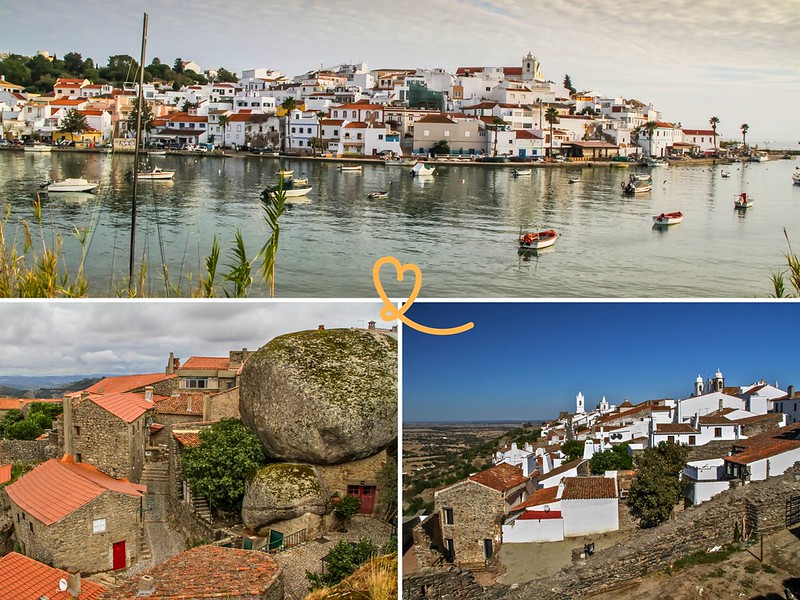
If you only need to visit 4, to get an overview of the different styles:
- Monsanto, the stone village
- Óbidos, the fortified town
- Monsaraz, the Balcony of the Alentejo
- Ferragudo, the fishing village
1. Monsanto
Why visit?
Known as the “most Portuguese village in Portugal” since 1938, Monsanto sits on a granite hill in the Beira Baixa region. His houses are literally built between, under, and sometimes inside enormous granite boulders, which serve as walls or roofs. We found something unique in this country: you never know whether you’re looking at a house or a rock.

The village is also home to the ruins of a medieval castle, accessible via a steep trail; the climb is rewarded with one of the most beautiful views in the region. In fact, we strongly recommend that you go up at the end of the day to enjoy the sunset over Beira Baixa.
The must-dos
- The ruins of Monsanto Castle and its ramparts
- The houses that blend into the rocks, particularly around Rua Fernando Namora
- The Matriz Church of São Salvador
- The Romanesque Chapel of São Miguel do Castelo
- The Twin Rocks Trail to the Castle

How to get there
- In the Beira Baixa region, near the Spanish border
- From Castelo Branco = 45-minute drive
- From Lisbon = 3-hour drive
- From Porto = 3-hour drive
- Parking is required at the village entrance (Rua Fernando Namora); traffic is very limited inside the village
- There is no train station or regular bus service: a car remains the only practical way to get to the village

Practical advice
- Wear good walking shoes; the alleys are steep, and the trail to the castle is rocky.
- Plan on spending at least half a day there—or longer if you go up to the castle
- The village offers little shade in the summer: be sure to bring water and a hat
- To experience it in a different setting, spend the night there! See the best rated accommodations
OUR TIPS FOR RENTING A CAR IN Portugal
- Compare prices on our preferred platform: DiscoverCars – one of the best rated sites.
- Don’t take a car that’s too wide, as old towns have narrow streets and small parking spaces.
- For more choice, book early.

2. Ferragudo
Why visit?
Located across from Portimão on the eastern bank of the Arade Estuary, Ferragudo has retained its character as a fishing village despite the Algarve’s growth as a tourist destination. Its cobblestone streets wind gently upward between white houses with colorful shutters, leading to a small church that overlooks the bay.

We enjoyed the authentic atmosphere of the harbor, where fishermen still set out their nets early in the morning. The São João do Arade Castle, built on the waterfront between Angrinha Beach and Praia Grande Beach, once served as a watchtower to defend against pirate attacks, and is a pleasant addition to the promenade.
The must-dos
- The walk along the harbor and its fishing boats
- The Castle of São João do Arade
- The cobblestone alleys that wind their way up to the church
- The Trail of the Headlands, a coastal trail accessible on foot or by car
- Nearby beaches: Praia Grande and Praia da Angrinha
- See our article on attractions

How to get there
- In the Algarve, across from Portimão, on the opposite bank of the Arade River
- From Portimão = 10-minute drive (5.5 km)
- From Lagos = 25-minute drive
- From Faro Airport = 45-minute drive
- It’s easy to explore the village on foot, but renting a car is still a good idea for exploring the surrounding area

Practical advice
- Let yourself be guided without a specific itinerary; the village is small and is best explored by strolling around
- Allow half a day for the village, or more if you include a trip to the beach
- Book your accommodations in advance during peak season—availability is limited
- The Ferragudo flea market is held regularly in the village; please check the schedule based on your visit date.
- To experience it in a different setting, spend the night there! See the best rated accommodations
3. Óbidos (a small town that feels like a village)
Why visit?
Óbidos, a former royal town that was given as a wedding gift to the queens of Portugal for several centuries, is entirely enclosed within its medieval ramparts. We walked along Rua Direita, the main street lined with whitewashed houses and craft shops, before climbing up onto the ramparts to take in the view of the village rooftops and the surrounding countryside.

The Óbidos Castle, now converted into a pousada, frames the view at the far end of the street. We recommend trying ginjinha, a local cherry liqueur served in a small chocolate cup—a specialty you’ll find on every street corner.
The must-dos
- A walk along the ramparts, a 1.5-kilometer route with views of the village and the valley
- Rua Direita and its pottery shops
- The Castle of Óbidos
- The Church of Santa Maria and its azulejo wall
- Ginjinha Tasting

How to get there
- About 85 km north of Lisbon, on the route to Porto
- From Lisbon = 1-hour drive on the A8
- From Nazaré = 30-minute drive
- Bus from the Campo Grande bus station in Lisbon, operated by Rapida Verde (1 hour and 15 minutes)
- A dirt parking lot at the entrance to the village, which fills up quickly during the day

Practical advice
- Óbidos is one of the most visited fortified villages in the country; come early or late in the day to avoid the tour buses
- The ramparts do not have a safety barrier on the village side, so please be careful with children.
- The Medieval Fair, which takes place every year in July for two weeks, draws large crowds
- Staying overnight lets you enjoy the village without the day-trippers— See the top-rated accommodations. We loved the sunsets and sunrises over the fortifications!

4. Mértola
Why visit?
Built on a promontory at the confluence of the Guadiana and the Ribeira de Oeiras, Mértola bears the marks of its successive occupations: Roman, Almohad, and then Christian. We were particularly impressed by its Matriz Church, a former 12th-century mosque that was slightly modified in 1238 following the Christian conquest, but which has retained its horseshoe arch—a feature typical of Islamic architecture.

The medieval castle overlooking the village offers a sweeping view of the Guadiana Valley, while the Mértola Museum, located beneath the church, displays archaeological artifacts found in the region. Unlike other villages in the Alentejo, Mértola has undergone very little restoration and gives the impression of a rare sense of authenticity.
The must-dos
- The medieval castle and its view of the Guadiana River
- The Matriz Church, a former Almohad mosque
- The Mértola Museum and Its Archaeological Collection
- The São Francisco Convent
- The abandoned São Domingos mine, 17 km away

How to get there
- In the Lower Alentejo, in the district of Beja, near the border with the Algarve
- From Beja = 50-minute drive
- From Faro = 1 hour and 30 minutes by car
- From Lisbon = 2.5-hour drive
- There are no trains, so the car is the most convenient way to get to the village

Practical advice
- The village slopes upward from the river to the castle, so be sure to wear sturdy shoes
- Spring and fall are still the best seasons; summer can be very hot in this inland region
- Plan on spending half a day in the village, or a full day if you include the São Domingos mine
- To experience it in a different setting, spend the night there! See the best rated accommodations
5. Monsaraz
Why visit?
Perched on a hill in the Alentejo, a few kilometers from the Spanish border, Monsaraz overlooks Lake Alqueva and the Guadiana Valley. The village, which is entirely pedestrian-only within its ramparts, features rows of immaculate white houses lining cobblestone streets dotted with carved doorways, small art galleries, and craft shops.

We climbed up to the castle, built in the 14th century during the reign of Dinis I, to admire one of the region’s most beautiful panoramic views of the surrounding olive groves and vineyards. Compared to other villages in the Alentejo, we found Monsaraz to be particularly well-preserved, without losing its peaceful atmosphere.
The must-dos
- Monsaraz Castle and its view of Lake Alqueva
- The city walls and their four gates: Porta da Vila, Porta d’Évora, Porta d’Alcoba, and Porta do Buraco
- Art galleries and local crafts in the narrow streets
- The region’s wineries, including Ervideira

How to get there
- In the Alentejo region, in the municipality of Reguengos de Monsaraz, in the district of Évora
- From Évora = 50-minute drive
- From Lisbon = 2-hour drive
- Free parking at the village entrance; cars are not allowed inside the ramparts

Practical advice
- The village isn’t very big; allow 2 to 3 hours to explore it at a leisurely pace.
- It’s best to come at the end of the day to enjoy the sunset from the castle
- Combine this visit with a trip to Évora or an excursion to Lake Alqueva
- To experience it in a different setting, spend the night there! See the best rated accommodations

6. Marvão

Why visit?
At an elevation of 860 meters on a granite spur of the Serra de São Mamede, Marvão overlooks the Alentejo plain and looks all the way to Spain. The village is accessed through a narrow medieval arch, near which stands the Moorish-style Jerusalem Chapel. We strolled along the cobblestone streets lined with white houses featuring wrought-iron balconies, before reaching the 13th-century castle that marks the western edge of the village. The view from the crenellated ramparts stretches for kilometers, and we understand why the writer José Saramago said that you could see the whole world from Marvão.
The must-dos
- Marvão Castle and its crenellated ramparts
- The Jerusalem Chapel, at the entrance to the village
- The Municipal Museum, housed in the former Santa Maria Church
- The Notre-Dame d’Estrela Convent, outside the city walls
- The PR1 trail toward Portagem, below the village

How to get there
- In the Alto Alentejo, on the border with Spain (Valencia de Alcántara is visible from the village)
- From Castelo de Vide = 20-minute drive
- From Lisbon = 2.5-hour drive
- Parking is available at the village entrance; the final stretch is on foot

Practical advice
- The access roads are winding and narrow; please drive carefully.
- Come at the end of the day to enjoy the softer light on the ramparts
- It takes 2 to 3 hours to explore the village, or longer if you include a hike in the Serra de São Mamede Natural Park
- To experience it in a different setting, spend a night there! See the top-rated accommodations. We loved the sunsets and sunrises over the fortifications!
7. Porto Covo
Why visit?
On the Alentejo coast, within the Southwest Alentejo and Costa Vicentina Natural Park, Porto Covo has retained the charm of a fishing village, despite its growing popularity. We loved its main square, Praça Marquês de Pombal, as well as the string of beaches and coves nestled among the cliffs all around the village.

From the coast, the view of Pessegueiro Island—which can be reached by boat in the summer—adds an extra attraction. Unlike the seaside resorts of the Algarve, the atmosphere here remains decidedly peaceful.
The must-dos
- Praia Grande, the largest beach, accessible from the village
- Praia dos Buizinhos, a small cove in the heart of the village
- Samoqueira Beach and its natural pools
- Pessegueiro Island, accessible by boat during the season

How to get there
- On the Alentejo coast, 20 km north of Vila Nova de Milfontes
- From Lisbon = 1 hour and 45 minutes by car (170 km)
- From Sines = 15-minute drive
- From Vila Nova de Milfontes = 20-minute drive

Practical advice
- Praia da Grande is patrolled during the summer season; please exercise caution along the rest of the coastline
- Praia do Salto is an official naturist beach, distinct from the village’s other coves
- Accommodation options are still limited: be sure to book in advance during the summer. See the top-rated accommodations.

It’s time to book!
Compare everything: companies, prices, schedules and availability.
8. Costa Nova
Why visit?
On the coast of the Ria de Aveiro, Costa Nova is instantly recognizable by its *palheiros*—those old wooden fishermen’s huts painted with alternating red, blue, or yellow stripes on a white background. Originally, they were used to store nets and fishing gear, and their bright colors made them easy to spot from the often foggy waters of the lagoon.

We walked along José Estêvão Avenue, where these facades line the street, before reaching the Atlantic beach via a wooden plank path. We recommend rounding out your visit with a trip to the beach and its dunes.
The must-dos
- José Estêvão Avenue and its striped haylofts
- The Fish Market (Mercado do Peixe da Costa Nova)
- The Atlantic beach and its boardwalk
- The Barra Lighthouse, one of the tallest in Portugal, a little further north

How to get there
- On the coast, right next to Aveiro
- From Aveiro = 15-minute drive or by bus
- From Porto = 1-hour drive
- Aveiro is connected to Lisbon and Porto by direct train, making it easy to take a day trip

Practical advice
- Aveiro and Costa Nova are two separate towns that are not within walking distance of each other
- Come during the off-season if possible; this spot is very popular with photographers and gets crowded in the summer
- Combine your visit with a moliceiro boat tour on the canals of Aveiro
- To experience it in a different setting, spend a night there! See the top-rated accommodations.
9. Monchique
Why visit?
Nestled at an elevation of 450 meters in a gorge between the Fóia and Picota peaks, Monchique offers a side of the Algarve that’s quite different from the beaches along the coast. Its steep, cobblestone streets are lined with colorful facades, where we spotted several stork nests perched atop utility poles.

From the village, the road leads to the Miradouro da Fóia, the highest point in the Algarve at 902 meters, which offers a view stretching from Cabo de São Vicente to the Serra da Arrábida. We also enjoyed Parque das Fontes, a shaded area with a stream running through it that has been landscaped with steps—the perfect spot for a break after the climb.
The must-dos
- The Miradouro da Fóia, the highest point in the Algarve (902 m)
- Parque das Fontes and its landscaped stream
- The historic alleyways in the town center and local crafts (wicker, cork)
- The Caldas de Monchique hot springs, just a few kilometers away
- See our article.

How to get there
- In the hills that separate the Algarve and the Alentejo
- From Portimão = 30-minute drive
- From Faro = 1-hour drive
- From Albufeira = 40-minute drive

Practical advice
- Mountain roads are winding, so allow a little more time than your GPS indicates
- Bring a light jacket—it’s cooler here than by the sea
- Combine your visit with a trip to the Caldas de Monchique thermal baths for a relaxing break
- To experience it in a different setting, spend a night there! See the top-rated accommodations.
10. Penela (a small, village-like town)
Why visit?
About 20 kilometers from Coimbra, Penela is dominated by an 11th- and 12th-century fortified castle, built on a limestone outcrop that served as a defensive outpost during the Reconquista. We climbed up to the keep, built right into the rock, to enjoy a panoramic view of the village and the Serra da Lousã to the east.
Down below, the Church of Santa Eufémia houses a Renaissance altarpiece from the Coimbra school of sculpture, which we recommend you visit if your schedule allows. Penela is still off the beaten path for foreign visitors, making it a relaxing stopover between the region’s major attractions.

How to get there
- Coimbra District, Central Portugal Region
- From Coimbra = 20-minute drive (20 km)
- From the ruins of Conímbriga = 15-minute drive
OUR TIPS FOR RENTING A CAR IN Portugal
- Compare prices on our preferred platform: DiscoverCars – one of the best rated sites.
- Don’t take a car that’s too wide, as old towns have narrow streets and small parking spaces.
- For more choice, book early.
Other villages to explore
And if you have some time left, we also recommend the following villages, particularly the Aldeias Históricas de Portugal, a network of 12 historic villages in central and eastern Portugal.
11. Lindoso

In the Peneda-Gerês National Park, on the border with Spain, Lindoso features a medieval castle and more than 60 espigueiros—granaries built on granite stilts that protected crops from rodents and moisture.
In northern Portugal.

Almeida
Almeida is notable for its 12-pointed star-shaped fortress, a rare example of Vauban-style military architecture on the Iberian Peninsula.
From Guarda = 45-minute drive, near the Spanish border.
Belmonte
Belmonte, the birthplace of Pedro Álvares Cabral, the discoverer of Brazil, is home to a castle, an active synagogue, and one of the country’s oldest Jewish communities.
From Covilhã = 20-minute drive.
Castelo Mendo
Castelo Mendo, a nearly deserted fortified village, has preserved its medieval gates and an old pillory in its central square.
From Guarda = 30-minute drive.
12. Linhares da Beira
Located on a plateau in the Serra da Estrela, this village is one of the Aldeias Históricas. Its castle offers a sweeping view of the horizon, and its Romanesque church houses panels attributed to Grão Vasco, a 16th-century Portuguese painter.
From Guarda = 40-minute drive.

Castelo Novo
This village in Beira Baixa is known for its stately homes, its town hall, and its Baroque fountain dedicated to King João V.
From Castelo Branco = 30-minute drive.
Castelo Rodrigo
Perched on a plateau, this village is home to the ruins of an ancient fortress and the turbulent history of a rivalry between two noble families.
From Guarda = 45-minute drive.
Idanha-a-Velha
A former Roman city (Egitânia), Idanha-a-Velha is home to a Visigothic cathedral and ancient ruins scattered throughout a tiny village, just a few minutes from Monsanto.
From Monsanto = a 15-minute drive.
Piódão
Niché dans la Serra do Açor, Piódão est construit en terrasses de schiste, avec des volets et des portes peints en bleu qui tranchent avec la pierre sombre. C’est le seul des Aldeias Históricas sans château, la position isolée du village lui servant de défense naturelle.
Depuis Coimbra = 1h15 de route, sur des routes de montagne sinueuses.

Marialva
The northernmost of the Aldeias Históricas, Marialva combines a castle, Jewish heritage evident in its buildings, and typical granite houses, all located near the prehistoric rock engravings of Foz Côa.
From Guarda = 1-hour drive.
Sortelha
At an elevation of 760 meters, Sortelha sits on a rocky spur surrounded by ramparts. The view from the castle tower is one of the most striking in the Aldeias Históricas network.
From Guarda = 40-minute drive.
Trancoso
Surrounded by walls built on the orders of King Dinis, Trancoso still has a Jewish quarter where Hebrew symbols can still be seen engraved on the stones of the houses.
From Guarda = 30-minute drive.
Camara de Lobos (in Madeira)
Câmara de Lobos charms visitors with its small harbor filled with colorful fishing boats and its houses with orange-roofed, a place that Churchill loved to paint from the waterfront.

PLAN YOUR TRIP TO Portugal
- Best of
Best destinations
Best attractions in Portugal
The most beautiful landscapes
Most Beautiful Cities
Most beautiful villages
Portugal’s Most Beautiful Beaches

- Practical advice
When to go?
How to rent a car in Portugal
Driving tips
How many days