Should I drive in Portugal? Our answer is definitely yes. Here is our comprehensive guide to driving in Portugal, including:
- Safety and driving difficulties
- Rules of conduct
- Road conditions
This opinion is completely independent, based on our experiences. We visited the region anonymously, making our own choices and paying our bills in full.
Driving in Portugal: What You Need to Know
If you don’t want to read the whole article, at least read this short summary of the essential points to know:
- They drive on the right side of the road there.
- The minimumage to drive is 18, but some rental agencies may require drivers to be older.
- Seatbelts are compulsory for everyone.
- The legal blood alcohol limit is 50 mg per 100 ml of blood.
- Speed limits are clearly indicated on circular signs with red borders.
- Some highways have tolls: make sure your rental car is equipped with an electronic toll device (V-tag / Via Verde).
- Solid white lines must never be crossed.
- If your vehicle is wide, avoid driving into old villages—their streets are very narrow.
- In case of an accident – emergency number: 112
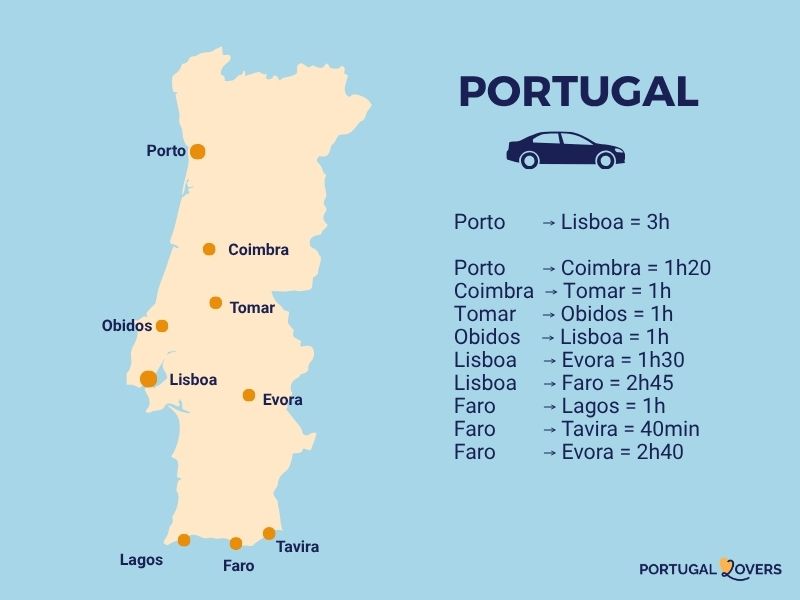
- Here are the travel times within the country, to give you an idea of how long your trips will take:
1. Renting the Right Car in Portugal
To make driving easier, it’s best to choose a car adapted to the type of road and conditions. For Portugal, we recommend:
- Not too wide, because old villages have narrow streets
- A manual transmission if you’re on a budget: automatic transmissions are still less common and cost more
- You don’t need a 4WD; almost all the roads are paved.
- Learn more in our article: How to Rent a Car in Portugal.
- >> View car rental deals on our favorite platform

2. Know the rules of conduct
Permit requirements
To drive in Portugal, you need a valid driver’s license from your home country.
If you have a valid driver’s license that includes a license number, a photo, an expiration date, and is written in the Latin alphabet, then you do not need an international driver’s permit. Otherwise, you’ll need one to go with it.
Also, be sure to always carry your vehicle registration documents and a valid form of identification, such as your passport.

Age
The minimum age for driving in Portugal is 18.
But keep in mind that many rental agencies may have different age requirements.
General rules
- In Portugal, people drive on the right side of the road
- Seat belts mandatory for all
- No cell phones while driving
- Headphones are forbidden
- Children under 12 are not allowed to sit in the front of the car.

Alcohol and driving
The legal blood alcohol limit is 50 mg per 100 ml of blood. Nevertheless, we recommend that you avoid drinking alcohol entirely if you’re going to drive.
Mandatory in-car equipment
In Portugal, the following equipment must be available in the car:
- Warning triangle
- Reflective vest or jacket
- Set of spare lights
- Spare wheel
- Booster seats for children under 12 or 1.35m tall

Compulsory insurance
Unlimited third-party insurance is compulsory for driving in Portugal.
It is automatically included in the price of all car rentals.
If you come with your own car, don’t forget to bring proof of insurance.

3. Preparing for different types of road
Highways
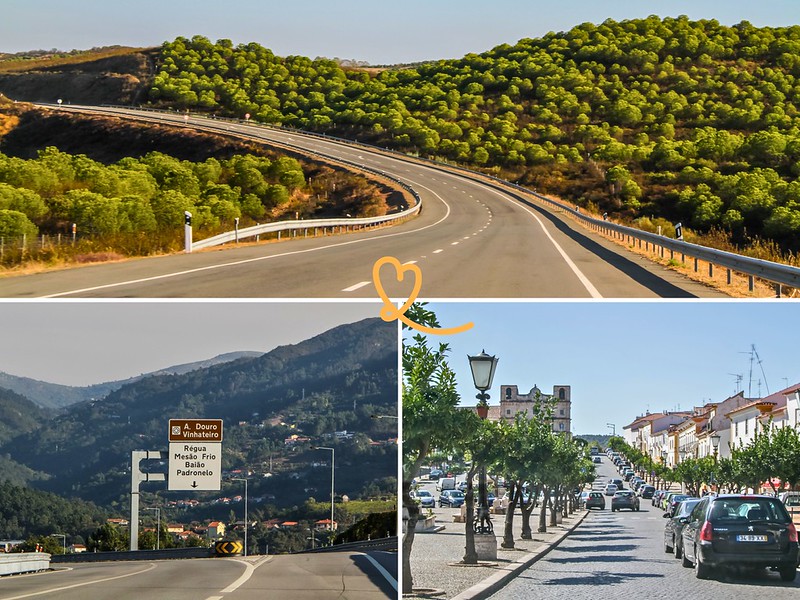
Portugal has an extensive network of highways connecting its major cities. These roads are in very good condition and allow for quick travel. Most of them are toll roads, a point we discuss in more detail below in the section on road signs.

Mountain roads
Outside of the highways, roads vary by region, but most have at least one lane in each direction. We encountered very few single-lane sections, and when we did, they were mainly used to reach a specific attraction over a short distance. On mountain roads, there’s usually a guardrail whenever there’s a steep drop-off on one side, which is quite reassuring on this kind of drive.

In towns and villages
Around Lisbon and Porto, traffic is heavy, just like in any big city. Both cities have good public transportation systems, so we recommend that you park your car before setting out to explore their neighborhoods. Small towns are generally easy to navigate.

It’s mainly the old villages that pose a challenge: their historic centers often have very narrow streets and sharp turns, so it’s best to park on the outskirts and continue on foot.
4. Understanding signs and tolls
Speed limits
- Speed limits are indicated on circular signs with a red border and a number
- They are expressed in kilometers per hour
- The national speed limits are: 50 km/h in residential areas, 90 km/h on rural roads, and 120 km/h on highways
- Vehicles towing a trailer must not exceed 80 km/h.
- Signs with a blue circle sometimes indicate a minimum speed limit on certain lanes
- The limits and certain hazards are also marked directly on the road surface

Road signs
Road signs are standard and written in the Latin alphabet; there’s nothing specific you need to know. Directions are generally well marked, although they may sometimes be missing in the countryside, so a GPS is still useful. Points of interest are marked on brown signs. The only downside we noticed while there: the signs marking the entrance to a town or village are white and unobtrusive, so it’s easy to forget to slow down when you pass them.

Tolls
Portuguese highways are not free; they have tolls at various points along the way. The simplest solution is still to get a V-tag with your rental car: this Via Verde device automatically records each trip, and the agency bills you for the total amount at the end of the rental.Without a V-tag, the procedure varies by region: in the north, most toll plazas have booths located near the V-tag lanes, where you can pull over to pay directly.

In the south, on the other hand, some toll booths have no booth at all; in that case, you must go to a post office within two days to pay the amount, with the risk of being charged for the entire trip if you cannot provide proof of your entry point.


It’s time to book!
Compare everything: companies, prices, schedules and availability.
5. Safety: understanding potential hazards
Is driving in Portugal dangerous?
No, overall, driving in Portugal is still easy. There are many new roads, most of which are well-maintained. It was especially in the Algarve that we felt the most tension, as that region has the highest concentration of tourist traffic in the country. Elsewhere, the pace is much more relaxed.

Potential hazards
- The scenery – Some roads are so beautiful that they distract the driver. It’s better to stop and admire the view than to look at it while driving.
- Rush-hour drivers – As is the case everywhere, some drivers speed or pass other vehicles recklessly. Keep an eye on your rearview mirrors.
- Nighttime Lighting – Many roads are not very well lit at night, which requires extra caution.

Specific driving tips
It is illegal to pass on the right when traffic is moving smoothly. Keep this in mind, especially on two-lane rural roads where this reflex might seem useful.
What to do in the event of an accident
If people are injured or there is a conflict, the emergency number is 112.
The best order of action is:
- contact emergency services
- contact the police
- contact your rental provider

6. And the rest: parking, fuel…
Fuels and service stations
- Gas is pretty expensive in Portugal
- Unleaded gasoline is called “gasolina sem chumbo”
- Diesel is called “gasoleo”
- The GPL is called “GPL”
- Gas stations are fewer and farther between in the Alentejo, so plan ahead
- You must fill the tank yourself
- At some gas stations, you have to pay in advance before you can fill up at night
Parking in town
Parking in Lisbon and Porto can quickly become a hassle: spots are scarce and parking lots are expensive. If your itinerary allows, we recommend visiting these two cities before picking up your rental car or after returning it. In small medieval towns, it’s best to park outside the city walls, as parking spaces are limited and the inner streets are extremely narrow.

Always remember to pay for your parking; inspections are frequent and quick, even early on Monday mornings. When you’re visiting Lisbon or Porto, choose a paid underground parking garage and then use public transportation to get around.
Parking at beaches and attractions
Parking conditions vary greatly from one location to another. Some beaches offer free parking, while others charge a fee. The same is true of certain palaces and churches. Always look for a large “P” sign to find available parking spots, and make sure you have some change on hand—you’ll often need it for the parking meters.

The Most Beautiful Roads in Portugal
Be sure to drive along Portugal’s most beautiful roads, including:
- Across the Alentejo, among the cork oaks
- In the Serra da Estrela, amid rock formations and glacial valleys
- Along the Douro Valley
- Around Peneda-Gerês National Park

Video
Here’s a video to give you a better idea of what to expect, from fast highways to the countryside, mountain roads, and city drives:
Frequently asked questions
Do you need a car in Portugal?
No, if you’re mainly planning to enjoy a beach resort in the Algarve or explore only Lisbon and Sintra. Yes, but if you want to enjoy the country’s diverse landscapes, have the freedom to adjust your itinerary based on the weather or peak travel times, and visit places off the beaten path. We believe that a car is still the best way to see most of Portugal, beyond the major cities.
Is it necessary to rent a 4WD vehicle in Portugal?
No, that’s not necessary. Almost all the roads are paved and generally in good condition; a standard vehicle is sufficient for exploring the country.
PLAN YOUR TRIP TO Portugal
- Best of
Best destinations
Best attractions in Portugal
The most beautiful landscapes
Most Beautiful Cities
Most beautiful villages
Portugal’s Most Beautiful Beaches

- Practical advice
When to go?
How to rent a car in Portugal
Driving tips
How many days