Perched on a hill in central-eastern Portugal, Monsanto is a unique village where houses blend in with enormous granite boulders. We have rarely seen such unique architecture—from pigsties carved into the rock to cobblestone alleys and a ruined castle. In fact, the village was named “the most Portuguese village in Portugal” in 1938.
Here is our guide to the must-see sights in the village of Monsanto, Portugal, along with helpful tips for planning your visit.
This opinion is completely independent, based on our experiences. We visited the region anonymously, making our own choices and paying our bills in full.
Is the village of Monsanto worth a visit?
Yes, the village of Monsanto is worth a visit. We were fascinated by the way the houses blend into the rocks, which are used as walls or roofs. You can also hike up to the castle ruins for some beautiful views.
It is one of the most beautiful villages in Portugal.
1. Stroll around to see the structures nestled among the rocks

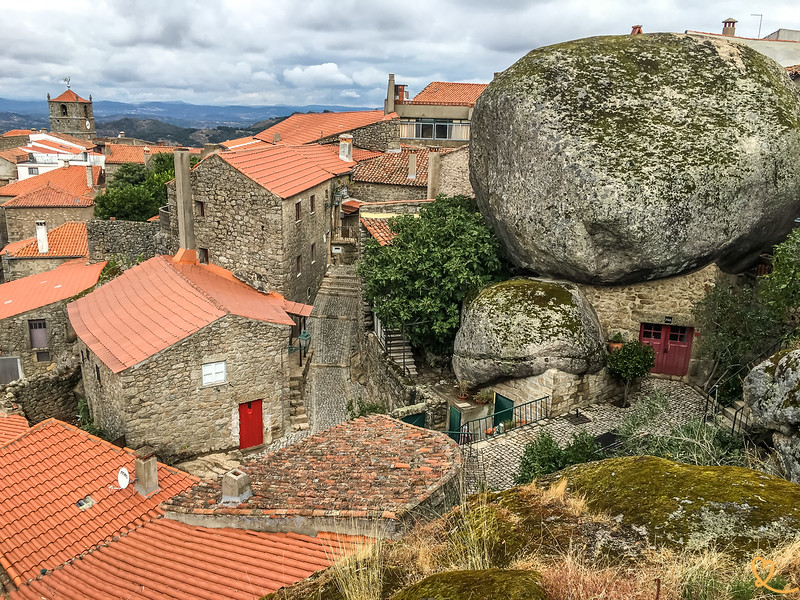
When we arrived in Monsanto, we immediately noticed that the rock doesn’t just border the houses—it’s often part of them. The granite blocks are used as walls, roofs, and pillars for the houses in the village, which is perched at an altitude of more than 750 meters. You’ll come across entire facades leaning against giant stones, some of which are cracked by erosion.

This blend of buildings and rock—a rare sight in Portugal—has earned Monsanto the nickname “the village of rocks.” We recommend that you wander through the narrow streets without a specific route in mind to spot these details. We’ve often seen villages with rocks, but this one is truly the most impressive because of the size, location, and frequency of the rocks.
OUR TIPS FOR RENTING A CAR IN Portugal
- Compare prices on our preferred platform: DiscoverCars – one of the best rated sites.
- Don’t take a car that’s too wide, as old towns have narrow streets and small parking spaces.
- For more choice, book early.

2. Miradouro do Forno and the most famous of the rock-cut houses

The Miradouro do Forno is one of the village’s must-see viewpoints. There, we discovered Monsanto’s most-photographed rock house, whose roof is a single, gigantic block of granite. You’ll quickly see why this image is circulating so widely: the building seems to be literally nestled beneath the rock.

We recommend taking a break here before continuing the tour.
There is a large square with beautiful views in several directions.
3. View from the Mirador Bastion

As you enter the village, you’ll come to a large square that opens out onto the valley: the Bastion Mirador, also known as Baluarte. This polygonal defensive structure once protected the corners of the fortifications. We enjoyed the unobstructed view of the plain from this high vantage point.

Local legend has it that the village held out for seven years against a Roman siege from this stronghold, an event commemorated every May 3 during the Festival of the Crosses (Festa das Cruzes). We think this square is a good first stop before heading up to the castle.

A LITTLE MORE patience
All the photos, maps, information and addresses you need to make your stay in Portugal a success will soon be available in a single ebook!
4. Farms and pig barns
On the hills above the village, you’ll notice small structures carved into the rock: the old pigsties. In medieval times, pigs were raised throughout Monsanto before being brought together in a single location for public health reasons.

We found it interesting to see that some of these enclosures still house animals today. Pork was an essential source of meat, which was then preserved as cured meats. We recommend taking your time as you walk past these small cavities: they reveal a great deal about the village’s past daily life.
5. The Lucano Tower and Its Views

You won’t be able to miss the Lucano Tower, the village’s clock tower. Its date of construction remains a matter of debate: some sources date it to the 15th century, while others date it to the 18th century. At its summit stands a replica of the silver rooster, a trophy received in 1938 when Monsanto was named the most Portuguese village in the country.

We climbed up the rocks at its base to enjoy the view, since the tower itself wasn’t open to visitors. We find that this makeshift lookout offers one of the most beautiful views of the village rooftops.
6. Spend the night there
Spending the night in Monsanto lets you enjoy the village once the day-trippers have left. We especially appreciate this calmer atmosphere, which is perfect for a quiet evening at one of the village bars. However, lodging options remain limited, ranging from guesthouses to small hotels such as the Monsanto GeoHotel Escola or Casa Da Maria. You’ll need to make reservations several months in advance if you’re visiting between May and October, which is the busiest time of year.
See the best rated accommodations

7. Pé Calvo Rock

If you take the path that branches off to the right of the village toward the castle, you’ll come across the Penedo do Pé Calvo, a giant rock split by a deep fissure. We were impressed by its size, even though the view from there is modest compared to other lookout points in the village.

It is one of the few rocks in Monsanto that has long been known by a name given to it by the locals. You can stop there briefly before continuing the climb up to the castle ruins. We recommend wearing sturdy shoes, as the trail is rocky and can be slippery at times.
8. Monsanto Castle

At the top of the hill, at an elevation of more than 758 meters, stand the ruins of Monsanto Castle. Built in the 12th century by the Knights Templar after Dom Afonso Henriques had ceded these lands to the knight Gualdim Pais, it overlooks the entire surrounding plain. We were struck by the extent of the damage caused by the explosion at the powder magazine in 1815, which destroyed a large part of the building. You can still see the medieval cistern, the remains of the towers, and the ruins of the Saint-Michel Chapel, surrounded by tombs carved into the rock. We would also like to note that the site served as a filming location for the series *House of the Dragon*.
- Hours: Free admission,
- Free admission
- Walk up from the village center
9. Hike above the village via the Joined Boulders

There is also a trail that starts above the village—on the left as you go up—and leads to the castle via the Joined Boulders. These two rocks, which appear to rest on top of one another, are one of the geological attractions along the trail. We liked this alternative route, which is less crowded than the main trail.

You’ll pass through a landscape of granite boulders shaped by erosion, with several scenic overlooks of the valley along the way. And we especially loved the view of the village rooftops from this angle.
We recommend bringing water, as shade is scarce along this stretch.
10. Admire the village from the plain

To appreciate the scale of the site, you also need to see Monsanto from the plain below. We stopped on the access road to look at the village nestled among the rocks that crown the hill. You’ll then be able to make out the houses against the gray of the granite—a contrast that perfectly captures the essence of the place. This overview helps explain why the village has long served as a defensive position. We recommend making this stop when you arrive, before heading up into the narrow streets.
Subscribe to our Newsletter
- Get away from it all with Region Lovers’ beautiful destinations!
- Once a month
- Advertising-free
Other Attractions in Monsanto and the Surrounding Area
Monsanto still has a few surprises in store. Here are a few more ideas to round out your visit to the village and its surroundings.
- The village has several other landmarks, such as the Igreja Matriz de São Salvador, the Igreja de Santa Maria, and the Igreja da Misericórdia, which you can see as you stroll through the narrow streets.
- Idanha-a-Velha: About ten kilometers to the south, Idanha-a-Velha is an ancient Roman village. There, we enjoyed seeing the ruins of aqueducts and temples, as well as its cobblestone streets steeped in Visigothic and Moorish history.
- Penha Garcia: Located about 11 km to the east, Penha Garcia features the ruins of a Templar castle and a 3-km trail leading to the Pego river beach. You can stop there for a drink after your walk.
How to Get to Monsanto + Parking
Where is Monsanto located?
- In the Beira Baixa region, Castelo Branco district, in eastern Portugal
- From Castelo Branco: about 50 km, or a 1-hour drive
- From Lisbon: about 275 km, or a 3-hour drive
- From Coimbra: about 190 km, or a 2.5-hour drive
- From Porto: more than 315 km, or more than 3 hours and 30 minutes by car

How to get there
The easiest way to get to Monsanto is by car: it takes about 3 hours from Lisbon. By public transportation, there is no direct bus from Lisbon; you must travel to Castelo Branco and then take the 1009 bus to Idanha-a-Nova.
We recommend traveling by car, as bus service is infrequent. Organized tours also depart from Castelo Branco or Lisbon for travelers without a car.

Parking at Monsanto
Parking in the village is very limited: the Parking do Miradouro de Monsanto, at the top of Rua Fernando Namora, has only nine spaces and is the only place where vehicles are allowed in Monsanto. We recommend arriving early in the morning to be sure to get a spot, especially during peak season. You’ll then have to continue on foot, as the village’s narrow streets are closed to cars.
Otherwise, you’ll need to park at the bottom of the hill and walk up (20 min) or take the shuttle (during the season).

Helpful Tips for Visiting Monsanto
How long and when?
Allow about 2 hours to explore the main parts of the village. We recommend spring (April–May) or fall (September–October), which are the most pleasant times of year to avoid the summer heat. If you’re visiting in the summer, it’s best to go in the morning or late in the day.
Tour directions, map and difficulty
The classic route starts at the Miradouro de Monsanto parking lot, descends toward the Mirador Bastion, then heads back up toward the Miradouro do Forno and the Lucano Tower before climbing up to the castle. We found that the cobblestone streets were steep in places, which calls for good shoes.

Visiting with children
The Monsanto tour is perfect for families; at 2 hours, it’s a manageable length for young children. We think the pigsties carved into the rock and the boulders to climb near the Lucano Tower will appeal to the younger visitors.
Restaurants
The village has several small restaurants and cafés that serve toastadas and tapas.

Visiting Monsanto in Winter
We didn’t visit Monsanto in the winter, but the village is located at a high altitude, in a region with a more continental climate than the Portuguese coast. It’s probably less crowded there than in the spring or summer. We recommend checking the hours of shops and restaurants before you go, as some may have reduced hours during the off-season [to be specified].
PLAN YOUR TRIP TO Portugal
- Best of
Best destinations
Best attractions in Portugal
The most beautiful landscapes
Most Beautiful Cities
Most beautiful villages
Portugal’s Most Beautiful Beaches

- Practical advice
When to go?
How to rent a car in Portugal
Driving tips
How many days