With its beaches, mountains, and cliffs, Portugal also boasts a rich architectural heritage: colorful houses, Gothic churches, and whitewashed stone walls… In this article, we share our selection of the most beautiful cities in Portugal.
Here, we’re focusing on cities to visit. See our other articles for more information: where to stay and the most beautiful villages.
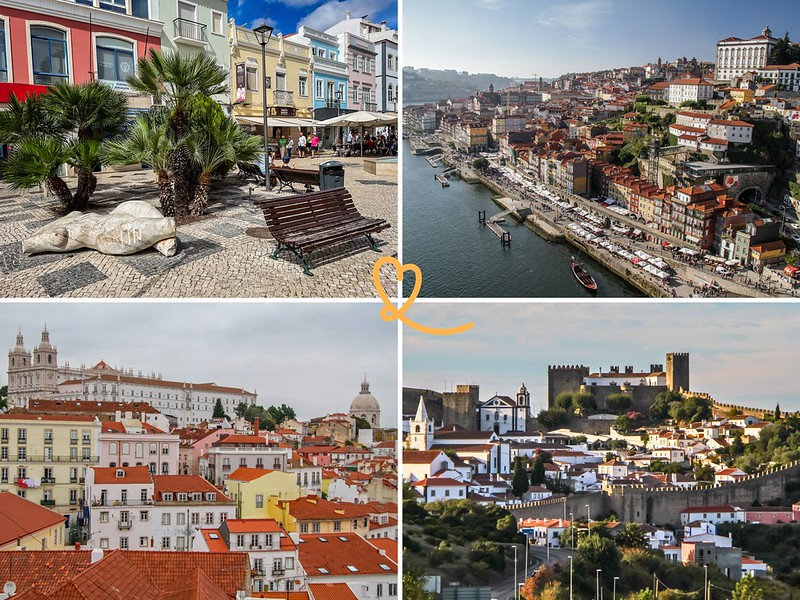
This opinion is completely independent, based on our experiences. We visited the region anonymously, making our own choices and paying our bills in full.
Portugal’s Most Beautiful Cities and Villages: Summary + Map
Map
Portugal offers a wonderful variety of cities and towns, with architectural styles that vary greatly from one region to another. Here’s the map with our top 15 places to visit:
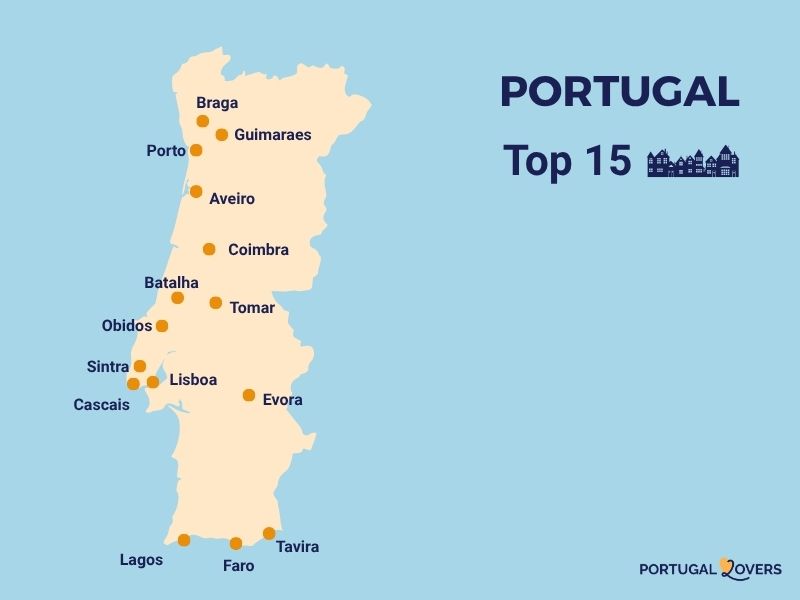
Which cities in Portugal should you visit? Quick response:
If you only need to visit 5, to get an overview of the different styles:
- Porto
- Guimarães
- Lisbon
- Sintra
- Tavira
1. Porto

Why we love it
Porto stretches along the steep banks of the Douro River, offering a striking view of its colorful houses stacked one on top of the other. We loved strolling through the Ribeira neighborhood, a UNESCO World Heritage Site, where the narrow streets lead down to the river.
The city also owes its reputation to Port wine: the wineries in Vila Nova de Gaia, right across the river, offer tastings that are well worth the trip. We also enjoyed walking across the Dom Luís I Bridge, which offers a breathtaking view of both banks. Porto charms visitors with its authenticity: far from the sanitized feel of some major European cities, it has retained its down-to-earth and lively character.

Attractions
- The Ribeira Neighborhood
- Lello Bookstore, the inspiration for Harry Potter
- The colorful houses and the azulejos
- Porto Cathedral (Sé do Porto)
- The Dom Luís I Bridge and its breathtaking views of the city
- The Port Wine Cellars in Vila Nova de Gaia

Advice
- Northern Portugal, on the Atlantic coast
- Plan for at least 2 days, ideally 3 days
- Wear comfortable shoes—there are cobblestones, and the path slopes on both sides of the river.
- See the best rated accommodations
OUR TIPS FOR RENTING A CAR IN Portugal
- Compare prices on our preferred platform: DiscoverCars – one of the best rated sites.
- Don’t take a car that’s too wide, as old towns have narrow streets and small parking spaces.
- For more choice, book early.

2. Lisbon

Why we love it
Lisbon is spread across seven hills, giving each neighborhood its own topography and identity. We especially enjoyed getting lost in the narrow streets of Alfama, the city’s oldest neighborhood, where the yellow trams struggle up the hills.
The Belém neighborhood, for its part, is home to some of the country’s most iconic landmarks, including the Belém Tower and the Jerónimos Monastery, both built in the 16th century.
We also enjoyed the nightlife in Bairro Alto and the terraces at Miradouro da Senhora do Monte, which are perfect for watching the sunset. Lisbon combines historical heritage, cuisine, and nightlife in a distinctly Mediterranean atmosphere.
Lisbon alone embodies several centuries of maritime, religious, and folk history, spread across neighborhoods with very distinct atmospheres.

Attractions
- The Belém Tower
- The Jerónimos Monastery
- São Jorge Castle
- The Alfama District
- The Santa Justa Elevator
- The National Palace
- The various views of the hills
- The Charm of the Different Neighborhoods
- See all of Lisbon’s attractions

Advice
- Capital, on the Atlantic coast
- From Porto = 3 hours
- Plan for at least 2 days, but 4 or 5 days will give you plenty of time to explore the city.
- See our selection of the best hotels
- Or view the top-rated accommodations directly
3. Sintra

Why we love it
Sintra is nestled in the heart of a forested hilly landscape overlooking the Atlantic coast, a setting that has inspired many Portuguese poets and kings. We were impressed by the Pena National Palace, a 19th-century building whose vibrant colors and blend of architectural styles (Moorish, Gothic, and Manueline) are striking at first glance.
The National Palace of Sintra, located right in the heart of the city, is also worth a visit for its instantly recognizable conical chimneys. We also made our way up to Quinta da Regaleira, whose Initiation Well remains one of the most photographed sights in the country. Plan on a full day—or better yet, two days—to explore the area, as traffic is often heavy during peak season.

Attractions
- The Pena National Palace
- Quinta da Regaleira
- The National Palace of Sintra
- The Château des Maures
- Monserrate Park
- See all attractions in Sintra

Advice
- Lisbon Region, inland
- From Lisbon = 30 min
- From Cascais = 20 min
- From Porto = 3 hours
- Plan on at least one day, but to see all the palaces, you’ll need two to three days.
- See our selection of the best hotels
- Or view the top-rated accommodations directly

4. Guimarães

Why we love it
Guimarães is considered the cradle of Portugal, as it was in its castle that the country’s first king, Afonso Henriques, is said to have been born in the 12th century. The historic center, a UNESCO World Heritage Site, has preserved its medieval houses and cobblestone squares. We enjoyed strolling through Praça de Santiago and Praça de Oliveira, lined with historic facades and lively terraces.
Perched on a hill, Guimarães Castle overlooks the city and offers an unobstructed view of the surrounding rooftops. We also visited the Palace of the Dukes of Braganza, which was rebuilt in the 20th century and now houses a collection of tapestries and period furniture.

Attractions
- Guimarães Castle
- The Palace of the Dukes of Braganza
- Santiago Square
- The Church of Nossa Senhora da Oliveira
- Mount Penha, accessible by cable car

Advice
- Northern Portugal
- From Porto = 45 min
- From Braga = 25 min
- From Lisbon = 3 hours and 30 minutes
- Allow 1 day.
- View the top-rated accommodations right away
5. Faro

Why we love it
Faro, the capital of the Algarve, is often just a stopover for travelers heading to the airport, who don’t linger there—which is a shame. We took the time to explore the old walled city, where Faro Cathedral stands, surrounded by cobblestone streets and 18th-century buildings. The harbor, lined with palm trees, is an ideal starting point for a boat trip to the Ria Formosa Natural Park. We also watched the storks nesting on the roofs of the historic district’s monuments—a rather unexpected sight right in the middle of the city. Faro is easy to explore in half a day before continuing on to other destinations in the Algarve.

Attractions
- Faro Cathedral
- The Ria Formosa Natural Park
- The Walled Old City
- The Municipal Museum
- The Chapel of Bones
- See all attractions in Faro

Advice
- Central Algarve
- From Tavira = 35 min
- From Lagos = 1 hour 5 minutes
- From Sevilla (Spain) = 2 hours 15 minutes
- Plan to spend one day in the old town, plus half a day at the Ria Formosa Nature Reserve
- See our selection of the best hotels
- Or view the top-rated accommodations directly

6. Tavira

Why we love it
Tavira stretches along both banks of the Gilão River in the eastern Algarve, an area that is less crowded than the seaside resorts in the western part of the region. We enjoyed the tranquility of the town, dotted with Baroque churches and white houses with tiled roofs. The Roman Bridge, which spans the river, connects the two banks, where restaurants and shaded outdoor seating areas are concentrated.
We also took a boat to Ilha de Tavira, a strip of sand bordered by the Atlantic Ocean, just a few minutes from the harbor. In our opinion, Tavira remains one of the most authentic towns in the Algarve, far from the tourist hustle and bustle of Faro or Albufeira.

Attractions
- The Roman Bridge
- Ilha de Tavira and its beaches
- Tavira Castle
- The Church of Mercy
- The Municipal Market
- See all attractions in Tavira

Advice
- Eastern Algarve
- From Faro = 35 min
- From Lagos = 1 hour 10 minutes
- From Sevilla (Spain) = 2 hours
- View the top-rated accommodations directly
7. Évora

Why we love it
Évora, the capital of the Alentejo, has preserved a historic center surrounded by ramparts and designated a UNESCO World Heritage Site. We were surprised by the Roman Temple, whose granite columns have stood proudly in the heart of the city for nearly two thousand years.
The Chapel of Bones, located inside the Royal Church of Saint Francis, has its walls lined with the bones of several thousand people—a place that invites reflection on the transience of life. We also explored the Évora Cathedral, the country’s largest medieval cathedral, where visitors can tour the roof and the cloister.

Attractions
- The Roman Temple
- The Chapel of Bones
- The Cathedral of Évora
- The Eau d’Argent Aqueduct
- Giraldo Square

Advice
- Alentejo, south-central Portugal
- From Lisbon = 1 hour 30 minutes
- From Faro = 2 hours and 30 minutes
- From Badajoz (Spain) = 1 hour 15 minutes
- Plan for at least 1 day; 1½ days is more comfortable
- View the top-rated accommodations directly
8. Óbidos

Why we love it
Óbidos is tiny, surrounded by a medieval wall that you can walk along its entire length. We strolled through the flower-filled alleyways lined with white houses trimmed with blue or yellow, typical of this part of the country. The Óbidos Castle, which has been converted into a pousada, overlooks the town and offers an unobstructed view of the surrounding countryside. We also sampled Ginjinha, a sour cherry liqueur served in small chocolate cups—a local tradition you’ll find on every street corner. You can see Óbidos in 2 to 3 hours, making it an easy day trip to combine with Nazaré or Batalha.

Attractions
- The Castle of Óbidos
- The medieval ramparts, which you can walk along to enjoy beautiful views
- The Church of Santa Maria
- Direita Street and its shops
- The International Chocolate Festival, in March

Advice
- Western Region, inland
- From Lisbon = 1 hour
- From Nazaré = 30 min
- From Batalha = 30 min
- Allow 1 day
- Be careful—there’s a drop-off right next to the ramparts. Keep an eye on your children and watch your step.
- View the top-rated accommodations directly
9. Tomar

Why we love it
Tomar owes its fame to the Convent of Christ, a former stronghold of the Knights Templar founded in the 12th century and designated a UNESCO World Heritage Site. We were struck by the chapter house’s Manueline window, carved with ropes, coral, and maritime symbols.
The old town, through which the Rio Nabão flows, still has a Jewish quarter and several bridges that invite visitors to take a leisurely stroll. We also enjoyed Parc do Mouchão, a wooded islet in the middle of the river, perfect for a break in the shade. Tomar is worth at least half a day; allow more time if you want to include a full tour of the convent.

Attractions
- The Convent of Christ
- The Synagogue, Luso-Hebrew Museum
- Mouchão Park
- The Church of Santa Maria do Olival
- The Castle of the Knights Templar

Advice
- Central Portugal
- From Lisbon = 1 hour 30 minutes
- From Coimbra = 45 min
- From Fátima = 25 min
- Allow 1 day
- View the top-rated accommodations directly
10. Aveiro

Why we love it
Aveiro is nicknamed the “Venice of Portugal” because of its canals, which are crisscrossed by moliceiros, flat-bottomed boats once used to harvest seaweed. We enjoyed a ride on a moliceiro along the canals, lined with Art Nouveau houses featuring colorful facades.
The city also owes its reputation to Ovos Moles, a pastry made with egg yolks and sugar, wrapped in a thin wafer-like dough. Aveiro is a good stopover between Porto and Coimbra, less than an hour’s drive from each.

Attractions
- A Ride on a Moliceiro
- The Art Nouveau District
- The Aveiro Museum, a former convent
- Les Salines and the Nature Reserve
- Costa Nova and its nearby striped houses

Advice
- Central Region, on the Ria de Aveiro lagoon
- From Porto = 1 hour
- From Coimbra = 45 min
- From Lisbon = 2 hours 30 minutes
- Allow 1 day
- View the top-rated accommodations directly
11. Cascais

Why we love it
Cascais was long a vacation destination for the Portuguese royal family before becoming a popular seaside resort for Lisbon residents. We loved its waterfront, dotted with fine-sand beaches such as Praia da Rainha and Praia da Conceição. La Boca do Inferno, a rock formation carved out by erosion, is best visited in the late afternoon to enjoy the sunset over the Atlantic.
We also strolled through the Cascais Marina and its cobblestone streets, lined with shops and seafood restaurants. Cascais is easy to combine with Sintra, which is just 20 minutes away, for a full day exploring both the coast and the mountains.

Attractions
- La Boca do Inferno
- Rainha Beach
- The Paula Rego Casa das Histórias Museum
- The Cascais Marina
- Marshal Carmona Park
- See all attractions in Cascais

Advice
- Atlantic Coast, Lisbon Region
- From Lisbon = 30 min
- From Sintra = 20 min
- From Porto = 3 hours and 30 minutes
- You’ll need at least one day to see the city and its beaches, but it’s a great place to use as a base for exploring the region
- See our selection of the best hotels
- Or view the top-rated accommodations directly

It’s time to book!
Compare everything: companies, prices, schedules and availability.
12. Lagos

Why we love it
Lagos, in the western Algarve, has long served as a port of departure for Portuguese sailors during the great maritime explorations. The old town, surrounded by ramparts, still features a former slave market—a grim reminder of Portugal’s colonial history—which has now been converted into a museum.
We were impressed by the cliffs of Ponta da Piedade, carved by erosion and accessible by kayak or boat. We also enjoyed the beaches at Dona Ana and Camilo, nestled among the ochre-colored rocks typical of the region. Lagos combines historical heritage with a lively nightlife, making it a convenient base for exploring the western Algarve.

Attractions
- Ponta da Piedade
- Dona Ana Beach
- The Castle and the Fort
- The Old City Walls
- Camilo Beach
- See all attractions in Lagos

Advice
- Western Algarve
- From Faro = 1 hour 5 minutes
- From Tavira = 1 hour 10 minutes
- From Sevilla (Spain) = 3 hours
- See our selection of the best hotels
- Or view the top-rated accommodations directly
13. Coimbra

Why we love it
Coimbra stretches along the banks of the Mondego River and is home to one of Europe’s oldest universities, founded in the 13th century. We visited the Joanina Library, whose gilded woodwork and colonies of protective bats make it a truly unique place.
The old town, built on a hillside, invites visitors to climb up to Sé Velha, the country’s oldest Romanesque cathedral. We also attended a Fado evening in Coimbra, which is a more traditional style than the one in Lisbon. It takes a full day to explore Coimbra, as the narrow streets and scenic viewpoints seem to multiply around every corner.

Attractions
- The University of Coimbra and the Joanina Library
- La Sé Velha
- The Botanical Garden
- The Monastery of Santa Clara-a-Velha
- Portugal of the Little Ones
Advice
- Centre Region
- From Lisbon = 2 hours
- From Porto = 1 hour and 15 minutes
- From Tomar = 45 min
- Allow 1 day
- View the top-rated accommodations directly
14. Batalha

Why we love it
Batalha owes its name and fame to the Monastery of Batalha, a masterpiece of Gothic and Manueline architecture built beginning in the 14th century to commemorate the Portuguese victory at Aljubarrota. We were impressed by the Unfinished Chapels, whose open-air vault offers a glimpse of the builders’ unfulfilled ambition. The royal cloister, adorned with delicate tracery, is one of the finest examples of the Manueline style in the country.
We also enjoyed the small town surrounding the monastery—it was quiet and easy to explore in an hour or two. Batalha can easily be combined with a visit to Fátima or Nazaré, both of which are less than 30 minutes away.

Attractions
- The Monastery of Batalha
- The Unfinished Chapels
- The Royal Cloister
- The Tomb of the Unknown Soldier
- The Battle of Aljubarrota Museum, nearby

Advice
- Central Portugal
- From Lisbon = 1 hour 30 minutes
- From Coimbra = 45 min
- From Fátima = 15 min
- Allow 1 day
- View the top-rated accommodations directly
15. Braga

Why we love it
Braga, often referred to as the religious capital of Portugal, has an impressive number of churches and shrines for a city of its size. We climbed the 577 steps of the Bom Jesus do Monte Sanctuary—a Baroque staircase adorned with fountains and statues—before taking the funicular back down.
The historic, pedestrian-friendly downtown area is home to Braga Cathedral, the oldest in the country, as well as many popular cafés. We also enjoyed the city’s student atmosphere, driven by the University of Minho, which brings the outdoor cafes to life in the evenings. Braga is easy to combine with a visit to Guimarães, which is only 25 minutes away, for a day trip to explore northern Portugal.

Attractions
- The Bom Jesus do Monte Sanctuary with its staircase (outside the city center)
- Braga Cathedral
- The Sameiro Shrine
- The Santa Bárbara Garden
- The Bishop’s Palace

Advice
- Northern Portugal
- From Porto = 1 hour
- From Guimarães = 25 min
- From Lisbon = 4 hours
- Allow 1 day
- View the top-rated accommodations directly
OUR TIPS FOR RENTING A CAR IN Portugal
- Compare prices on our preferred platform: DiscoverCars – one of the best rated sites.
- Don’t take a car that’s too wide, as old towns have narrow streets and small parking spaces.
- For more choice, book early.
Other Cities to Explore
Mainland Portugal has no shortage of other destinations worth visiting. We also include Funchal and Ponta Delgada, the capitals of the Madeira and Azores archipelagos: these two cities are administratively part of Portugal as autonomous regions, but are geographically located in the middle of the Atlantic Ocean, far from the mainland. We are clarifying this distinction so that you can plan your trip with full knowledge of the facts.
Portimão (Algarve)

Portimão, in the western Algarve, stretches along the Rio Arade and serves as a convenient starting point for visiting Praia da Rocha, one of the region’s most famous beaches. We enjoyed spending some time on the pier, where several restaurants grill sardines outdoors. See all of Portimão’s attractions and our selection of hotels.
Albufeira (Algarve)

Albufeira, in the central Algarve, is one of the region’s most popular beach resorts, thanks to its many sandy beaches and lively nightlife. We loved Praia dos Pescadores, right in the center, as well as the old pedestrian district with its white-washed alleyways. See all of Albufeira’s attractions and our selection of hotels.
Sesimbra

Sesimbra, south of Lisbon, is a former fishing village that has retained its active harbor, nestled below a Moorish castle perched on the hill. We loved its central beach, lined with grilled fish restaurants, as well as the coastal road to Cape Espichel. See all of Sesimbra’s attractions and our selection of hotels.
Funchal (Madeira Island)

Funchal, the capital of Madeira, is located about a 1.5-hour flight from Lisbon, off the coast of Africa. Although Madeira is part of Portugal as an autonomous region, it is distinguished by its subtropical climate and volcanic landscapes, which are quite different from those on the mainland.
We loved its covered market, the Mercado dos Lavradores, as well as its tropical gardens and lookout points overlooking the ocean. Funchal is worth a trip in its own right rather than just a day trip from the mainland.
See all the attractions in Funchal.
Ponta Delgada (Azores)
Ponta Delgada, on the island of São Miguel, is the main city of the Azores archipelago, located in the middle of the Atlantic Ocean, about a 2-hour-and-15-minute flight from Lisbon. Like Madeira, the Azores are an autonomous region of Portugal with lush, volcanic landscapes, quite a departure from the Mediterranean atmosphere of the mainland. We enjoyed its colorful ports, its calderas, and its natural hot springs. A trip to the Azores is usually planned as an independent trip, rather than as an additional stopover.
Mafra

Mafra, less than an hour from Lisbon, is home to the National Palace of Mafra, an 18th-century Baroque monastery-palace of impressive size. We loved its royal library, which houses thousands of ancient books protected by a colony of bats.
Nazaré

Nazaré, on the Atlantic coast, is world-famous for its giant waves, which attract professional surfers from around the world every winter. We climbed up to Sítio, the neighborhood perched high on the cliff, to see the lighthouse and Praia do Norte.
And the villages

Here, we’ve only covered the cities. But Portugal is also full of charming villages. Among our favorites:
- Ferragudo
- Monsaraz
- Marvao
- Mertola
- Monsanto
- Costa Nova
- …
PLAN YOUR TRIP TO Portugal
- Best of
Best destinations
Best attractions in Portugal
The most beautiful landscapes
Most Beautiful Cities
Most beautiful villages
Portugal’s Most Beautiful Beaches

- Practical advice
When to go?
How to rent a car in Portugal
Driving tips
How many days