Wondering where to go in Portugal?
Nestled between the Atlantic, the inland mountains, and the golden plains of the Alentejo, the country is full of very different landscapes. It’s hard to choose when you only have a few days or even a few weeks ahead of you.
Here is our selection of the 10 must-see destinations—which can be stand-alone trips or stops on a road trip that you can combine however you like.
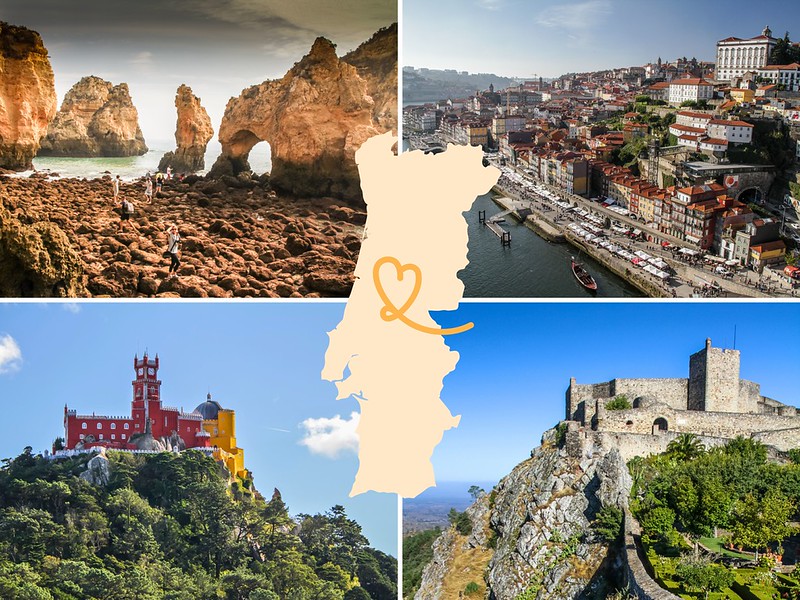
This opinion is completely independent, based on our experiences. We visited the region anonymously, making our own choices and paying our bills in full.
Where to Go in Portugal – Summary and Map
Portugal is ideal for a road trip: each region has its own character, and sometimes just two neighboring destinations are enough to completely change the atmosphere in less than an hour’s drive.
Here are our 10 favorite regions, from north to south, along with a map to help you find your way:
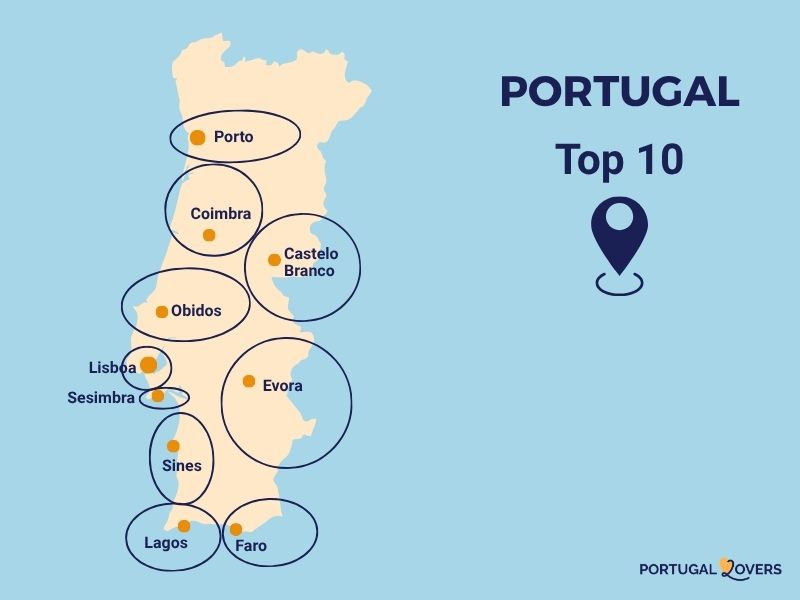
- Lisbon, Sintra, and Cascais: the capital, its fairy-tale palaces, and its chic coastline
- Lagos and the Western Algarve for the golden cliffs
- Porto and the Douro Valley, home to the country’s most authentic city and its terraced vineyards
- Évora and Eastern Alentejo for their endless plains, white villages, and Roman history
- Óbidos, Nazaré, and the Monastery Region: The Best of Gothic and Manueline Heritage
- Faro and the Eastern Algarve for the Ria Formosa and one of the long sandy beaches
- Coimbra and the Center, home to Europe’s oldest university, and the canals of Aveiro
- Sesimbra and the Serra da Arrábida for the most beautiful beaches near Lisbon
- Sines and the Alentejo Coast to the rugged coastline of the Costa Vicentina
- Castelo Branco and the Central-Eastern Natural Parks, home to villages clinging to the cliffs

It’s time to book!
Compare everything: companies, prices, schedules and availability.
1. Lisbon, Sintra, and Cascais
There’s no better place to start: this region alone is home to the capital, the country’s most extravagant palaces, and a chic seaside resort. It is also the easiest area to reach, with Lisbon Airport less than an hour away from each of these three cities.
Lisbon, the capital of the seven hills

Built on seven hills, Lisbon takes on a different character in every neighborhood. Alfama, the oldest neighborhood, is best explored by following the yellow trams as they labor up the cobblestone slopes. The Belém neighborhood is home to two of the country’s most iconic landmarks: the Belém Tower and the Jerónimos Monastery, both dating from the 16th century. In the evening, head to Bairro Alto for the atmosphere, or to one of the miradouros to watch the sunset.

- The Belém Tower and the Jerónimos Monastery
- São Jorge Castle and the Alfama District
- The Santa Justa Elevator
- See all of Lisbon’s attractions
- Plan on at least 2 days—ideally 4 to 5—so you can take the time to wander through the neighborhoods.
Sintra, the Forest of Palaces

Located 30 minutes from Lisbon, Sintra is nestled in a forested hilly landscape overlooking the Atlantic. The Pena Palace, with its bright colors and blend of architectural styles (Moorish, Gothic, and Manueline), remains Portugal’s most famous postcard image. People often include the National Palace, right in the city center, for its conical chimneys, and the Quinta da Regaleira with its much-photographed initiatory well.

- The Pena National Palace and the Quinta da Regaleira
- The Château des Maures and Monserrate Park
- See all attractions in Sintra
- Plan on at least one full day, or two if you want to visit all the palaces—traffic is often heavy during peak season.
Cascais, the Royal Resort

Located 20 minutes from Sintra, Cascais was long a vacation destination for the royal family before becoming the favorite beach resort of Lisbon residents. Its waterfront features several beautiful beaches with fine sand, and Boca do Inferno—a rock formation carved out by erosion—is best visited at sunset.

- La Boca do Inferno and Praia da Rainha
- The Cascais Marina and its cobblestone streets
- See all attractions in Cascais
Bonus: Cabo de Roca

Less than an hour from Lisbon, this enormous 18th-century Baroque monastery-palace is worth a visit for its royal library, where bats still protect the ancient books from insects.
And other attractions in the region:
- Praia do Magoito and its fossilized dune
- Praia da Adraga and its arch
Where to stay
- Lisbon:
See our selection of the best hotels
or view the top-rated accommodations directly - Sintra:
See our selection of the best hotels
or view the top-rated accommodations - Cascais:
See our selection of the best hotels
or view the top-rated accommodations

To Know
- Allow 6 to 8 days to fully enjoy the three cities at a leisurely pace
- Sintra is very easy to visit by train from Lisbon, but a car is useful for getting to Cascais and Mafra
- Book your tickets to the palaces of Sintra online to avoid the lines, especially in the summer
OUR TIPS FOR RENTING A CAR IN Portugal
- Compare prices on our preferred platform: DiscoverCars – one of the best rated sites.
- Don’t take a car that’s too wide, as old towns have narrow streets and small parking spaces.
- For more choice, book early.

2. Lagos and the Western Algarve
The western Algarve combines the most spectacular ochre cliffs in southern Portugal, fishing villages still untouched by mass tourism, and a surprising mountainous hinterland.
Lagos, Between City Walls and Cliffs

Once a port of departure for Portuguese sailors, Lagos has preserved its fortified old town, which is home to a former slave market that has now been converted into a museum space chronicling this dark colonial past. The cliffs of Ponta da Piedade, sculpted by erosion, can be explored by kayak or boat, and the beaches of Dona Ana and Camilo are among the most beautiful in the region.

- Ponta da Piedade and the Dona Ana and Camilo beaches
- The ramparts of the old town and its fort
- See all attractions in Lagos
Ferragudo, the fishing village

Across from Portimão, Ferragudo has retained its character as a fishing village despite the Algarve’s growth as a tourist destination. Its cobblestone streets wind their way up between white houses with colorful shutters to a small church, while the São João do Arade Castle, perched on the waterfront, once served as a watchtower against pirates.

- the view from the mouth of the river
- charming alleyways
- The Castle on the Beach
- See our article on Ferragudo
The Western Algarve Coast

Whether you prefer small coves or large beaches with lots of activities, you’re sure to find what you’re looking for! The western coast of the Algarve is beautiful, with colorful cliffs, caves, and rock formations.
But watch out for the tide—parts of the beach may disappear when the water comes in!

- Praia da Marinha, the best-known
- The Benagil Cave
- Praia da Falesia with its magnificent colors
- Praia dos Três Irmãos and its double arch
- Lots of boat and kayak tours!
- Check out our article on the most beautiful beaches in the Algarve.
Bonus: Monchique, the Mountain of the Algarve

About 30 minutes from Portimão, Monchique offers a completely different side of the Algarve than the coastal region. Perched at an altitude of 450 meters, this village with its steep, winding streets leads up to the Miradouro da Fóia, the highest point in the Algarve at 902 meters, with a view that stretches all the way to Cabo de São Vicente. See our article on Monchique
And the other attractions:
- Silves and its castle
- Sagres and its fort
- Loulé Salt Caves
Where to stay
- Lagos:
See our selection of the best hotels
or view the top-rated accommodations - Portimão:
See all attractions
and our selection of hotels. - Albufeira
See all attractions
and our selection of hotels.

To Know
- Lagos and Portimão are very popular in the summer, so book early
- A car is still essential for exploring both the coast and the inland areas (Monchique)
- Plan on spending 4 to 5 days in this area—or more if you want to visit the museums, salt caves, forts, and castles.

3. Porto and the Douro Valley
Porto and the Douro are a must-see combination: the country’s most charming city, and less than an hour and a half’s drive away, one of the world’s most beautiful terraced vineyards.
Porto, the Authentic City

Porto stretches along the steep banks of the Douro River, with its colorful houses stacked one on top of the other. The Ribeira neighborhood, a UNESCO World Heritage Site, is best explored on foot all the way to the river, and crossing the Dom Luís I Bridge offers a breathtaking view of both banks. Across the river, in Vila Nova de Gaia, the Port wine cellars offer tastings that are well worth the trip.

- The Ribeira neighborhood and the Dom Luís I Bridge
- The Wine Cellars of Vila Nova de Gaia
- The Lello Bookstore and the Cathedral (Sé do Porto)
- Allow at least 2 days, ideally 3.
The Douro Valley: Vineyard Terraces and Wine-Growing Villages

Listed as a UNESCO World Heritage Site since 2001, the Douro Valley is one of the oldest wine-growing regions in the world. From Porto, the N222 road between Peso da Régua and Pinhão is often cited as one of the most beautiful roads in the world, winding close to the river through terraced vineyards. Peso da Régua is more urban, with its Douro Museum; Pinhão, more picturesque, is the heart of the wine region and the starting point for many rabelo boat cruises. Nearby, don’t miss Lamego and its Baroque azulejo staircase, or the Casal de Loivos lookout point for the river’s famous “L”-shaped bend. Between June and October, the historic steam train runs from Régua to Tua via Pinhão, offering a particularly nostalgic journey.

- The N222 highway between Peso da Régua and Pinhão
- The Pinhão train station and its azulejos depicting vine cultivation
- Lamego and its Nossa Senhora dos Remédios Shrine
- A wine tasting at a quinta (Quinta do Seixo, Quinta do Tedo…) or a rabelo boat cruise
Bonus: Guimarães

Located 45 minutes from Porto, Guimarães is considered the cradle of Portugal: it is said that the country’s first king was born in its castle in the 12th century. The historic center, a UNESCO World Heritage Site, has preserved its medieval houses, and the Palace of the Dukes of Braganza now houses a beautiful collection of tapestries.
Where to stay
- Porto: See the top-rated accommodations
- Guimarães: See the top-rated accommodations
- The Douro Valley, along the river through the vineyards: see options

To Know
- A car is the best way to explore the Douro at your own pace, but the train and boat tours from Porto are still good alternatives if you don’t want to drive
- May through October is the busiest time of year, especially during the grape harvest in September and October
- Allow 4 to 6 days for this region (Porto, the Douro, and Guimarães)

4. Évora and Eastern Alentejo
The Alentejo is the opposite of the Algarve: endless plains, white villages perched on hills, and a decidedly slow pace of life. This eastern part, near the Spanish border, is where most of our favorites are located.
Évora, the capital of the Alentejo

Évora has preserved a historic center surrounded by ramparts, which is designated as a UNESCO World Heritage Site. The Roman Temple, with its granite columns standing in the heart of the city for nearly two thousand years, never fails to impress at first glance. The Chapel of Bones, lined with the bones of several thousand people, invites reflection, while the Évora Cathedral—the country’s largest medieval cathedral—can be explored all the way up to its roof.

- The Roman Temple and Giraldo Square
- The Chapel of Bones
- Évora Cathedral
- The Eau d’Argent Aqueduct
Monsaraz, the balcony overlooking Lake Alqueva

Perched 50 minutes from Évora, Monsaraz overlooks Lake Alqueva and the Guadiana Valley. The village, which is entirely pedestrian-only within its ramparts, features rows of immaculate white houses lining cobblestone streets where art galleries and craft shops stand side by side. Climb up to the castle, built in the 14th century, to enjoy one of the most beautiful sunsets in the region.
Mertola

An hour and a half from the coast, Mértola—built at the confluence of the Guadiana River—still bears traces of its Roman, Almohad, and later Christian settlements. Its Matriz Church, a former 12th-century mosque, has retained its horseshoe arch—a feature typical of Islamic architecture—and the village remains far less restored—and therefore far more authentic—than other towns in the Alentejo.
Where to stay
- Évora: See the top-rated accommodations
- Monsaraz: See the top-rated accommodations
- Mertola: See the top-rated accommodations

To Know
- Summer can be sweltering in the inland Alentejo; it’s best to visit in the spring or fall
- A car is essential; the distances between villages are considerable, and public transportation is scarce
- Allow 3 to 5 days for this region
It’s time to book!
Compare everything: companies, prices, schedules and availability.
5. Óbidos, Nazaré, and the Monastery Region
An hour north of Lisbon lies the West and Central Region, home to three UNESCO-listed monasteries and a coastline perfect for surfing. This is probably the area with the most cultural heritage per square kilometer in the country.
Óbidos, the fortified town

Óbidos, a former royal town that was given as a wedding gift to the queens of Portugal for several centuries, is entirely enclosed within its medieval ramparts. Rua Direita, lined with whitewashed houses, leads up to the castle, which has now been converted into a pousada. Be sure to try ginjinha, a cherry liqueur served in a chocolate cup, which you’ll find on every street corner.
Peniche and the Berlengas Islands

Known as the “capital of the waves,” Peniche hosts international surfing competitions every year at Supertubos Beach. But the peninsula is worth a visit even without a surfboard: its rocky coastline, with its striking formations, is almost reminiscent of the Giant’s Causeway, and Cabo Carvoeiro, the country’s westernmost point, offers a breathtaking view of the Berlengas archipelago. This UNESCO-designated nature reserve can be visited by boat from the harbor, preferably when the sea is calm.
Nazaré, the capital of giant waves

Known worldwide for its giant waves, which attract professional surfers every winter, Nazaré can also be explored from Sítio, the neighborhood perched high on the cliff, with views of the lighthouse and Praia do Norte.
The Three Monasteries Tour: Alcobaça, Batalha, and Tomar
The Alcobaça Monastery, a masterpiece of Cistercian Gothic art founded in 1153 and designated a UNESCO World Heritage Site in 1989, houses the tombs of Pedro I and his mistress Inês de Castro, a tragic love story that left a lasting mark on the country. Visitors can explore the nave, the cloister of silence, and the monks’ vast refectory.

About 30 minutes away, the Monastery of Batalha—a Gothic and Manueline masterpiece built beginning in the 14th century to commemorate a military victory—impresses visitors with its open-air Unfinished Chapels and its royal cloister featuring delicate tracery.
Finally, Tomar rounds out the tour with the Convent of Christ, a former stronghold of the Knights Templar founded in the 12th century, where the Manueline Window—carved with ropes and maritime symbols—remains one of the pinnacles of Portuguese art.

Where to stay
- Obidos: See the top-rated accommodations
- Batalha: See the top-rated accommodations
- Tomar: See the top-rated accommodations

To Know
- A combined ticket is often available for the monasteries of Alcobaça and Batalha
- It’s best to visit Óbidos early in the morning or late in the day to avoid the tour buses
- Allow 3 to 5 days to explore this entire region
FUN around Lisbon: activities
Lisbon by E-Bike
Day Trip to Sintra from Lisbon
Dolphin watching
Kayaking in Arrabida
Surfing in Cascais

6. Faro and the Eastern Algarve
Less crowded than the western part, the eastern Algarve retains a more local atmosphere, dominated by the Ria Formosa lagoon and its white houses.
Faro, the gateway to the Ria Formosa

Faro, the capital of the Algarve, is often passed through without a second glance by travelers on their way to the airport. Its old walled town, with its cathedral and 18th-century buildings, is well worth spending half a day exploring, as does the Ria Formosa Natural Park, accessible by boat from the palm-lined harbor—where you can also spot the storks nesting on the rooftops of the historic center.

- Faro Cathedral
- Old Fortified City
- A boat tour of the Ria Formosa Natural Park
- The Municipal Museum and Its Cloister
- See all attractions in Faro
Tavira, the Authentic One

Tavira stretches along both banks of the Gilão River, in an area that is much less crowded than the seaside resorts to the west. The Roman Bridge connects the two banks, where restaurants and shaded outdoor seating areas are concentrated, and Ilha de Tavira—a sandbar accessible by boat—adds an almost island-like touch to the visit.

- The Roman Bridge
- The beautiful white church
- the ruins of the castle, now turned into a garden
- the riverbanks
- Ilha de Tavira
- See all attractions in Tavira
The long sandy beaches

Unlike the western Algarve, the eastern Algarve has very long white-sand beaches. No cliffs, but the chance to walk with your feet in the sand for a very long time. For example, in Manta Rota
Where to stay
- Faro:
See our selection of the best hotels
or View the top-rated accommodations - Tavira
See the best rated accommodations - Manta Rota
See the best rated accommodations

To Know
- Faro Airport is the ideal gateway to the entire region
- Check the tide schedules to make the most of your visit to the Ria Formosa
- Allow 3 to 4 days for this area
FUN in the Algarve: activities
Caves and Cliffs by Boat
Kayak Tours
Dolphin watching
Jeep Tour

7. Sesimbra and the Serra da Arrábida
Less than an hour from Lisbon, on the other side of the Tagus River, lies one of the country’s most beautiful coastlines—and yet one of the least known to foreign visitors.
Sesimbra, the old fishing village

Sesimbra has preserved its active fishing port, situated below a Moorish castle perched on the hill. Its central beach, lined with restaurants serving grilled fish, and the coastal road leading to Cabo Espichel—where an 18th-century lighthouse stands facing the vertiginous cliffs—make it an ideal stopover before heading to the nearby natural park.

- The Moorish Castle of Sesimbra
- St. Mary’s Church
- The sandy beach
- Dolphin-Watching Excursion
- Cabo Espichel and its lighthouse
- See all attractions in Sesimbra
The Serra da Arrábida

This small limestone massif, covered in Mediterranean vegetation, hides a handful of coves with turquoise waters that look as if they’ve been transplanted from elsewhere in the Mediterranean. Portinho da Arrábida, with its light-colored sand and calm waters, remains the best known, but the beaches at Galapinhos and do Creiro, which are a bit more off the beaten path, are just as beautiful.
The Estrada de Escarpa (N379-1), which runs along the ridge of the mountain range between the ocean and the forest, is one of the most scenic roads in the country. Wine lovers will stop in the Azeitão region to taste Moscatel de Setúbal.

- Ribeiro de Cavalo Beach
- The beaches of Portinho da Arrábida, Galapinhos, and do Creiro
- The Estrada de Escarpa Scenic Route (N379-1)
- A Moscatel de Setúbal Tasting in Azeitão
Where to stay
Sesimbra:
See our selection of the best hotels
Or go straight to the top-rated accommodations.

To Know
- Traffic to the Arrábida beaches is restricted on weekends during the summer (access is regulated between 9 a.m. and 6 p.m.)
- A car is essential for exploring the Serra da Arrábida
- Two to three days are enough, whether as a day trip from Lisbon or as a stopover on the way to the Alentejo
OUR TIPS FOR RENTING A CAR IN Portugal
- Compare prices on our preferred platform: DiscoverCars – one of the best rated sites.
- Don’t take a car that’s too wide, as old towns have narrow streets and small parking spaces.
- For more choice, book early.
8. Sines and the Alentejo Coast
Further south, the Alentejo coast (Costa Vicentina) offers a still-untouched coastline, halfway between Lisbon and the Algarve, where cliffs and deserted beaches stretch for more than 100 km.
Porto Covo, the unspoiled fishing village

Located in the Southwest Alentejo and Costa Vicentina Natural Park, Porto Covo has retained the charm of a fishing village despite its growing popularity. Its main square, Praça Marquês de Pombal, and the string of beaches and coves nestled between the cliffs are what give it its charm, with the added bonus of a view of Pessegueiro Island, which is accessible by boat in the summer.

Vila Nova de Milfontes, the Princess of the Alentejo
Located at the mouth of the Mira River, Vila Nova de Milfontes offers two distinct landscapes: a calm, almost lagoon-like estuary on one side and a rougher Atlantic coastline on the other. The sheltered Franquia Beach is ideal for families, while the wilder Malhão Beach embodies the spirit of freedom that characterizes this coastline. The trails along the Rota Vicentina allow you to explore the route on foot, particularly as far as Porto Covo to the north or Zambujeira do Mar to the south.

- Malhão Beach and Franquia Beach
- A section of the Rota Vicentina on foot
- The cliffs of Zambujeira do Mar, a little further south
Where to stay
- Sines: See the top-rated accommodations
- Porto Covo: See the top-rated accommodations
- Vila Nova de Milfontes: See the top-rated accommodations
To Know
- Accommodation options remain limited along this coast: be sure to book in advance during the summer
- Avoid the town of Sines itself, which is dominated by its industrial port and refinery
- Allow 3 to 4 days for this region
9. Coimbra and the Central Region
Located between Porto and Lisbon, the Central Region is home to both Europe’s oldest university and the colorful canals of Aveiro, nicknamed the “Venice of Portugal.”
Coimbra, the university town

Coimbra stretches along the banks of the Mondego River and is home to one of Europe’s oldest universities, founded in the 13th century. The Joanina Library, with its gilded woodwork guarded by a colony of protective bats, is a place like no other. The hillside old town invites you to climb up to the Sé Velha, the country’s oldest Romanesque cathedral, and an evening of Coimbra fado—more academic than that of Lisbon—is the perfect way to round out the visit.

- The view from the bridge
- The University of Coimbra
- the Joanina Library
- La Sé Velha and the Botanical Garden
Aveiro and Costa Nova, the Venice of Portugal

Aveiro owes its nickname to its canals, crisscrossed by moliceiros—flat-bottomed boats once used to harvest seaweed. A Moliceiro boat ride along the colorful Art Nouveau facades is a classic experience, as is sampling Ovos Moles, a local pastry made with egg yolk wrapped in a thin wafer-like dough.

Just 15 minutes away, Costa Nova is instantly recognizable by its *palheiros*—old wooden fishermen’s huts painted with red, blue, or yellow stripes—which were once visible from the often misty lagoon. José Estêvão Avenue, followed by a boardwalk, leads to the Atlantic beach and its dunes.

- A Moliceiro Boat Ride on the Canals of Aveiro
- The Striped Haystacks of Costa Nova
Other Attractions in the Region

- About 20 kilometers from Coimbra, Penela is dominated by an 11th- and 12th-century fortified castle built on a limestone outcrop, offering a panoramic view of the Serra da Lousã from the keep.
- The Roman ruins of Conimbriga, featuring mosaics
- The Lousa Mountains with the ruins of a hidden castle
- Bussaco Palace and Park

Where to stay
- Coimbra: See the top-rated accommodations
- Aveiro: See the top-rated accommodations

To Know
- Aveiro and Coimbra are well connected to Porto and Lisbon by train, which is convenient if you’re traveling without a car
- Aveiro and Costa Nova are two separate towns that are not within walking distance of each other
- Allow 3 days for this region
10. Castelo Branco and the Natural Parks of Central-Eastern Portugal
Located near the Spanish border, this region—comprising Beira Baixa and northern Alentejo—is the least touristy on our list—and that’s precisely what makes it so appealing, with its villages built literally into the rock.
The main city is Castelo Branco, but the region’s main attraction lies in its villages, so that’s what we’ll be showcasing.
Monsanto, the most Portuguese village in Portugal

Known as the “most Portuguese village in Portugal” since 1938, Monsanto sits on a granite hill where the houses are literally built between, under, and sometimes inside enormous granite boulders, which serve as walls or roofs. The result is unique in the country: you never know whether you’re looking at a house or a rock. The ruins of the medieval castle, accessible via a steep trail, reward visitors for the climb with one of the most beautiful views in the region—perfect for watching the sunset.

- The ruins of Monsanto Castle and its ramparts
- The houses that blend into the rocks, particularly around Rua Fernando Namora
Marvão, the Eagle’s Nest

Perched at an elevation of 860 meters on a granite spur, very close to the Spanish border, Marvão looks out toward Spain from its crenellated ramparts. The writer José Saramago said that you could see the whole world from this village—a view not to be missed at the end of the day.

Where to stay
- Castelo Branco: See the top-rated accommodations
- Monsento: View the top-rated accommodations
- Marvao: See the top-rated accommodations

To Know
- There are no train stations or regular bus service to the villages: a car is the only practical way to get there
- Wear sturdy shoes—the alleys are steep, and the path to the castle is rocky.
- Allow 2 to 3 days for this region, which is often combined with a visit to the nearby Serra da Estrela
And if you have more time…
These four destinations are a bit outside our top 10 regions, but they definitely deserve a spot on a longer itinerary.
Braga and Peneda-Gerês

Braga, often referred to as the religious capital of Portugal, is best known for the Bom Jesus do Monte Sanctuary and its 577 Baroque steps, which visitors can also descend by funicular. See the top-rated accommodations in Braga

Just 45 minutes away, in Peneda-Gerês National Park, the village of Lindoso features a medieval castle and more than 60 espigueiros—granaries built on granite stilts that were used to protect the harvests.
Manteigas and the Serra da Estrela

The highest point in mainland Portugal at 1,993 m, the Serra da Estrela is home to the Vodafone ski resort (the only one in the country) and, most notably, the Zêzere glacial valley, carved 20,000 years ago into a distinctive “U” shape—one of the largest glacial valleys in Europe. The village of Manteigas, right in the heart of the region, is the ideal starting point for the Rota do Glaciar, a 17-kilometer trail that climbs up to the Torre.

Not far away, the village of Linhares da Beira, situated on a plateau in the Serra, is home to a castle offering sweeping views, while Piódão—built on terraces of schist with blue-painted doors—remains the only historic village in the region without a castle, its isolated location serving as a natural defense.

- The Zêzere Glacial Valley and the Rota do Glaciar from Manteigas
- La Torre, the highest point in mainland Portugal (1,993 m)
- The villages of Linhares da Beira and Piódão
Madeira (an archipelago a 1.5-hour flight from Lisbon)

About a 1.5-hour flight from Lisbon, the island of Madeira is part of Portugal as an autonomous region, but its subtropical climate and volcanic landscapes are nothing like those of the mainland.
Funchal, the capital, charms visitors with its covered market, the Mercado dos Lavradores, and its tropical gardens overlooking the ocean. Just a few kilometers away, the small port of Câmara de Lobos, with its colorful fishing boats, was one of Winston Churchill’s favorite places to paint from the waterfront.
Check out all of Madeira’s attractions on our website dedicated to the archipelago.

The Azores (an archipelago a 2.5-hour flight from Lisbon)
Comprising nine volcanic islands divided into three geographical groups, the Azores archipelago is located about a 2.5-hour flight from Lisbon, in the middle of the Atlantic Ocean. Ponta Delgada, on the island of São Miguel—the largest of the islands—is the classic starting point, with its volcanic lakes, hot springs, and the Terra Nostra Park in Furnas, where visitors can bathe in a pool of iron-rich water at 38°C. Terceira, with its UNESCO-listed town of Angra do Heroísmo, and Pico, dominated by Portugal’s highest peak (the stratovolcano Ponta do Pico, at 2,351 m), are the perfect additions to a multi-island tour.
PLAN YOUR TRIP TO Portugal
- Best of
Best destinations
Best attractions in Portugal
The most beautiful landscapes
Most Beautiful Cities
Most beautiful villages
Portugal’s Most Beautiful Beaches

- Practical advice
When to go?
How to rent a car in Portugal
Driving tips
How many days