Golden cliffs, sea caves, fishing villages and beaches as far as the eye can see… the Algarve offers remarkable diversity. But the region stretches over 150km from east to west, so where to spend your vacation: East or West Algarve?
Here’s our detailed comparison with our reviews to help you choose according to your preferences and enjoy a successful stay in southern Portugal!
This opinion is completely independent, based on our experiences. We visited the region anonymously, making our own choices and paying our bills in full.
East or West Algarve? Quick summary
Geographical clarification
The Algarve is naturally divided into three sections: east (Sotavento), center (around Faro) and west (Barlavento). In this article, we mainly compare the East and West, the two most distinctive areas for visitors.
To the east, you’ll find Tavira, Vila Real de Santo António and the barrier islands of the Ria Formosa Natural Park.
To the west, you’ll discover Lagos, Sagres, Carvoeiro and the spectacular cliffs for which the region is famous.

Algarve East vs. West – our verdict
Here’s our comparison based on different criteria:
- Most beautiful beaches = West (for spectacular scenery)
- Most beautiful villages = equality (preserved authenticity)
- Cultural sites = equality
- Natural landscapes = West (cliffs and sea caves)
- Atmosphere = East for calm, West for liveliness
- Nautical activities = West (more diversity)
- Crowds= East (less touristy)
- Gastronomy = equality (excellent in both)
- Choice of accommodation = west
Where to stay?
Our recommendations for accommodation:
In the East:
- Tavira – see the best rated accommodations
- Faro, more central,- see top-rated accommodations
In the West:
- Lagos – see the best rated accommodations
- Portimao – see the best rated accommodations


It’s time to book!
Compare everything: companies, prices, schedules and availability.
East or West Algarve: comparing beaches
Both regions boast exceptional beaches, but with very different characteristics. The choice really depends on what you’re looking for.
Beaches of the Western Algarve
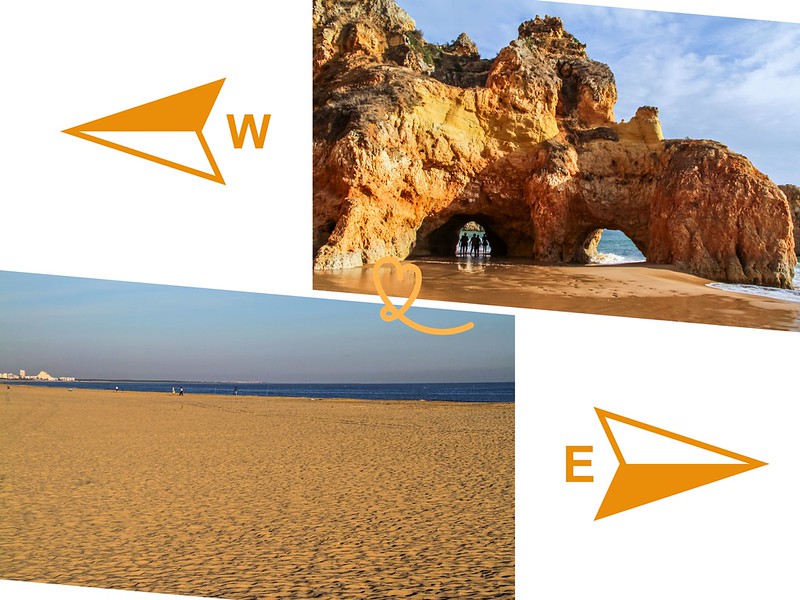
The western Algarve is famous for its spectacular rock formations and sea caves. Ochre and golden cliffs frame turquoise coves. We were impressed by the diversity of scenery over such a short distance.
Here you’ll discover coves surrounded by cliffs and vast stretches of sand.
Among our favorites:
- Praia da Marinha
- Praia da Falesia
- Praia dos Tres Irmaos
- Praia Dos Tres Castelos
- …
Almost all our favorite beaches are in the western Algarve.

Beaches of the Eastern Algarve
The east offers a different style, with its barrier islands and protected lagoons. The beaches are generally longer, flatter and the water calmer. The atmosphere is also much quieter.
Consider:
- Ilha de Tavira Accessible only by ferry
- Praia da Manta Rota

Water quality and temperature
Water temperatures vary little between east and west. In contrast, the water is generally calmer and warms up slightly faster in the protected eastern lagoons. To the west, the ocean is livelier and the waves more present, which appeals to water sports enthusiasts but can be less comfortable for a simple swim.
OUR ADVICE FOR RENTING A CAR IN THE Algarve
- Compare prices on our preferred platform: DiscoverCars – one of the best rated sites.
- Don’t take a car that’s too wide, as old towns have narrow streets and small parking spaces.
- For more choice, book early.

Algarve East or West: towns, villages and authenticity
Towns and villages of the Eastern Algarve
The East retains a remarkable authenticity. We found the villages less transformed by tourism and the atmosphere more Portuguese. You have:
- Tavira with its Roman bridge, churches with traditional azulejos and tiled roofs
- Faro and its historic center, surrounded by ramparts
- Olhão, an active fishing port

Villages of the Western Algarve
The west also has some beautiful villages, but many are more oriented towards tourism. That said, some retain an undeniable charm. Among our favorites:
- Ferragudo has preserved its character as a fishing village.
- Lagos has a historic center with 16th-century ramparts
- Silves and its magnificent red-tinted castle

Natural landscapes: cliffs vs. lagoons
The spectacular cliffs of the West
The western Algarve is famous for its geological formations. Erosion-sculpted limestone cliffs create caves, arches and rock piles. We particularly enjoyed exploring the Ponta da Piedade area by kayak. The play of light on the ochre rocks and turquoise water is exceptional.
The Seven Hanging Valleys Trail (Percurso dos Sete Vales Suspensos) between Praia da Marinha and Vale de Centeanes offers breathtaking panoramas along 6km of coastline.

The Ria Formosa: a unique ecosystem in the heart of the country
The Ria Formosa Natural Park stretches for 60km along the east coast. This system of lagoons, channels, salt marshes and barrier islands is home to remarkable biodiversity. We recommend a boat trip from Olhão or Faro to observe migratory birds, particularly the pink flamingos that frequent the salt marshes.
The landscape is more level and soothing than the spectacular cliffs of the West, but just as fascinating for those who take the time to observe it.

The Costa Vicentina: untamed nature
The Costa Vicentina Natural Park, in the north-west of the Algarve, offers dramatic landscapes. The dark cliffs contrast with the white foam of the waves. Rough vegetation and wild flowers cover the plateaus. We find this part of the coast more rugged and less accessible, giving it a special charm for lovers of unspoilt nature. On the edge of the Algarve, Praia de Odeceixe is a magnificent beach!


Water sports and activities
Activities in the West
The West offers the greatest diversity of water sports activities. Kayak trips to explore the sea caves from Lagos are very popular. We tested several providers and recommend leaving early in the morning to avoid large groups. Stand-up paddling is also popular in sheltered bays. For thrill-seekers, coasteering (swimming, jumping and climbing along cliffs) is particularly well developed around Lagos and Sagres. The more exposed west coast is a surfer’s paradise, with famous spots such as Arrifana, Bordeira and Amado.

FUN in the Algarve: activities
Caves and Cliffs by Boat
Kayak Tours
Dolphin watching
Jeep Tour

Activities in the East
The east offers gentler but equally interesting activities. Boat trips in the Ria Formosa allow you to observe wildlife and visit oyster-farming villages. We enjoyed a tasting of fresh oysters in a production basin. Kitesurfing is very popular thanks to the calm, shallow waters of the lagoons. Sport fishing is also available from Tavira and Olhão. For nature lovers, the hiking trails along the Ria Formosa offer great birdwatching opportunities.

Activities on the ground and in the sky
Quad bikes and buggies are available in both regions, mainly in the hinterland. We recommend excursions that combine beaches, dirt roads and traditional villages. Cycling is a pleasure along the Ecovia, a cycle path that crosses the entire Algarve. The flat section between Tavira and Vila Real de Santo António along the Ria Formosa is particularly family-friendly.
You can also go Parasailing or hot-air ballooning.

Cultural heritage and historic sites
Moorish heritage in the East
The eastern Algarve has more traces of Moorish occupation, which lasted for five centuries. Tavira Castle, although rebuilt after the 1755 earthquake, occupies a Moorish site. Terraced gardens and irrigation systems bear witness to the Arab influence. In Castro Marim, the medieval castle overlooks the salt marshes and the Spanish border. We find the eastern architecture more interesting, with its typical openwork chimneys and terraced roofs.

The Age of Discovery in the West
Lagos and Sagres are closely linked to the Portuguese Great Discoveries of the 15th century. The Sagres fort and its giant rosa dos ventos (compass rose) evoke Prince Henry the Navigator’s school of navigation. In Lagos, the Santo António church and its gilded Baroque interior are well worth a visit. The Municipal Museum traces the town’s history back to prehistoric times. We also appreciate the remains of the ramparts and the Porta de São Gonçalo.

Churches and religious architecture
Tavira, to the east, stands out with its 37 churches, many of which feature magnificent azulejos. The Igreja da Misericórdia features a remarkable Renaissance portal.
In Silves, the ancient Moorish capital to the west, the Gothic cathedral and red castle dominate the town. We recommend a visit to Silves to understand the importance of this region before Faro became the administrative capital.

Atmosphere and type of tourism
The West: lively and diverse
The West attracts a more international and younger tourism, particularly around Lagos. Bars, clubs and restaurants abound. The atmosphere is festive in summer and the nightlife lively. We find it stimulating but sometimes noisy, depending on the accommodation chosen. Albufeira, although technically central, shares this lively atmosphere with its large beaches and resorts. For those seeking peace and quiet in the west, we recommend staying in small villages such as Ferragudo or Carrapateira rather than in the main seaside resorts.

East: tranquillity and authenticity
The East retains a more peaceful, traditional atmosphere. Tourism is present, but less massive. Visitors are often families or couples seeking peace and quiet. We appreciate the slower pace of life and the opportunity to rub shoulders with the Portuguese in their daily lives. Local markets, small family restaurants and village festivals offer a more authentic cultural immersion. On the other hand, nightlife options are limited and some may find the atmosphere too quiet.

Gastronomy: East vs. West
Both regions excel in seafood cuisine. Fish and seafood are exceptional everywhere. However, we did notice a few differences.
Eastern specialties
The east is famous for its oysters and clams from the Ria Formosa. In Olhão and Tavira, restaurants serve a particularly tasty cataplana (seafood stew in a copper pot). Grilled octopus and sardines are prepared in the traditional way. We recommend Restaurant Hifén in Tavira for quality local cuisine. Conventional pastry shops offer excellent pastéis de nata and almond specialties.
Western specialties
The West offers a more varied gastronomic offering, with international restaurants and fusion establishments. Seafood remains excellent, especially in Ferragudo and Sagres. Lagos offers the widest choice, with restaurants to suit all budgets. We enjoyed several establishments combining traditional cuisine with modern presentation. The proximity of Portimão, a major fishing port, guarantees fresh produce.

Where to stay in the Algarve: recommendations by region
Lodging in the East
In the east, there’s less choice of housing. You’ll find fewer hotels and resorts and more rentals.
We recommend staying in the historic center of Tavira to enjoy the evening atmosphere. Options range from traditional guesthouses to boutique hotels in renovated buildings. Hotel Vila Galé Tavira, located near the municipal market, offers good value for money and a swimming pool that’s great in summer.
Or if you prefer to relax on the beach, rent near Praia da Manta Rota.
Tavira: see the best rated accommodations

Faro is also an excellent option, as it’s a more central town with lots of charm.
Among our favorites:
- Amália Boutique Suites & Studios – Seeprices, photos and availability
- Roots Hotel – See prices, photos and availability
- 3HB Faro – See prices, photos and availability
See our complete selection of the best hotels in Faro
or see the best rated accommodations

Lodging in the West
In the west, the choice is enormous.
All styles and price ranges are available.
Our two favorite seaside resorts are:
- Lagos – see our top-rated accommodations or our selection of hotels
- Portimao – see our top-rated accommodations or our selection of hotels
Among our favorites:
- Hotel Vivenda Miranda – See prices, photos and availability
- Hotel Cascade Wellness Resort – See prices, photos and availability
- Jupiter Marina Hotel – See prices, photos and availability

Access and travel
Getting to the Algarve
Faro airport, in the center of the region, serves the whole of the Algarve. Journey times from the airport are:
- East: Tavira 30min, Vila Real de Santo António 45min
- West: Portimão 50min, Lagos 1h, Sagres 1h30
There are regular buses from the airport to the main towns, but we strongly recommend renting a car to get the most out of the region.

Moving between East and West
The N125 national road crosses the Algarve from east to west. The A22 freeway is faster, but you have to pay for it. Allow around 1h30 between Tavira and Lagos without a stopover. We suggest planning a full day if you’re staying at one end and want to visit the other, including stops for sightseeing.
Can you visit both regions in one trip?
For a two-week stay, we recommend splitting your time between East and West. A week in each zone allows you to take full advantage without spending too much time on the road. For one week only, choose one or the other according to your priorities. Day trips between the two regions are possible, but the distances are long and you’ll spend a lot of time in the car.
Frequently asked questions
Which region for a family vacation?
The east is better suited to families with young children, thanks to the calm, shallow beaches of the barrier islands. The water heats up faster in the lagoons and waves are absent. Tavira offers a good balance between tranquillity and services. For families with teenagers looking for more activities, the west around Lagos offers more options for water sports and excursions.
Best time to visit?
May, June and September offer the best compromise. Temperatures are pleasant (22-28°C), the water is good (19-22°C) and the beaches less crowded than in July and August. The west can be windier in spring, which appeals to surfers but can be less comfortable for swimming. Winters remain mild (15-18°C) and the Algarve is a pleasant off-season destination for hiking and cultural discovery.
Budget: East or West more expensive?
The West, particularly Lagos and the more developed seaside resorts, generally commands higher prices for accommodation and restaurants. The east remains more affordable, especially if you avoid the most touristy areas. In Tavira and Olhão, you can easily find local restaurants at reasonable prices. Value for money is often better in the East.
PLAN YOUR TRIP TO THE algarve
- Best of
What to do in the Algarve
The most beautiful landscapes
Most beautiful towns and villages
Algarve’s most beautiful beaches
Best excursions

- Practical advice
When to go?
How to rent a car in the Algarve
How many days?
Itineraries
Where to stay in the Algarve
Lagos, Portimao or Albufeira
Most beautiful hotels