We recommend a visit to the Jesuit College Convent in Portimão, a 17th-century architectural gem overlooking the Praça da República. We enjoyed discovering this monumental complex, which bears witness to the religious history of the Algarve.
In this article, you’ll find some useful tips to help you prepare for your visit and have a great time.

This opinion is completely independent, based on our experiences. We visited the region anonymously, making our own choices and paying our bills in full.
Why visit the Jesuit College Convent?
Is Jesuit College worth it? Our opinion:
Yes, the Jesuit College Convent is well worth a visit. We appreciated its monumental façade dominating the central square and its unique architecture blending Mannerism and Baroque. It is one of the most remarkable examples of 17th-century Portuguese architecture and a listed property of municipal interest.
This is one of Portimão’s best activities!

Why is the Jesuit College Church famous?
The Jesuit College in Portimão is renowned for its unique Mannerist-Baroque architecture. It represents a milestone in Portuguese religious art. We were struck by this monument, which reflects the sober, austere aesthetic of the Jesuit Order while incorporating rich Baroque ornamentation. It also represents an important page in the religious history of the Algarve.

Our favorite moments
You’ll find details of our visit later in the article, but we can’t resist sharing our favorite moments with you right now:
- Discover the monumental façade, divided into 3 sections, which majestically dominates the Praça da República.
- Viewing the mausoleum of Diogo Gonçalves, hidden in the choir area
- Contemplating the Baroque altarpieces decorated with gilded sculptures dating from the 18th century

WHERE TO STAY IN Portimao
Our favorites: neighborhoods and hotels
Best Luxury Hotel –
Bela Vista Hotel & Spa – Check photos and availability
Best 4-star hotel –
Jupiter Marina Hotel – Check photos and availability
Best Hotel for Families –
Vitor’s Plaza Aparthotel – Check photos and availability

History in brief
The history of the Jesuit College spans several centuries. Here are a few important dates we’ve chosen:
- 1660: Construction begins on the initiative of nobleman Diogo Gonçalves
- 1707: Official inauguration of the Jesuit College
- 1757: Expulsion of the Jesuits from Portugal
- Between 1780 and 1834: Administered by the Camilos brothers
- 1834: Abolition of religious orders
- Today: Portimão parish headquarters, Diogo Gonçalves Gallery and retirement home

Access: Convent of the Jesuit College, Portimão
Where is the Jesuit College?
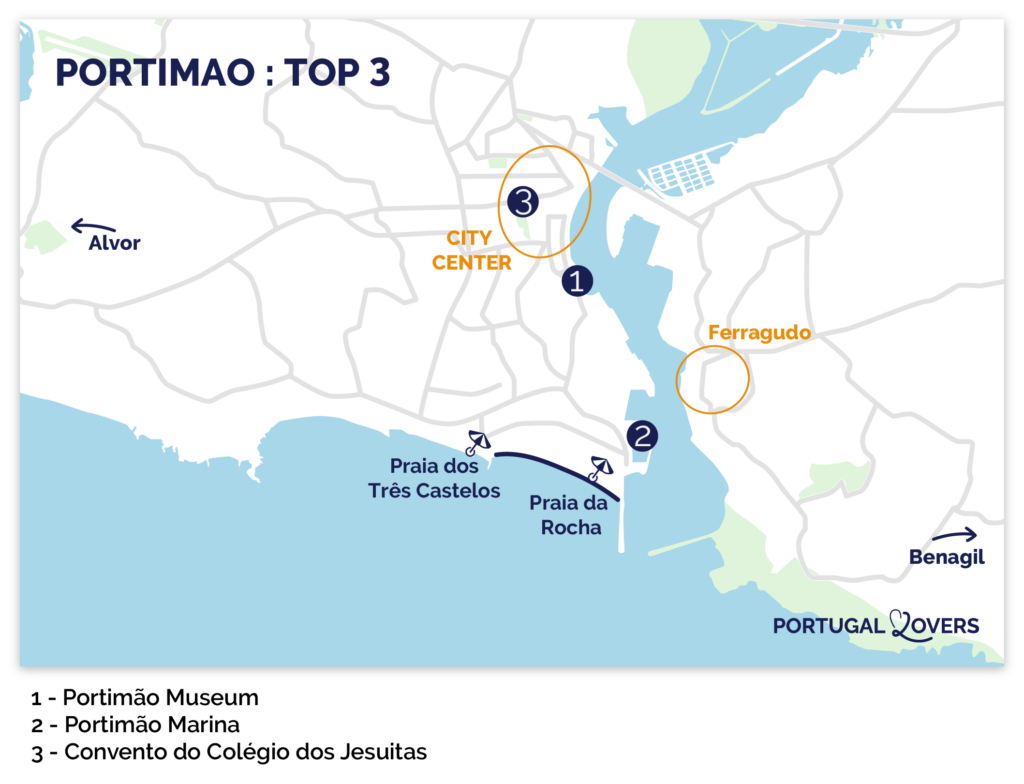
The Jesuit College is located on the Praça da República in Portimão (Algarve).
- In the heart of Portimão
- 4min walk from Notre-Dame de la Conception church
- 7min walk from Zona Ribeirinha
- 17min walk from Portimão Museum
- 10min drive from Praia da Rocha
Our map will help you find your way around the city:
OUR ADVICE FOR RENTING A CAR IN THE Algarve
- Compare prices on our preferred platform: DiscoverCars – one of the best rated sites.
- Don’t take a car that’s too wide, as old towns have narrow streets and small parking spaces.
- For more choice, book early.

How to get there?
The Jesuit College is within easy reach of Portimão city center. You can walk there directly from the station or marina in 10 to 15 minutes.
The monument is also well served by public transport: the “Alameda Norte” bus stop is right next door. To prepare your journey, you can consult the timetables and itineraries here.

Parking
If you’re travelling by car, there’s a covered parking lot on Praça da República. It’s also very convenient if you plan to explore the city center on foot afterwards.

DISCOVER Portimao

Useful tips: duration, schedules, eating…
Best time to visit
We recommend visiting the Jesuit College Convent in the morning or late afternoon to enjoy the softer light on the façade. You’ll particularly appreciate a visit outside the tourist season, when Praça da República is quieter. In summer, opt for the cooler hours of the morning or evening to avoid the heat.

Length of visit and main difficulties
Allow 15-30 minutes for a visit to the Church of the Jesuit College, or even longer if you also visit the Diogo Gonçalves Gallery.
We observed 2 small steps at the entrance to the church, which could represent a difficulty for wheelchair users. The aisles within the religious building are also narrow. The Diogo Gonçalves Gallery has a ramp for easy access.

Advice on how to visit
We recommend starting your visit with the monumental façade, which can be seen from Praça da República. The scale and symmetrical structure of the Jesuit building is best seen from this central square. If the church is open, continue by exploring its Baroque interior, paying particular attention to the richly carved altarpieces and the tomb of the founder, Diogo Gonçalves, located in the choir. If it’s accessible during your visit, take a detour to the Galerie Diogo Gonçalves, housed in the former wing of the college.


Visiting with children
The visit to the Jesuit College Convent is not particularly suitable for young children. Inside the building, there are no special facilities for young audiences, nor any interactive or play areas. However, if you’re with the family, there’s a playground right next door, on the Praça da República. A good compromise to allow the little ones to let off steam after the visit.

Schedules and rates
Admission to the Collège des Jésuites Church is free.
The site is open Monday to Friday, 8am to 12:30pm and 3pm to 6pm. Schedules may be subject to change, however, particularly during religious or cultural events. To avoid any unpleasant surprises, we recommend that you contact the Portimão Parish before your visit on (+351) 282 422 612 or visit their official website here.
Galerie Diogo Gonçalves appears to be open from 2pm to 5pm, Monday to Saturday, according to the sign at the entrance.

Catering
The convent doesn’t offer on-site dining options, but you’ll find plenty of eateries in downtown Portimão. Our article on the city’s best restaurants will be available soon, but in the meantime we suggest Restaurant Mãe Terra for its healthy, vegetarian dishes that are as beautiful as they are good!

The sober but imposing façade of the Collège des Jésuites
As soon as we arrived on the Praça da República, the monumental façade of the Jesuit College caught our eye. The building rises up among the low-rise houses, marking the urban landscape with its imposing imprint. The most striking feature of the complex is the impressive facade, divided into 3 distinct sections: the central, high-ceilinged one, corresponding to the church, and the lateral ones, oblique to the former wings of the college. A Jesuit building, the architecture reflects the sober, austere aesthetic dominant of the Order.

In the footsteps of its founder
The history of the Collège des Jésuites interested us because of its strong link with its founder, Diogo Gonçalves. This nobleman from Vila Nova de Portimão, near the Orient, decided in his will to create a college of the Society of Jesus. Construction began in 1660, but the building was not inaugurated until 1707. He is buried in the choir of the church in a tomb with a long epigraphic inscription.

After the expulsion of the Jesuits in 1757, the site was taken over by the Camilos brothers, then transformed following the abolition of religious orders. The building has housed various public services and continues to serve the community to this day. It houses the Diogo Gonçalves Gallery, parish headquarters and a retirement home, continuing its humanist vocation in the heart of Portimão. Unfortunately, the gallery was closed at the time of our visit.

The church interior at the crossroads of Mannerism and Baroque
The interior of the church reveals a striking mix of artistic styles. Built over a long period, the building illustrates the transition from austere Mannerism to flamboyant Baroque, typical of 17th-century Jesuit architecture. The choir and side chapels are home to magnificent 18th-century gilded altarpieces, rich in sculpted detail, which we loved to contemplate. This combination of sobriety and opulence creates a unique atmosphere, reflecting a constantly evolving spiritual and artistic history.

Subscribe to our Newsletter
- Get away from it all with Region Lovers’ beautiful destinations!
- Once a month
- Advertising-free

Frequently asked questions
Can we visit the interior of the Jesuit College Convent?
Part of the interior of the Jesuit College Convent can be visited. The church is open to visitors, and it’s also possible to discover the Diogo Gonçalves Gallery, which occupies a wing of the building. Access to these areas depends on their respective opening hours, which you should check before visiting.

What can you see in the Diogo Gonçalves Gallery?
The Diogo Gonçalves Gallery, located in the convent, exhibits works of art linked to local and religious history. Here you can discover pieces that illustrate the artistic evolution of the region and the cultural heritage of the college’s founder. These are mainly paintings.

PLAN YOUR TRIP TO THE algarve
- Best of
What to do in the Algarve
The most beautiful landscapes
Most beautiful towns and villages
Algarve’s most beautiful beaches
Best excursions

- Practical advice
When to go?
How to rent a car in the Algarve
How many days?
Itineraries
Where to stay in the Algarve
Lagos, Portimao or Albufeira
Most beautiful hotels