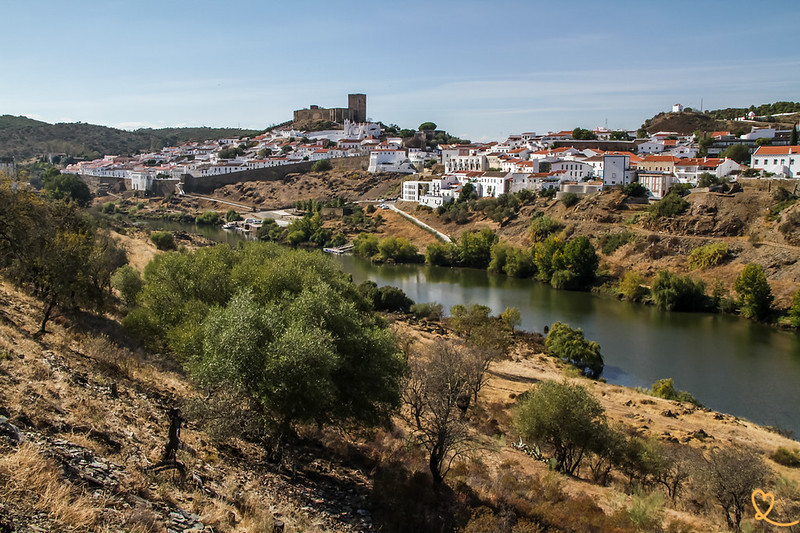
Mértola is a village in the Baixo Alentejo region, perched on the banks of the Guadiana River. We enjoyed its medieval castle, its former mosque that has been converted into a church, and its many museum clusters scattered throughout the white-washed streets. You’ll be surprised by the rich history of this small village, where Roman, Islamic, and Christian influences converge.
Here is our guide to the must-see sights in the village of Mértola in the Alentejo, along with helpful tips for planning your visit.
This opinion is completely independent, based on our experiences. We visited the region anonymously, making our own choices and paying our bills in full.
Is the village of Mértola worth a visit?
Yes, the village of Mértola is worth a visit. We loved its peaceful atmosphere, with its whitewashed houses, ramparts, and views of the Guadiana River. It didn’t make it onto our list of Portugal’s most beautiful villages, but it’s not far off!
It is one of the most beautiful villages in Portugal.

If you don’t have a car, please note that we are not aware of any organized tours departing from major Portuguese cities specifically to visit Mértola: renting a car remains the most reliable way to get there.
1. The views from the bridge over the Guadiana River

When we arrived in Mértola, we crossed the bridge over the Guadiana River, which was opened in 1961 and designed by engineer Edgar Cardoso. Before that, people crossed the river by boat, a method that was replaced in 1924 by a pontoon bridge, which was eventually abandoned after it sank. From the bridge deck, supported by seven piers, you can enjoy an unobstructed view of the village clinging to the hillside and its castle. The bridge is lit up at night, which also makes it easier to cross on foot.
OUR TIPS FOR RENTING A CAR IN Portugal
- Compare prices on our preferred platform: DiscoverCars – one of the best rated sites.
- Don’t take a car that’s too wide, as old towns have narrow streets and small parking spaces.
- For more choice, book early.

2. The view from the Guadiana pier

Across from the village, along the river, you’ll find a pier with a magnificent view of the village. From here, you can see the fortifications very clearly, as well as the castle’s strategic position at the top of the hill.
3. Stroll through the village’s narrow streets

We enjoyed getting lost in the whitewashed alleys of Mértola’s historic center. The village is built in terraces on a hill overlooking the confluence of the Guadiana and Oeiras rivers, offering ever-changing views. The facades blend Roman, Islamic, and Christian influences, reflecting the area’s turbulent history.
Cobblestone streets, some of which are sloped. Be sure to bring good walking shoes


4. Mértola Castle

The castle overlooks the village from its rocky outcrop. The current fortress dates from the 13th century and was built by the Order of Santiago after the Christian reconquest, on top of earlier Roman and Islamic fortifications. We climbed up to the Torre de Menagem, which houses a small section of the museum and offers the widest view of the Guadiana River and the bridge. Access to most of the site is free; only the climb up to the keep requires an admission fee.

- Hours: Tuesday through Sunday, 9:20 a.m. to 12:30 p.m. and 2:00 p.m. to 5:20 p.m. — closed on Mondays, January 1, Easter Sunday, May 1, and December 24 and 25
- Price: Free admission to the castle; admission to the Torre de Menagem is €2 (free for children under 12 and local residents; discounts available for students and those 65 and older)
- Visit the official website for more info here

5. Spend a night there
Mértola invites you to slow down, and we recommend spending at least one night there to enjoy the peaceful village once the day-trippers have left.
You can stay in the village, such as at the Hotel Museu, built on the ruins of an old Muslim quarter on the banks of the Guadiana River. It has a swimming pool.
But you can also head out of the village to enjoy views of the village, such as at Quinta do Vau, which also has a pool.
Book early during peak season: accommodation options are limited in this small village— see the top-rated options and check availability
WHERE TO STAY IN Alentejo
- Évora, Capital of the Alentejo
See the top-rated accommodations in Évora
For example:
Hotel Evora Olive, in the city center
Espinheiro Convent, in the countryside
- Mertola, on the way to the Algarve
See the best rated accommodations
For example: Quinta do Vau Hotel
- Vila Nova de Milfontes, on the coast
See the best rated accommodations
For example: Quinta da Boavista Hotel

6. The Clock Tower

The Torre do Relógio, built in the late 16th century, is one of the most photographed landmarks in Mértola. We climbed the outdoor staircase to enjoy the view of the Guadiana River. A second staircase, added in 1920 and funded by the Mason & Barry mining company—which was operating the Minas de São Domingos at the time—leads directly down to the riverbank. The tour of the tower itself is quick, but it’s worth stopping by.
7. The Church of Mértola: the Igreja Matriz

The Igreja Matriz de Mértola, dedicated to Nossa Senhora da Anunciação, is housed in the village’s former Almohad mosque, built in the 12th century. After the Christian reconquest of 1238, the Order of Santiago converted the building into a church without erasing all traces of its Islamic past. We noticed the multilobed arches and the mihrab, the niche that once indicated the direction of Mecca to Muslim worshippers. During the 16th century, a Renaissance portal and a gabled roof—in the late Gothic style characteristic of the Alentejo—were added. You’ll also recognize the columns arranged in rows of six, remnants of the former prayer hall.

- Hours: Tuesday through Sunday, 9:00 a.m. to 12:30 p.m. and 2:00 p.m. to 5:30 p.m.; closed on Mondays
- Free admission
- Designated a national monument since 1910
- Visit the official website for more info here
8. The Mértola Museum

The Museu de Mértola – Cláudio Torres, established in 2004 by the municipality, is not limited to a single building: it comprises 14 sites spread throughout the village and its surroundings. We visited the Casa Romana, with its Byzantine-inspired mosaics, and the Núcleo de Arte Islâmica, which houses a rich collection of ceramics from the 9th to the 13th centuries. You can also visit the Núcleo de Arte Sacra, located in the Igreja da Misericórdia, or the Basílica Paleocristã, an open-air archaeological site. Allow half a day to explore the neighborhoods of the historic center.

- Hours: Tuesday through Sunday, 9:15 a.m. to 12:30 p.m. and 2:00 p.m. to 5:15 p.m.; closed on Mondays, January 1, May 1, and December 25
- Price: Free for most of the exhibition areas; €2 for the Torre de Menagem, the Islamic Art Exhibition Area, and the Sacred Art Exhibition Area
- Guided tours are available by prior reservation at the Mértola Tourist Information Office
- Visit the official website for more info here
Other Attractions in Mértola and the Surrounding Area
The area around Mértola has other sights to discover, some closer to the village and others farther away. Here is an overview:
- Mina de São Domingos: a former copper and pyrite mine that has left behind a vast open-pit site. Former mining buildings—including the headquarters, which has been converted into the São Domingos Hotel—as well as a small English cemetery, bear witness to this period.
- Guadiana Valley Natural Park and Pulo do Lobo, a sanctuary for black storks.
- Alcoutim: On the other side of the Guadiana River, already in the Algarve, the village of Alcoutim lies across from its Spanish neighbor, Sanlúcar de Guadiana. You can get there by boat from Mértola.
How to Get to Mértola + Parking
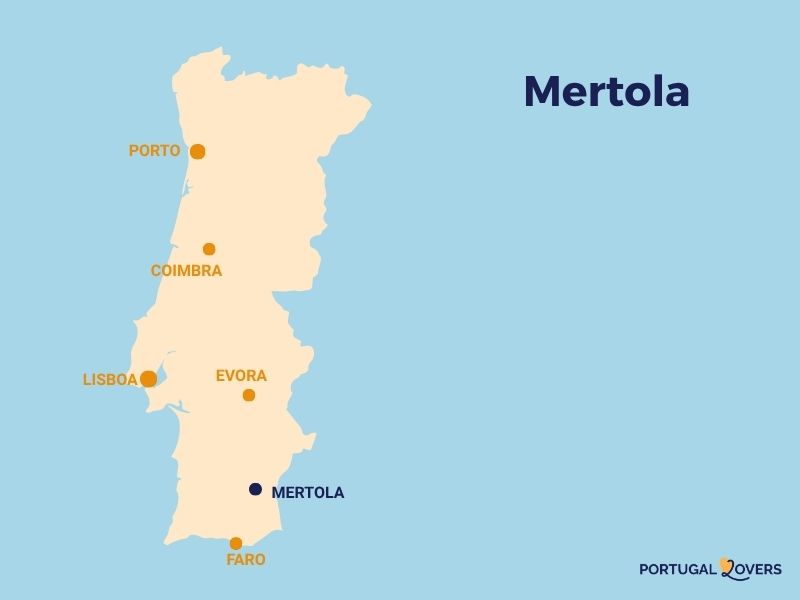
Where is Mértola?
- In the Baixo Alentejo, in the district of Beja, at the confluence of the Guadiana and Oeiras rivers
- From Évora: a 1-hour-40-minute drive
- From Faro: a 1.5-hour drive
- From Lisbon: about 180 km, a 2-hour, 40-minute drive
- Spanish border: about 20 km
How to get there
A car is still the most convenient way to get to Mértola and then explore the surrounding area, since there is no train service to the village. Rede Expressos buses connect Lisbon to Mértola in about 3 hours and 35 minutes, via Beja. From Beja, Rodoviária do Alentejo also operates several daily routes, each taking just over an hour.

Parking in Mértola
The historic center of Mértola is best explored on foot, but there are several free parking lots on the outskirts and near the Hotel Museu, along the banks of the Guadiana River. We recommend parking there before setting out to explore the narrow streets.
EXPLORE Alentejo
- Attractions in Alentejo
- Attractions in Évora
- The Village of Mertola
- The Village of Monsaraz
- The Village of Marvao

Helpful Tips for Visiting Mértola
How long and when?
Plan on spending half a day to see the highlights of the village, or a full day if you’d like to visit several sections of the museum and enjoy the river. We recommend spring or fall, as summers can be particularly hot in this part of the Alentejo.

Tour directions, map and difficulty
We began our tour at the bridge and the pier, then made our way up through the cobblestone streets toward the historic center, all the way to the castle. Some streets are steep, and the ground is uneven in places, so you’ll need good shoes.
And the climb up to the castle is steep; my parents decided to stay behind and enjoy the view while I (Claire) explored the castle.

Visiting with children
The Mértola Museum, with its various sections to explore like a treasure hunt, is sure to appeal to children who are curious about history. Climbing the castle and the Clock Tower, as well as the walk to the pier, are also great ways to get some exercise. A stop at Gelados Nicolau ice cream shop is the perfect way to round out a family outing.
Restaurants
We haven’t tried the restaurants in Mértola yet.
Visiting Mértola in Winter
Winter is still a pleasant time to visit Mértola, with mild temperatures in the Baixo Alentejo. We liked the idea of enjoying the village outside of the hottest times of the year, when it’s perfect for long walks along the Guadiana. Be aware, however, that some of the museum’s sections have reduced hours during the off-season.
PLAN YOUR TRIP TO Portugal
- Best of
Best destinations
Best attractions in Portugal
The most beautiful landscapes
Most Beautiful Cities
Most beautiful villages
Portugal’s Most Beautiful Beaches

- Practical advice
When to go?
How to rent a car in Portugal
Driving tips
How many days