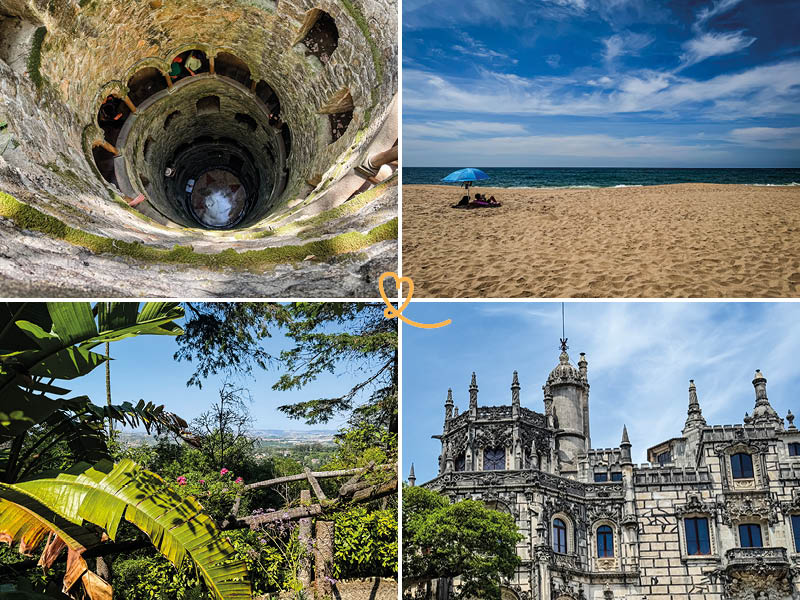
Nestled in Portugal’s Serra mountains, Sintra is a charming town where fairytale palaces, lush forests, wild seashores and idyllic beaches meet. We were won over by this unique destination that combines exceptional architectural heritage with unspoilt nature.
In this article, we share with you 8 reasons to visit Sintra.
This opinion is completely independent, based on our experiences. We visited the region anonymously, making our own choices and paying our bills in full.
Is Sintra worth a visit?
Absolutely! A UNESCO World Heritage site, this former holiday resort of the royal family is an architectural gem located just a few kilometers from Lisbon. The city is home to some superb palaces and castles. We also marveled at its lush gardens and spectacular mountain and seascapes. A romantic destination with a rich historical and natural heritage.
Below is a more detailed list of reasons to visit Sintra. You can also take a look at our selection of the city’s top attractions.

Reason 1 – A picturesque downtown area
The historic heart of Sintra is utterly charming, with its narrow streets winding up and down through the town, creating a maze in which to get lost. We were particularly taken by the unique blend of Moorish and Gothic influences reflected in its architecture, including the beautiful Manueline Town Hall. Soak up the city’s typical atmosphere and stop off at pretty squares like Largo Rainha Dona Amelia, one of the most beautiful in our opinion. But expect to go up and down, as the city is very steep!

WHERE TO STAY IN Sintra
Our favorites: neighborhoods and hotels
In downtown Sintra, with easy access to the palaces –
Hotel Sintra Jardim – Check photos and availability
In the Sintra countryside, in the natural park—
Penha Longa Resort Hotel – Check photos and availability
By the sea, a little further on—
Hotel Arribas Sintra – Check photos and availability

Reason 2 – Extraordinary palaces and castles
Sintra is home to some exceptional residences that bear witness to its rich royal past. We were impressed by the Palais de Pena, perched high above the Serra de Sintra, a work of art commissioned by King Ferdinand II that combines neo-Islamic, neo-Gothic and neo-Renaissance elements in full color! The Château des Maures, built during the Muslim period, offers breathtaking panoramic views of the region. And don’t forget to visit the Biester Palace, the Monserrate Palace and the Sintra National Palace, the oldest in Portugal. The latter fascinated us with its eclectic architecture, which echoes many important historical episodes.

OUR TIPS FOR RENTING A CAR IN Portugal
- Compare prices on our preferred platform: DiscoverCars – one of the best rated sites.
- Don’t take a car that’s too wide, as old towns have narrow streets and small parking spaces.
- For more choice, book early.

Reason 3 – Unique parks and gardens
Sintra’s green spaces are true havens of peace, where nature and architecture blend to perfection. We were particularly taken by the Quinta da Regaleira. We were delighted to lose ourselves in its vast grounds, which include a surprising inverted well inspired by Dante’s Inferno. Botanical enthusiasts will also be delighted by the 50-hectare Monserrate Park. Its oak forest and exotic gardens designed by James Burt, dominated by a marvellous oriental palace, will take you on a journey. Why not also explore the Palácio Biester, a 19th-century palace surrounded by a botanical park where trees from all over the world flourish? The gardens of the Palacio de Pena, meanwhile, offer an immense fern-filled promenade.


Reason 4 – A wild seaside
The Sintra coastline is adorned with spectacular scenery that left us speechless. Azenhas do Mar, an old fishing village overlooking a natural swimming pool, is well worth a visit. It’s a pleasant place to stroll around, swim in its basin at high tide (depending on the strength of the waves) and enjoy fish in a small restaurant. Venture to Cabo da Roca, Europe’s most westerly point. An exceptional view of the Atlantic Ocean awaits you.

Reason 5 – Beautiful beaches
Sintra is also synonymous with the beach. Head to Praia Grande, the largest beach in the Serra de Sintra, for surfing, sunbathing or dinosaur fossils. The wilder Praia da Ursa enchanted us with its unique rock formations and unspoilt landscape. It’s accessible after a steep hike, but the effort is well worth it. Fans of wind sports such as kitesurfing will love Praia do Guincho. Finally, Praia da Adraga, nestled in a deep valley and surrounded by imposing cliffs, offers a beautiful natural setting ideal for walks or photos.

Subscribe to our Newsletter
- Get away from it all with Region Lovers’ beautiful destinations!
- Once a month
- Advertising-free

Reason 6 – An ideal location
Sintra’s location makes it an ideal base for exploring the region. We particularly appreciated its proximity to Lisbon, which can be reached in just 40 minutes by train. This makes it easy to organize day trips. The coastal town of Cascais is also within easy reach, offering you the chance to combine cultural heritage with sea bathing. What’s more, Sintra’s location in the heart of the Sintra-Cascais Natural Park means you can take full advantage of the surrounding natural areas. Sintra is the perfect starting point for discovering the treasures of the Portuguese coast and inland, while enjoying a quieter setting than the capital.

Reason 7 – Local gastronomy
Sintra’s culinary scene is very appealing. Try local pastries such as queijadas and travesseiros, traditional recipes for which the city is famous. A must in the center, Restaurant Incomum by Luis Santos will surprise you with its creative, modern reinterpretation of traditional Portuguese dishes. For a romantic evening, we recommend Restaurant A Raposa, which combines an intimate atmosphere with refined Portuguese cuisine featuring local produce. On the coast, you can enjoy excellent seafood and fish, notably at the Bar do Fundo where we had lunch in Praia Grande.

Reason 8 – Nature activities
Sintra offers a wide range of outdoor activities. This mountain region is ideal for hiking, for example. The Villa Sassetti trail from downtown Sintra takes you all the way to the Château des Maures. The climb isn’t easy, but as we made our way along the trails, we came across charming watering holes, lush vegetation and old buildings. Explore the Peninha Sanctuary for panoramic views of the surrounding area. On the coast, it’s possible to take surfing lessons, go kiteboarding or simply enjoy the seaside.

Some disadvantages of a trip to Sintra
The tourist influx
Sintra’s popularity means it’s very popular with tourists, especially during the high season. In summer, it’s literally crowded! We were there at the end of May and it was already packed. Major sites such as the Pena Palace can be very crowded. We therefore advise you to plan your visits for early morning or late afternoon. For a more exclusive visit, why not opt for the low season from November to March? Sintra is still very pleasant in winter!

Sloping topography
Sintra’s steep terrain can be a challenge for some visitors. We found the downtown area quite steep. If you’d like to walk, you’ll need to be in good physical condition and have suitable walking shoes. Getting around the center by car is further complicated by the limited parking available. For ease of travel, you can opt for tuk-tuks or take the 435 or 434 buses, which serve the center fairly well (but expect long queues in summer). To explore the coast, however, we recommend that you have a vehicle, as the sites are scattered and less accessible by public transport.

How to get to Sintra
There are several options for getting to Sintra. By train from Lisbon, you can leave from Rossio or Oriente stations for an average journey time of 40 minutes. By bus, routes 403 or 417 connect the main terminal at Cascais with Sintra station in 30 to 60 minutes. If you prefer to drive from Lisbon, take the A37 freeway or the IC19 road, but beware of traffic and limited parking in Sintra.
The nearest airport is Lisbon, serving many international destinations.

PLAN YOUR TRIP TO Portugal
- Best of
Best destinations
Best attractions in Portugal
The most beautiful landscapes
Most Beautiful Cities
Most beautiful villages
Portugal’s Most Beautiful Beaches

- Practical advice
When to go?
How to rent a car in Portugal
Driving tips
How many days