Évora, the capital of the Alentejo and a UNESCO World Heritage Site, boasts an exceptional heritage: a Roman temple, a medieval cathedral, the Chapel of Bones, and whitewashed narrow streets. We were captivated by the diversity of its monuments, which bear witness to more than two thousand years of history.
Check out our ideas for things to do in Évora, illustrated with photos that will make you want to go there. Bonus: useful tips and additional activities.
This opinion is completely independent, based on our experiences. We visited the region anonymously, making our own choices and paying our bills in full.
1. Chapel of Bones

Why visit?
The Capela dos Ossos is one of the most visited sites in Évora. We entered this small chapel adjoining the São Francisco Church and discovered its walls lined with human bones and skulls, which had been brought from the city’s old cemeteries in the 16th century.
The inscription at the entrance—“We, the bones that are here, await yours”—sets the tone for this Franciscan meditation on mortality. You’ll also notice the macabre murals painted on the vaults, as well as a mummy on display near the altar. We recommend going early in the morning, when it’s quieter and the light is better for taking photos.

Practical advice
- Duration of visit: allow about 20 to 30 minutes
- Opening hours:
March 28 through October 30, from 9:00 a.m. to 6:30 p.m.,
October 31 through March 27, from 9 a.m. to 5 p.m. - Challenges and Access for People with Disabilities: This is an old, cramped space; wheelchair access is difficult.
- Rates:
A single ticket granting access to the Capela dos Ossos, the Núcleo Museológico, and the Coleção de Presépios:
€7 full price;
€5 for young people up to age 25 and seniors age 65 and older;
Admission to the church alone is free - Visit the official website for more info here.
2. Évora Cathedral

Why visit?
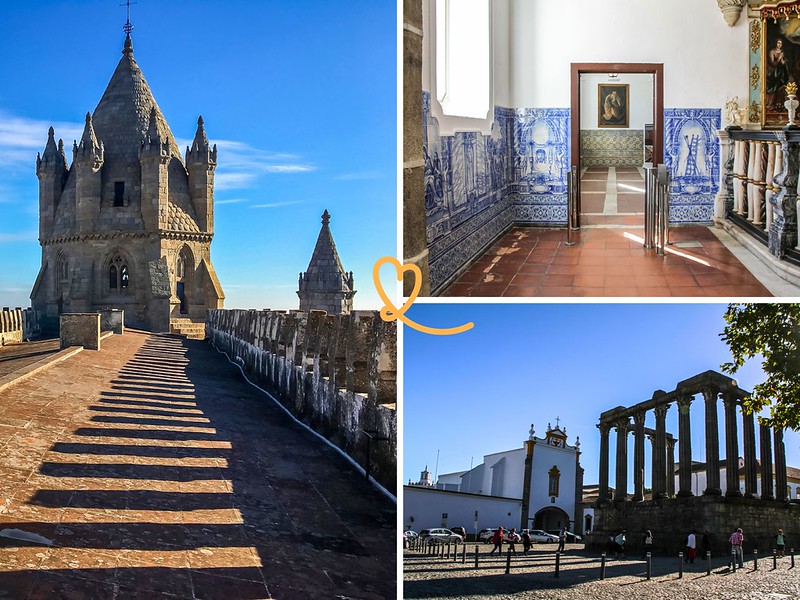
The Évora Cathedral is the largest medieval cathedral in Portugal. We admired its granite façade, flanked by two asymmetrical towers, a blend of Gothic and Romanesque styles that reflects the various construction phases between the 13th and 14th centuries. The main chapel, rebuilt in 1718 in the Baroque style, is adorned with precious marble.
Above all, you can go up to the terrace, the highest point in the city, where the view stretches across the entire historic center and out to the surrounding plains of the Alentejo. We recommend setting aside some time to visit the 14th-century cloister and its Romanesque bell tower, which can be seen from the hilltop.

Practical advice
- Duration of visit: 1 hour to 1 hour and 30 minutes for the cathedral, the cloister, the museum, and the panoramic terrace
- Opening hours:
Every day from 9 a.m. to 5 p.m.,
Last admission 30 minutes before closing;
Closed on the afternoon of December 24, December 25, and January 1 - Accessibility and Challenges: Access to the terrace is via a narrow staircase, which is difficult for people with limited mobility to navigate.
- Rates:
Full tour (cathedral + cloister + panoramic terrace + museum) €5;
Free for children under 12 when accompanied by an adult - Visit the official website for more info here.

WHERE TO STAY IN Alentejo
- Évora, Capital of the Alentejo
See the top-rated accommodations in Évora
For example:
Hotel Evora Olive, in the city center
Espinheiro Convent, in the countryside
- Mertola, on the way to the Algarve
See the best rated accommodations
For example: Quinta do Vau Hotel
- Vila Nova de Milfontes, on the coast
See the best rated accommodations
For example: Quinta da Boavista Hotel

3. Roman Temple in Évora, known as the Temple of Diana

Why visit?
The Roman Temple of Évora, often called the Temple of Diana, is one of the best-preserved ancient ruins on the entire Iberian Peninsula. We observed its Corinthian columns, erected in the 1st century during the reign of Emperor Augustus and later modified under Claudius. Contrary to what its name suggests, there is no evidence that it was dedicated to the goddess Diana: this name is believed to have first appeared in the 17th century.
You’ll find it on Largo Conde de Vila Flor, right next to the cathedral and Jardim Diana. Access remains free and open to the public at all times; however, visitors are not permitted inside the building in order to preserve this monument, which has been a UNESCO World Heritage Site since 1986.
We liked the contrast between this ancient monument and the white facades typical of Portugal.

Practical advice
- Duration of visit: 10 to 30 minutes to tour the site and enjoy the adjoining garden
- Hours: Open 24/7; no set hours; outdoor monument
- Challenges and Access for People with Disabilities: A Flat, Accessible Public Space
- Rates: free of charge
OUR TIPS FOR RENTING A CAR IN Portugal
- Compare prices on our preferred platform: DiscoverCars – one of the best rated sites.
- Don’t take a car that’s too wide, as old towns have narrow streets and small parking spaces.
- For more choice, book early.

4. São Francisco Church

Why visit?
Located next to the Capela dos Ossos, the Igreja de São Francisco is well worth a visit in its own right. We took the time to admire its single nave, flanked by ten side chapels, as well as its Manueline-style vaulted ceiling, adorned with maritime motifs dating back to the Age of Discovery. Built between 1475 and 1550 during the reigns of Afonso V and then João III, the church combines Late Gothic and Manueline styles with later Baroque elements.
You can also head up to the terrace at La Galilé for another view of the city. We recommend that you don’t limit yourself to the ossuary and take the time to explore the entire building.

Practical advice
- Duration of visit: about 20 minutes for the church alone
- Hours: Same hours as the Capela dos Ossos, from 9:00 a.m. to 6:30 p.m. in the summer and from 9:00 a.m. to 5:00 p.m. in the winter
- Challenges and Access for People with Limited Mobility: The terrace is difficult for people with limited mobility to access
- Admission: Free admission to the church
5. Praça do Giraldo

Why visit?
Praça do Giraldo has been the beating heart of Évora for centuries. We strolled beneath its 16th- and 18th-century arcades, lined with shops, cafés, and restaurants, including the historic Café Arcada, which opened in 1942. The square is named after Geraldo Sem Pavor, who recaptured the city from the Moors in 1167.
At its center stands a Renaissance-style marble fountain, built in 1571 by Afonso Álvares and topped with a crown in 1619: its eight spouts symbolize the eight streets that converge there. You’ll also see the Igreja de Santo Antão, which has overlooked the area since the 16th century. This place has also seen darker times, having been the site of the Inquisition’s book burnings.

Practical advice
- Duration of visit: a 15- to 30-minute stop; longer if you sit on the patio
- Hours: Public space open at all times
- Accessibility and Challenges: flat, paved area, accessible
6. The Historic Center and the Narrow Streets of Évora

Why visit?
The historic center of Évora, a UNESCO World Heritage Site since 1986, is best explored on foot. We loved getting lost in its maze of whitewashed alleyways, lined with houses featuring wrought-iron window frames and eclectic facades that blend Moorish and Gothic influences. L
The remains of two successive city walls—first Roman, then medieval—still define the city’s layout. As you stroll along, you’ll come across artisans, traditional stalls, and small, shaded squares—perfect for taking a break. We recommend setting aside at least half a day for this leisurely stroll, without a set itinerary, to soak up the city’s atmosphere.

Practical advice
- Duration of visit: Allow at least half a day for a leisurely stroll without a specific itinerary
- Challenges and Accessibility for People with Disabilities: cobblestone alleys, some of which are sloped; please provide specific details

7. Almendres Cromlech

Why visit?
The Cromeleque dos Almendres is nicknamed the “Portuguese Stonehenge,” even though it is about 2,000 years older than its English counterpart. We explored this megalithic site, consisting of several dozen menhirs arranged in concentric circles, about 15 km west of Évora.
There are no barriers around the stones: you can walk freely around the entire area and even touch them. We suggest stopping by the Centro Interpretativo do Megalitismo in Évora first to gain a better understanding of the context of this site, which has been designated as a site of public interest.

Practical advice
- Duration of visit: 30 to 45 minutes on site
- Hours: Open at all times; no set hours or ticket office
- Challenges and Access for People with Limited Mobility: uneven terrain and an access road that is partially unpaved; not recommended for people with limited mobility
- Rates: free of charge
- Directions: About 15 km west of Évora via the N114 and then the CM1075; accessible only by car or through an organized tour; there is no public transportation to the site
- Parking: Free, easily accessible outdoor parking on site
- Food and Drink: There are no dining options on site, so be sure to bring something to drink and snack on, or eat before or after your visit to Évora
8. Medieval City Walls and Gates of Évora

Why visit?
Évora is one of the few Portuguese cities to have preserved a large portion of its fortifications. We followed certain sections of the “cerca velha,” which dates back to Roman and Visigothic times, and then the “cerca nova,” commissioned in the 14th century by King Afonso IV and completed under King Fernando I before being reinforced with bastions in the 17th century.
Several historic gates still stand, including the Porta de Avis, the Porta de Moura, and the Porta de Alconchel. You’ll also see some ruins near the Jardim Público and along the aqueduct. We find this fortified heritage particularly illuminating for understanding the city’s military and urban history.

Practical advice
- Duration of visit: varies depending on the sections chosen; allow 30 minutes to 1 hour for a partial tour
- Hours: Open 24/7; ramparts and gates are outdoors

It’s time to book!
Compare everything: companies, prices, schedules and availability.
9. Palace of the Dukes of Cadaval

Why visit?
The Palácio dos Duques de Cadaval stands across from the Roman temple, built on the foundations of an ancient Moorish castle dating from the 14th century. We discovered this residence, which is still home to the family of the Dukes of Cadaval, and which blends the Mudéjar, Gothic, and Manueline styles.
Its pentagonal tower was once part of the city walls. You will be able to tour some of the rooms as well as the private chapel, adorned with blue azulejos, which houses the family’s historical and contemporary collection. We enjoyed this immersion in a family heritage that is still very much alive—something quite rare in Évora, where most of the monuments belong to the state.

Practical advice
- Visit duration: 45min to 1h
- Hours: Tuesday through Sunday from 10 a.m. to 1 p.m. and from 2 p.m. to 6 p.m.; closed on Mondays
- Accessibility and Challenges: To be completed; several rooms spread across different levels
- Prices: palace + church, 6€
- Visit the official website for more info here.
10. Palace of Dom Manuel I

Why visit?
The Palácio de Dom Manuel, also known as the Galeria das Damas, is located in Évora’s Jardim Público. We have learned that this is the only remaining structure of the former Paço Real de São Francisco, a royal residence that was partially destroyed after its roof collapsed in 1881. The style blends Late Gothic, Manueline, and Moorish influences, with windows reminiscent of those at the National Palace of Sintra.
It was here that Vasco da Gama was appointed commander of the expedition to India in 1497. You can enjoy it at your leisure while strolling through the garden, with no time restrictions and no need to buy a ticket.

Practical advice
- Duration of visit: 15 to 20 minutes; best enjoyed as part of a stroll through the Jardim Público
- Hours: Open during the same hours as the Jardim Público; outdoor venue
- Accessibility and Challenges: Flat, accessible public park
- Rates: free of charge
11. Roman Baths of Évora

Why visit?
The Roman Baths of Évora are tucked away inside the City Hall building on Praça de Sertório. We were surprised to discover these remains, which were not unearthed until 1987, during construction work at City Hall.
The site includes a laconicum featuring a remarkably well-preserved circular pool 9 meters in diameter, as well as a praefurnium, which was used to heat the rooms, and a natatio, an outdoor pool discovered in 1994. It is believed to be the largest public building in Roman Évora. You’ll have to enter the town hall lobby to catch a glimpse of this unexpected relic, which lights up automatically as you approach.
Practical advice
- Duration of visit: 10 to 15 minutes
- Hours: Monday through Friday, 9:00 a.m. to 5:30 p.m.; closed on weekends and holidays
- Challenges and Access for People with Disabilities: Level access from the town hall lobby
- Rates: free of charge
12. Água de Prata Aqueduct

Why visit?
The Água de Prata Aqueduct stretches approximately 18 km from Herdade do Divor to the center of Évora. We followed part of its route, designed by the royal architect Francisco de Arruda—who is also known for the Belém Tower in Lisbon—and completed in just six years in the 1530s. Some sections reach a height of more than 26 meters.
The most distinctive section is on Rua do Cano, where houses and shops have been built right into the arches. You can take an approximately 8.3-km hiking trail that runs along part of the structure; the trail is not a loop and has three possible entry points.

Practical advice
- Duration of visit: a few minutes for Rua do Cano, up to several hours for the entire walking trail
- Hours: Open 24/7; outdoor structure
- Challenges and Access for People with Disabilities: hiking trail with uneven ground in some places; the urban section of Rua do Cano is accessible
- Rates: free of charge
13. Ruinas Fingidas and Jadrin Public

Why visit?
The Ruínas Fingidas are nestled in Évora’s Jardim Público, incorporated into a section of the medieval city wall. We found it amusing to learn that these “fake ruins” were assembled in the 19th century from architectural elements salvaged during the demolition of other monuments in the city, notably Manueline-Mudejar-style mullioned windows.
This penchant for romanticism and nostalgia was very popular in the design of public gardens at the time. You’ll have a good chance of spotting the peacocks roaming freely around these reconstructed ruins, adding an extra touch of color to the garden.

Practical advice
- Duration of visit: 10 to 15 minutes, as part of a tour of the Jardim Público
- Hours: Open during the Jardim Público’s regular hours
- Accessibility and Challenges: Flat, accessible public park
- Rates: free of charge
- Directions: in the Jardim Público, near the Palácio de Dom Manuel
- Book your ticket now to save time! (free admission, no ticket required)
14. Nossa Senhora da Graça Church

The Igreja de Nossa Senhora da Graça, built in the 16th century during the reign of João III according to plans by Miguel de Arruda, is considered one of the earliest Renaissance buildings in the Alentejo. We were particularly struck by its Mannerist façade, dominated by four giant granite statues that the residents of Évora ironically call the “Meninos da Graça.”
These figures, attributed to the sculptor Nicolau de Chanterene, are said to symbolize the four parts of the world discovered by the Portuguese. You will also notice the bell tower, which is adorned with three oculi and crowned with a triangular pediment. The adjoining convent now serves as a mess hall for officers of the Évora military garrison.
15. University of Évora

The University of Évora, founded in 1559 at the initiative of Cardinal D. Henrique, is the second-oldest university in Portugal. We visited the Colégio do Espírito Santo, a historic building originally entrusted to the Jesuits, and admired its Renaissance cloister with two levels of colonnades. The classrooms, which are still in use today, are decorated with 18th-century Baroque azulejos featuring biblical and mythological themes.
You can also see the library, which features a ceiling painted around 1708, as well as the small single-nave church. Please enter quietly, as the facility is still an active educational institution.
Things to Do in Évora: Other Ideas
Other Museums in Évora
Located near the cathedral, the Museu Nacional Frei Manuel do Cenáculo—formerly the Évora Museum—houses archaeological and sacred art collections spanning from Roman antiquity to the Renaissance. There, we discovered artifacts unearthed during excavations conducted throughout the city. You can round out your visit to the Roman Temple and the Sé with a stop at this nearby museum, which puts the history of Évora into perspective.

The Eugénio de Almeida Foundation is located in the Paço de São Miguel, just a stone’s throw from the cathedral, and features contemporary art exhibitions in a historic setting. We enjoyed this contrast between historic heritage and contemporary design. You’ll find a regularly updated schedule there, so be sure to check it before you come.
Other Churches in Évora
The Church of St. John the Evangelist, known as the Igreja dos Lóios, is adjacent to the Palace of the Dukes of Cadaval. We admired its 18th-century azulejo panels, which depict the life of São Lourenço Justiniano. You can visit it with a combined ticket to the Palácio Cadaval for €5.

The Igreja do Salvador do Mundo, located on Praça de Sertório, is all that remains of the former Poor Clare convent, which was consecrated in 1610. We noted its medieval watchtower, a remnant of the “cerca velha” dating back to the 14th century and later incorporated into the convent as a lookout post. The Baroque-style interior still features 17th-century polychrome azulejos. Right next to the thermal baths.
The Ermida de São Brás, one of Portugal’s oldest chapels, dating from the 15th century, is notable for its unusual rounded buttresses. We spotted it near the train station, a short distance from the historic center. You’ll be able to catch a glimpse of it on your way to the train station or on your way back from the Jardim Público.
Things to Do in Évora When It Rains
On rainy days, we prefer indoor visits: the Sé and its museum, the Palácio dos Duques de Cadaval, the University, or the Museu Nacional Frei Manuel do Cenáculo. That way, you’ll have enough to keep you busy for a whole day, regardless of the weather.
Day Trips Around Évora
The Alentejo is a great destination for day trips from Évora, with its hilltop villages, castles, and royal palaces. We’ve selected four destinations that are less than an hour’s drive away, which you can combine however you like, depending on your preferences and how much time you have.
Monsaraz

Monsaraz, a fortified village perched on a hill overlooking Lake Alqueva, is located about 50 km from Évora, a 45- to 50-minute drive away. It is one of the most beautiful villages in Portugal.
We loved its cobblestone streets, its medieval castle, and the Torre das Feiticeiras, the Witches’ Tower. You’ll also enjoy a remarkable view of the dam and the surrounding Alentejo plain.
Learn more.
Beja

Beja is located about 60 km south of Évora, about a 1-hour drive away. There, we visited the medieval castle and its keep, as well as the historic center, where Roman ruins and religious architecture stand side by side. You can easily combine this tour with a lunch break at one of the city’s traditional restaurants.
Vila Viçosa

Vila Viçosa, located about 60 km northeast of Évora (a 45-minute drive), was the residence of the Dukes of Braganza before they became kings of Portugal. There you’ll find the Paço Ducal, a vast 16th-century palace with a façade made of local marble, which houses collections of furniture and porcelain, as well as an impressive carriage museum. You’ll also notice the marble quarries visible from the road as you enter the town.
Terena Castle

The Castelo de Terena, located about 60 kilometers northeast of Évora in the municipality of Alandroal, was part of the defensive line along the Guadiana River, alongside the castles of Juromenha, Alandroal, and Monsaraz. We admired its chicane-style main entrance, adorned with Manueline arches attributed to Francisco de Arruda. You can climb the ramparts to enjoy an unobstructed view of the village and the Alentejo countryside, before continuing your walk to the nearby Lucefecit Dam.
Is the city of Évora worth a visit?
We believe that Évora is well worth a visit, if only for the abundance of its UNESCO-listed heritage sites, which are concentrated within a small area that is easy to explore on foot. Between Roman ruins, Renaissance palaces, and lively squares, you’ll find plenty to keep you busy for one or two full days—not to mention excursions to nearby sites like the Cromlech des Almendres.

Helpful Tips for Visiting Évora
Where is Évora located?
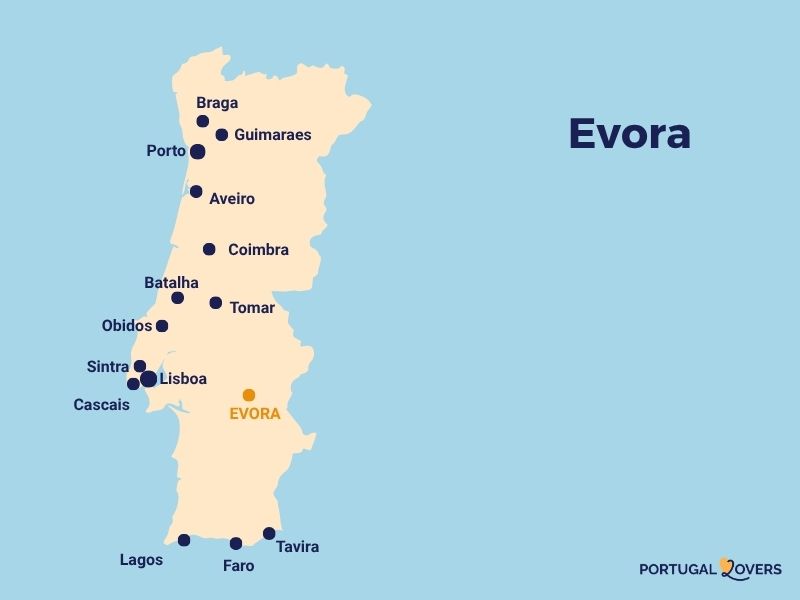
- Évora is located in the Alentejo region, about 130 km east of Lisbon
- From Lisbon to Évora = about 1 hour and 230 minutes by car
- From Faro to Évora = about a 2-hour, 45-minute drive
- Here is a map to help you find your way:
How do I get to Évora?
From Lisbon, the Intercidades train runs from the Lisboa Oriente station to Évora in about 1 hour and 30 minutes, with several daily departures. Buses also provide service along this route in a similar amount of time. By car, allow about 1 hour and 20 minutes to 1 hour and 30 minutes via the A6 and then the A2 highways.
Parking in Évora
Parking is metered on weekdays from 8:30 a.m. to 7:30 p.m. and on Saturdays from 9:00 a.m. to 2:00 p.m. in the historic district; it is free outside these hours, as well as on Sundays and holidays. We recommend parking outside the city walls—specifically near the aqueduct or Largo Luís de Camões—and then walking to the city center.

Getting Around in Évora
The historic center of Évora is best explored on foot, as many of its narrow streets are closed to traffic. We didn’t need transportation to get to the main sites from Praça do Giraldo.

Where to Eat in Évora
You can sample Alentejo cuisine at many restaurants around Praça do Giraldo and in the narrow streets of the historic center. We’ve identified ensopado de borrego and açorda alentejana as traditional dishes worth trying. You’ll be spoiled for choice as you stroll through downtown.
Visiting Évora in Winter
In winter, Évora offers a more peaceful visit and cooler temperatures, typical of the Alentejo. We prefer this season for visiting museums, palaces, and churches, without the summer heat. However, you should check the hours of operation for certain sites, as they may be reduced during the off-season.
PLAN YOUR TRIP TO Portugal
- Best of
Best destinations
Best attractions in Portugal
The most beautiful landscapes
Most Beautiful Cities
Most beautiful villages
Portugal’s Most Beautiful Beaches

- Practical advice
When to go?
How to rent a car in Portugal
Driving tips
How many days