Exploring theAlgarve and passionate about archaeology? The Alcalar Megalithic Site near Portimão awaits you for a fascinating journey into prehistory. These remains, dating from the third millennium BC, transported us into the mysterious world of the prehistoric communities that inhabited the region. Home to 2 funerary temples, this unique site offers an enriching cultural experience in the heart of an unspoilt landscape.
In this article, you’ll find some useful tips to help you prepare for your visit and have a great time.
This opinion is completely independent, based on our experiences. We visited the region anonymously, making our own choices and paying our bills in full.
Why visit the Alcalar Megalithic Site?
Are the Megalithic Monuments of Alcalar worth it? Our opinion:
Yes, especially for archaeology and ancient history enthusiasts. A 20-minute drive from Portimão, the site takes us back to the third millennium BC, when a large prehistoric community lived here. The visit is short but rewarding, as long as you know how to project yourself, as the remains are not very spectacular visually. A small, slightly dated museum near the ticket office features a reconstruction video and a number of useful explanatory panels to help visitors better understand the site. A cultural break off the beaten track and one of Portimão’s best activities for understanding the region’s prehistoric roots.

Why is the Alcalar megalithic site famous?
These monuments are among the best-preserved and most significant megalithic complexes in the Algarve, bearing witness to human presence in the third millennium BC. Since 1880, archaeological research has revealed a series of collective tombs and funerary temples. The site bears witness to the prehistoric occupation of the area between the Alvor estuary and the Monchique hills, an area particularly suited to human settlement thanks to its abundant resources.

Our favorite moments
Here are the highlights of our visit:
- Discover the remains of the 2 main funerary temples, impressive examples of prehistoric architecture.
- Exploration of the 19th-century lime kiln, an ingenious construction that demonstrates the continuity of the site’s occupation.
- The introduction to the small museum, which contextualizes the archaeological discoveries with its informative panels and short film.

History in brief
The history of Alcalar’s megalithic monuments spans several millennia:
- Third millennium BC: Construction and use of funerary temples and collective tombs by prehistoric communities.
- 1880: Systematic archaeological research begins on the site and in the region.
- 19th century: Construction of the traditional lime kiln, testimony to the continuous occupation of the area.
- Contemporary period: Transformation into an archaeological site open to the public, with the creation of an interpretation museum.

WHERE TO STAY IN THE Algarve
Our independent picks for the accommodation of your dreams:
- Where to stay in the Algarve
- Our favorite: Hotel Palmares Signature Apartments
Select by hotel type:
- Best hotels
- 5-star hotels (coming soon)
- Best boutique hotels (coming soon)
- Best adults-only hotels (coming soon)
- Best all-inclusive hotels (coming soon)
- Best hotels for families (coming soon)
Select by city:
- Best hotels in Lagos
- Best hotels in Portimao
- Best hotels in Albufeira
- Best hotels in Faro
- Best hotels in Tavira (coming soon)

Access: Alcalar Megalithic Monuments, Portimão
Where is the archaeological site?
- In the municipality of Portimão in Alcalar (Algarve)
- North of Alvor and Portimão inland
- Driving time from Alvor: 15min
- Driving time from Portimão: 20min
- Driving time from Lagos: 30min
- Driving time from Faro: 1h
How to get there?
The most practical way to reach the monuments is by car. The site is off the main roads, accessible via well-signposted secondary roads from Portimão. Public transport in this rural area is very limited, so we strongly recommend the use of a private or rental vehicle.

OUR ADVICE FOR RENTING A CAR IN THE Algarve
- Compare prices on our preferred platform: DiscoverCars – one of the best rated sites.
- Don’t take a car that’s too wide, as old towns have narrow streets and small parking spaces.
- For more choice, book early.

Read our tips (coming soon)
Parking
Free parking is available directly on site, with ample space for visitors.

Useful tips: duration, schedules, eating…
Best time to visit
It’s best to visit in the morning or late afternoon, to avoid the hottest hours of the day, especially in summer. As the site is mainly outdoors, weather conditions greatly influence the comfort of the visit. The spring and autumn months offer ideal temperatures for quietly exploring the archaeological remains.

Length of visit and main difficulties
Allow 30min to 1h for a complete visit, including the museum and exploration of the exterior remains.
The terrain has some unevenness and cobbled paths, so we recommend wearing suitable footwear. Accessibility for people with reduced mobility may be limited in certain areas of the archaeological site.

Advice on how to visit
We suggest you start with the small museum behind the ticket office for a contextual introduction, then move on to the outdoor archaeological area. This approach gives you a better understanding of the historical significance of the remains you’ll discover on your outdoor tour.

A LITTLE MORE patience
All the photos, maps, information and addresses you need to make your stay in Portugal a success will soon be available in a single ebook!
If you would like to be informed when our guide to Portugal is published, please register:
Visiting with children
A visit to the site can make a great family outing, provided children are curious and old enough to take an interest in history. There are no special facilities for younger visitors, and you need to be able to imagine what daily life was like for these prehistoric communities.
Schedules and rates
Opening times vary according to the time of year:
- From September 1 to July 14, the site is open Tuesday to Saturday, 10am to 1pm, then 2pm to 4:30pm (last entry 15 minutes before closing time). Closed Mondays, Sundays and public holidays.
- From July 15 to August 31, opening hours are Tuesday to Saturday, 10am to 1pm and 2pm to 6pm, and Sundays 10am to 2pm. Closed on Monday. Visit the official website for more up-to-date info here.
Standard admission costs €2. You can also buy a combined ticket for €4 to visit the Portimão Museum.

Guided tours
To enrich your visit and better understand the daily lives of prehistoric populations, the Portimão Museum offers a number of educational activities at the Alcalar site. Guided tours place the monuments in their historical context, while themed workshops – such as Life 5,000 Years Ago, The Sounds of Nature, Prehistoric Hunters and Monument Builders – invite young and old to explore different aspects of life in prehistory. It’s a great way to make your visit more lively and immersive!

Catering
No catering options are available directly on the archaeological site. On the other hand, the village of Alcalar doesn’t offer much in the way of quality. We suggest you take the car and head for Restaurant Xarme, 15 minutes away, for its pleasant setting and Portuguese cuisine. It is one of Portimão’s finest restaurants.

Subscribe to our Newsletter
- Get away from it all with Region Lovers’ beautiful destinations!
- Once a month
- Advertising-free
Immerse yourself in prehistory at the museum
Behind the ticket office, a small exhibition room effectively introduces the visit. Explanatory panels and a short film explain the archaeological importance of the site. We learned that since 1880, archaeologists have been carrying out extensive research north of the Alvor estuary to the foot of the Monchique hills. This territory had abundant resources for human survival, particularly in terms of food and drinking water, which is why prehistoric communities settled here. The archaeological site thus constitutes an exceptional monumental complex where a series of collective tombs and megalithic funerary temples were built and used in the third millennium BC. Discover these fascinating testimonies to prehistoric human ingenuity!

Discovery of the two funerary temples
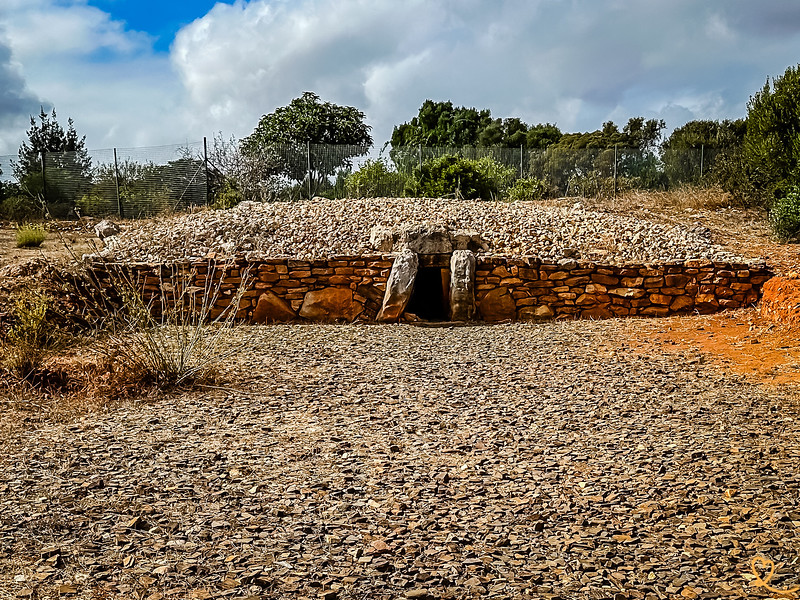
After this brief museographic introduction, head to the archaeological zone to discover the site’s most impressive remains. After a few metres of walking, you’ll come across the first funerary monument dating back to the third millennium BC, then a second a little further along the path. The entrance to these monuments gave access to a gallery leading to a circular vaulted chamber with lateral niches, an elaborate architectural feature that testifies to the technical knowledge of these ancient communities.

These temples were built from slate stones covered with heavy limestone blocks, materials chosen for their strength. It has to be said that the visit requires a certain effort of imagination, as the structures are currently fragmentary. A more interactive museography would undoubtedly have enabled us to better visualize the daily life of prehistoric communities and to better understand their ritual practices.

Exploring the rest of the site
Although the 2 main monuments of the site are undeniably the prehistoric funerary temples, your exploration doesn’t stop there. A little further along the route, you’ll discover a traditional lime kiln dating back to the 19th century, a fascinating testimony to the continuity of occupation of this area through the ages. This ingenious round construction was built inside an artificial mound, demonstrating the adaptation of local techniques to the constraints of the terrain. The oven was cut into the rock, with a small shed for storing firewood.

Throughout the site, you’ll also see small structures formed from knotted tree branches and cut trunks serving as seats in certain places, installations that echo the activities organized by the Portimão Museum to immerse visitors in the prehistoric way of life.

PLAN YOUR TRIP TO THE algarve
- Best of
Things to do in the Algarve
Most beautiful landscapes (coming soon)
Most beautiful towns and villages
Algarve’s most beautiful beaches

- Practical advice
When to go? (coming soon)
How to rent a car in the Algarve (coming soon)
Driving tips (coming soon)
How many days?
Itineraries (coming soon)

- The must-dos
Ponta da Piedade (coming soon)
Benagil cave (coming soon)
Praia da Marinha
Dolphin watching (coming soon)
What to do in Lagos
What to do in Portimao
What to do in Albufeira
What to do in Faro