Centro Ciência Viva de Lagos is a pleasant surprise in the heart of theAlgarve. This interactive museum combines history, science and maritime adventure, with a lively approach that will appeal to children and adults alike. During our visit, we were pleasantly surprised by the quality of the exhibits and the care taken to welcome families.
In this article, you’ll find some useful tips to help you prepare for your visit and have a great time!
This opinion is completely independent, based on our experiences. We visited the region anonymously, making our own choices and paying our bills in full.
Why visit the Lagos Science Museum?
Is the museum worth it? Our opinion:
Yes, the Centro Ciência Viva de Lagos is definitely worth a visit. This multi-disciplinary museum succeeds in making complex themes such as navigation, exploration and marine science accessible. It’s clearly designed with children in mind: the exhibits are interactive, fun and adapted to the youngest visitors, with lots of games, experiments to handle and even a large outdoor play area. The location is pleasant, even in midsummer, and ideal for an outing with family or friends. This is one of the best cultural activities in Lagos, and a must if you’re staying in the city for several days!

Why is Centro Ciência Viva so famous?
The center is renowned for its fun, educational approach to maritime science and history. It is part of the national network of “Ciência Viva” museums, which seek to bring science closer to the general public in Portugal. Lagos is distinguished by its roots in the history of the Great Portuguese Discoveries. The museum is nationally recognized for the quality of its reception and scientific mediation.

Our favorite moments
We really liked the first exhibition area, which focused on navigation. It’s packed with games and interactive experiments to help you understand the workings of winds, currents and on-board instruments in a fun way.
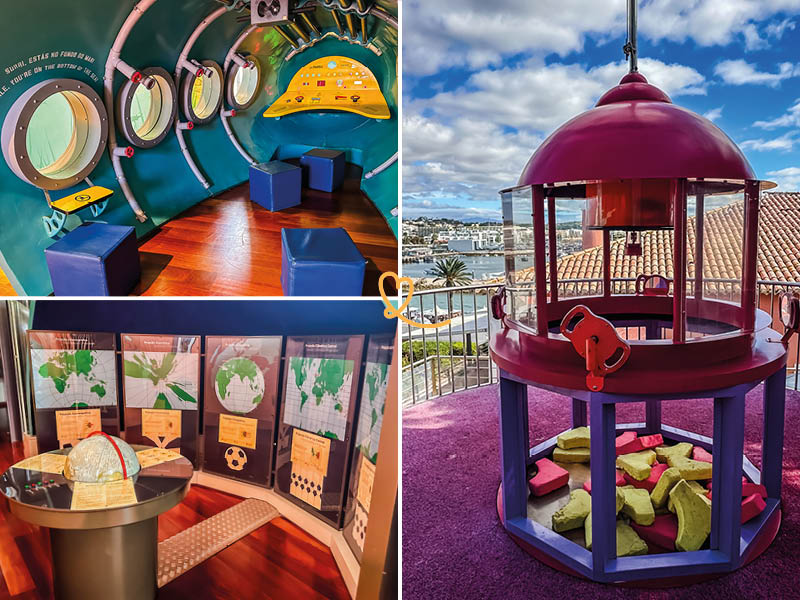
Another highlight was the children’s-scale reconstruction of the interior of a submarine. Playful and immersive, this module was a hit with the youngest visitors.
And of course, the outdoor playground is a must. It features several interactive installations related to the sea, the weather and the great explorations, in a safe and pleasant setting.

WHERE TO STAY IN Lagos
Our favorites: neighborhoods and hotels
Best Hotel in Porto de Mós –
Hotel Vivenda Miranda – See prices, photos and availability
Best Hotel in Ponta da Piedade –
Cascade Wellness Resort Hotel – See prices, photos and availability
Best Hotel in Meia Praia –
Aparthotel Palmares Signature – See prices, photos and availability
Best Hotel in the Old Town –
Hotel Lagos Avenida – See prices, photos and availability

History in brief
The Lagos Museum of Living Sciences opened its doors in 2009 as part of the national “Ciência Viva” network, an initiative to make science accessible to everyone in Portugal. In Lagos, the theme of the Great Discoveries was a natural choice: it was from this port that many Portuguese navigators set out to explore the world during the era of the Great Explorations. The museum draws on this historical heritage to offer original, lively scientific outreach for all ages.

Access: Lagos Living Science Center
Where is the Lagos Science Museum?
- Right in the historic center of Lagos (Algarve)
- Rua Dr. Faria e Silva 34
- Upstairs at the Lagos Municipal Market
- Facing Ribeira de Bensafrim and the port
- 7min walk from Musée de l’Esclavage
- 8min walk from Municipal Museum Dr. José Formosinho
OUR ADVICE FOR RENTING A CAR IN THE Algarve
- Compare prices on our preferred platform: DiscoverCars – one of the best rated sites.
- Don’t take a car that’s too wide, as old towns have narrow streets and small parking spaces.
- For more choice, book early.

How do I get there?
The museum is within easy walking distance of the city center. You can enter either via the side alley (Rua Dr. Faria e Silva), or directly from the upper floor of the Lagos Municipal Market.

If you prefer public transport, several bus routes stop nearby, including the “Praça do Infante” stop, just an 8-minute walk away. To help you plan your visit, you can consult the bus timetables on the local network’s official website here.

Parking
The museum doesn’t have its own parking lot, but it’s easy to park nearby. A convenient option is the Parking da Frente Ribeirinha, a 7-minute walk away. It’s a covered, pay parking lot that lets you visit the historic center without worrying about your vehicle. In high season, remember to arrive a little earlier to find a seat.


Useful tips: duration, schedules, eating…
Best time to visit
During the day, it’s best to visit in the morning to take advantage of the interactive areas before groups or families arrive. Afternoons can be busier, especially during school vacations. When the weather’s clear, it’s even better: avoid rainy days, as a large part of the tour takes place outdoors.
The museum is open all year round. In summer, it’s an excellent air-conditioned refuge during the hot hours. In winter or off-season, visitor numbers are lower and the visit even more comfortable.

Length of visit and main difficulties
Allow between 1h30 and 2h for a complete visit, more if you take part in a workshop or let the children play outside.
On the whole, the museum is very accessible: there are elevators to all floors, toilets adapted for people with reduced mobility, and a changing table for toddlers. A few strollers can be borrowed from reception if required. Beware, however, of outdoor areas with cobblestone floors: bring comfortable shoes for young children.

Advice on how to visit
After entering the museum, head for the first exhibition area, entitled “Welcome aboard”, located on the first floor next to the ticket office. This space is an excellent starting point for immersing yourself in the world of navigation. During our visit, a guide accompanied us along the way, explaining how each interactive game worked one by one. The games are fun and educational, and appeal to children and adults alike.

Once you’ve explored this first area, head for the outside. It houses 3 themed areas: the boat garden, the lighthouse garden and the discovery garden. You’ll love testing out the fun and educational facilities with your children. This open-air area is particularly pleasant and well-designed for families: take your time to enjoy it before continuing your visit.

Then go up to floor 1 of the museum. It houses a recreation of a submarine on a child’s scale, as well as 2 complementary rooms: one devoted to life on board and the other to communication at sea. Here again, games and interactive modules make learning fun. After this wonderful sequence of discoveries, all you have to do is go back down to the first floor to leave the museum, with plenty of memories in your head.


Visiting with children
Centro Ciência Viva de Lagos is clearly designed for families. The youngest visitors will find adapted manipulations, fun games and even an immersive reconstitution of a submarine on their scale. Children can explore the various educational facilities at their own pace and in complete safety. The outdoor play area is a real plus for prolonging your visit without getting bored. A stroller is available at reception, and there’s a changing table in the toilets on the first floor: everything has been thought of to make the visit a pleasant one for families.

Schedules and rates
The museum is generally open Tuesday to Sunday, 10am to 6pm. Closed Mondays, January 1, December 24, 25 and 31.
Admission is €6 for adults and free for children under 6. Discounts are available for families, students and groups. More details on the official website here.

Guided tours
The Centro Ciência Viva de Lagos does not offer traditional guided tours, but regularly organizes workshops for families and schools. These educational activities cover a wide range of topics, from programming robots to creating objects with 3D pens – find out more about programming here.
The museum is also part of the national Circuitos Ciência Viva network, which promotes science through 21 centers in Portugal. This network encourages fun and cultural discoveries all over the country. Find out more here.

Catering
There’s no on-site restaurant, but the museum is ideally located above the market. So you’ll have no trouble finding a good place to eat nearby, whether for a gourmet break or a real meal. Alternatively, check out our recommendations for good restaurants in Lagos, including Restaurant A Petisqueira, a 5-minute walk away.

Subscribe to our Newsletter
- Get away from it all with Region Lovers’ beautiful destinations!
- Once a month
- Advertising-free
Before exploring the seas, we need to understand how Portuguese navigators found their way, communicated and survived on board. The Lagos Science Museum offers an exciting, interactive introduction to science that we’ve tried and tested!
The tour begins with the “Welcome aboard” area on the first floor. This room covers the basics of navigation: ancient instruments, maps, compasses, winds and currents… everything is explained in a clear and entertaining way. A guide accompanied us on our tour of the space. He showed us how each game worked one by one, taking the time to answer our questions. A lively approach that transforms the visit into a genuine guided exploration.

Games for young and old
The children loved handling the objects, testing experiments and playing at being navigators. For our part, we also enjoyed taking part: the games are cleverly designed, both educational and fun. With the “From the astrolabe to GPS” collection, the museum proves that it is not rooted in the past, but highlights the evolution of navigation tools right up to the present day. We tested a game that involved positioning mirrors to direct beams of light: once all were correctly oriented, a green light lit up, validating the experiment. A great way to get started, interactive and suitable for all ages!

Explorers’ gardens
Outside the museum, the adventure continues in a fun and educational open-air area. 3 themed gardens invite visitors to learn while having fun, in a setting designed for the whole family.
Themed gardens for fun and learning
Outside the museum are 3 themed gardens: the boat garden, the lighthouse garden and the discovery garden. Each area features educational installations related to science and the sea. Children can try to open the pirate ship’s treasure chest, or play with water to understand ocean currents. Each installation is accompanied by an explanatory label. It’s an open-air extension of the museum, just as educational, and perfectly integrated into the tour itinerary. Can you recognize the tool in our photo?

A pleasant, family-friendly setting
The garden is a real family favorite. The facilities are safe, fun and invite you to take your time. You can easily spend half an hour or more here, letting the kids play while the parents enjoy the surroundings. The area is well shaded, equipped with benches, and the games have been designed to arouse curiosity without being too complicated. A real plus for your visit, especially in fine weather. We watched young children climb to the top of the lighthouse like little pirates!

Life on board
Head for the top floor for a glimpse into the daily lives of sailors. Between submarine reconstructions and interactive modules, we discover how crews lived and communicated on the high seas.
Inside a miniature submarine
Upstairs, children discover an immersive reconstruction of a miniature submarine. The space is designed on their scale, with portholes, controls and ambient sounds to make you feel as if you’re really underwater. It’s one of the most popular areas for youngsters: you can explore, touch the buttons and imagine yourself living in the depths of the sea. Even adults are falling back into childhood!

Daily life and communication at sea
2 rooms complete the visit upstairs: one dedicated to the daily life of sailors, the other to means of communication at sea. We discover how crews organized themselves on board, what objects they carried, and how they exchanged messages during the crossing. The materials are varied, with explanatory labels, period objects and always an element of manipulation. We even rowed like ancient sailors… and watched the ship’s speed in real time, displayed in meters per second! A great way to end the visit on an immersive, human note.

Frequently asked questions
Can we visit the Caravela Boa Esperança replica?
According to the official website of the Municipality of Lagos, the Caravelle Bonne-Espérance is normally open to the public and moored at Cais da Ribeira de Bensafrim. It is an integral part of the tour offered by Centro Ciência Viva de Lagos. On our visit, it didn’t appear to be accessible, but we were able to observe it from the promenade. We therefore advise you to check in advance, directly with the museum, whether visits are possible on the day of your visit – see here.

Does the museum have an ecological vocation?
Yes, the Centro Ciência Viva de Lagos doesn’t just explain the past: it also raises awareness of the issues of today and tomorrow. Several modules in the exhibition address environmental issues, such as the impact of climate change on the oceans and the importance of preserving marine resources. The center emphasizes a sustainable approach to science, notably through educational activities aimed at the very young. It’s a place that encourages scientific curiosity while awakening eco-citizenship.

PLAN YOUR TRIP TO THE algarve
- Best of
What to do in the Algarve
The most beautiful landscapes
Most beautiful towns and villages
Algarve’s most beautiful beaches
Best excursions

- Practical advice
When to go?
How to rent a car in the Algarve
How many days?
Itineraries
Where to stay in the Algarve
Lagos, Portimao or Albufeira
Most beautiful hotels