We highly recommend a visit to the Portimão Museum. Housed in a former canning factory, this unique museum traces the history of the town and its region. We loved this authentic immersion in the industrial and maritime world of theAlgarve.
In this article, you’ll find some useful tips to help you prepare for your visit and have a great time!
This opinion is completely independent, based on our experiences. We visited the region anonymously, making our own choices and paying our bills in full.
Why visit the Portimão Museum?
Is the Portimão Museum worth it? Our opinion:
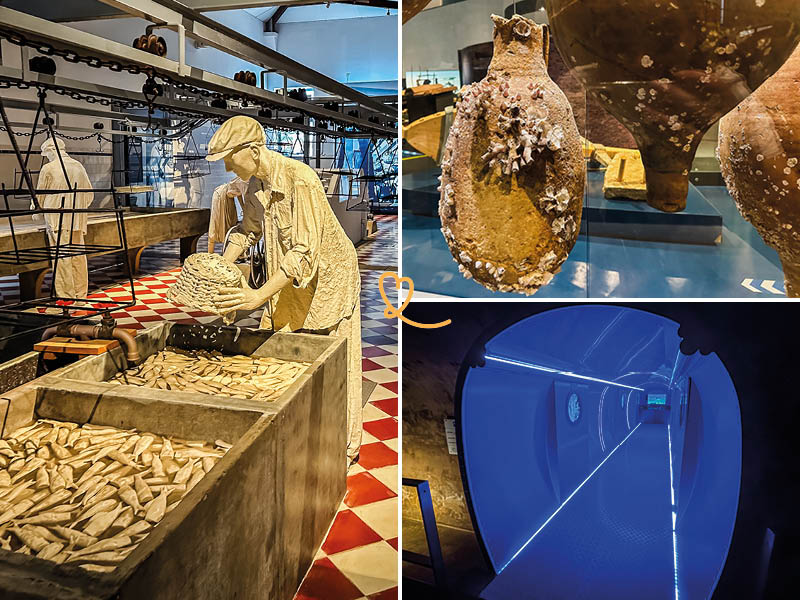
Yes! In fact, it’s one of the must-do activities in Portimão. It is housed in a former canning factory. We particularly enjoyed the reconstruction of the sardine production lines, the everyday objects and the stories of local life. It’s a great opportunity to discover Portimão’s port identity beyond its beaches. Temporary exhibitions regularly enhance the visit. The venue is modern, well-designed and accessible to all.

Why is the Portimão Museum famous?
The Portimão Museum is renowned for its unique location in a former local cannery. We appreciated this industrial conversion, which preserves the authenticity of the site. The museum also presents the economic and social history of the region, in particular the canning industry that made Portimão rich in the 20th century.

Our favorite moments
Here are the 3 highlights of our visit:
- Reconstruction of the old cannery, highlighted by mannequins
- Vintage printing presses used to produce promotional items for canned fish.
- The fish landing stage, an ingenious and practical mechanism that linked the Arade River directly to the cannery.

WHERE TO STAY IN Portimao
Our favorites: neighborhoods and hotels
Best luxury hotel
Bela Vista Hotel & Spa – See prices, photos and availability
Best 4-star hotel
Jupiter Marina Hotel – See prices, photos and availability
Best hotel for families
Vitor’s Plaza Aparthotel – See prices, photos and availability

History in brief
Portimão has grown up around its natural resources, the river and the sea. Since ancient times, fishing and the preservation of fish with salt have shaped local life. In the 20th century, a powerful canning industry was established on the banks of the Arade. In 1996, the municipality bought the former São Francisco factory to preserve this memory. In 2008, the Portimão Museum opened in this 19th-century building. It traces the development of the area and highlights the town’s industrial and maritime identity.

Access: Portimão Museum, Algarve
Where is the museum?
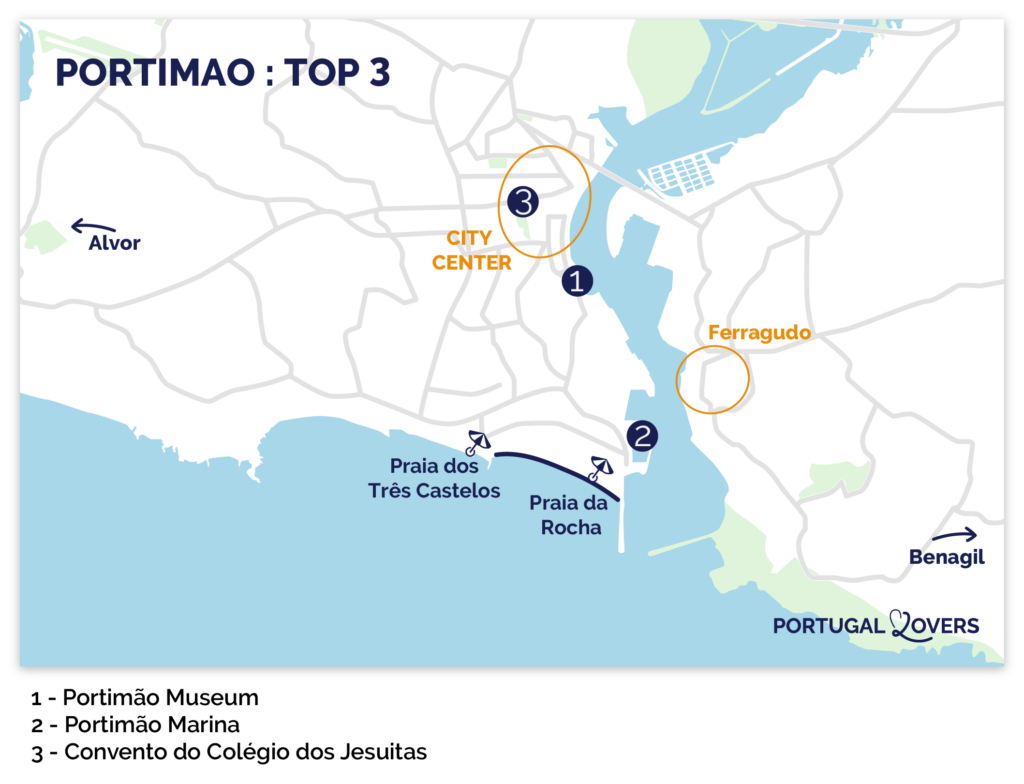
The museum is located on Rua D. Carlos I Zona Ribeirinha in Portimão (Algarve).
- South of downtown Portimão
- In the Zona Ribeirinha
- On the banks of the Arade River
- Close to the marina
Use our Portimão map to find your way around the city:
OUR ADVICE FOR RENTING A CAR IN THE Algarve
- Compare prices on our preferred platform: DiscoverCars – one of the best rated sites.
- Don’t take a car that’s too wide, as old towns have narrow streets and small parking spaces.
- For more choice, book early.

Read our tips (coming soon)
How to get there?
The museum is easily accessible from downtown Portimão. Allow a 10-15 minute walk along the Arade River.
The site is also well served by public transport: the “Museu 2” bus stop is right next door. To prepare your journey, you can consult the timetables and itineraries here.

Parking
If you have a car, there’s ample free parking nearby, on Rua 28 de Maio, on the Zona Ribeirinha side.


Useful tips: duration, schedules, eating…
Best time to visit
We recommend that you visit the museum in the morning or late afternoon to avoid groups. As the museum is covered, this is also an excellent option on very hot or rainy days. In summer, choose slots outside peak tourist times.

Length of visit and main difficulties
Allow 1 to 1h30 for a complete visit of the museum.
The course is accessible to people with reduced mobility. Adapted equipment is available: access ramp, elevators, toilets and wheelchair loan at reception. The museum strives to provide a comfortable and inclusive experience for all its visitors.

Advice on how to visit
The museum is open to the public, but if you’d like to follow the itinerary designed by our staff, simply follow the directional signs. For a smooth, chronological experience, we recommend you start with the section “The evolution of human occupation”, before moving on to the area dedicated to “The fishing industry and the challenges of the sea”. The tour naturally leads to the “A Casa do Descabeço” room, at the heart of the canning process. Then descend into the old cistern to discover the underwater world, and finish your visit outside, at the landing stage. This tour will give you a better understanding of Portimão’s evolution, from its origins to its industrial past.

A LITTLE MORE patience
All the photos, maps, information and addresses you need to make your stay in Portugal a success will soon be available in a single ebook!
If you would like to be informed when our guide to Portugal is published, please register:
Visiting with children
The museum offers an interactive experience that will appeal to younger visitors too. An enriched guided tour is available on smartphone, ideal for capturing their attention along the way. Touch-screen displays line the different rooms, making discovery even more fun. In the former cistern, children can manipulate buttons, pick up a telephone or observe underwater fauna through portholes: an immersive space that stimulates curiosity and the senses.

Guided tour
To enhance your visit, the museum offers a digital guide accessible via a free app, available in several languages: Portuguese, Spanish, German, English and French. Installation takes just a few minutes on both Android and iOS. Once launched, the application gives you access to a complete audio guide, accompanied by an interactive map to help you find your way around the different sections of the museum. We really appreciated this tool, which lets you explore the site at your own pace! Find out more here.

Schedules and rates
Admission to the museum is very affordable: €3 per adult, and free for children under 15. A great opportunity for a cultural family outing at an affordable price.
The museum is open from Tuesday to Sunday. From September 1 to July 14, opening hours are from 10am to 6pm, except on Tuesdays, from 2:30pm to 6pm. In summer, from July 15 to August 31, it stays open later, from 3pm to 11pm. The museum is closed on Mondays and public holidays. To check updated opening times or exceptional closures, visit the official website here.

Catering
The museum doesn’t offer on-site dining options, but you’ll find plenty of eateries in downtown Portimão. Our article on the city’s best restaurants will be available soon, but in the meantime we suggest Restaurant Mãe Terra for its healthy, vegetarian dishes that are as beautiful as they are good!

A land shaped by centuries
Portimão’s first civilizations
The collection entitled “Portimão, Territory and Identity” took us on a fascinating journey through local history. Over an area of around 1000m2, we discovered a remarkable historical synthesis of the path taken by local communities, from prehistory to the present day. The museum displays objects that belonged to the Alcalar community, where death occupied a central place and was the subject of carefully codified rituals. We suggest that you visit the Alcalar Megalithic Site to find out more.

Portimão’s Roman and Islamic presence is also highlighted by a number of archaeological remains on display in the museum. Among them are architectural elements from Roman villas and cisterns found in the region, as well as a beautiful series of amphorae dating from this period, presented in a showcase that we particularly appreciated. The tour continues with traces of the Islamic period, including those of the “Alcaria de Arge”, a rural community active between the 11th and 13th centuries. This structure comprised 2 wings organized around an inner courtyard, several remains of which can be seen in the museum today. It bears witness to the establishment of small farming units near the River Arade, at a time when the Islamic town of Silves was spreading its influence throughout the region.

Portimão before industry
This section took us back to a time when Portimão’s activities were very different from those of modern industry. We were interested in the history of logging and shipbuilding. You’ll discover how tree trunks were transported in carts from the mountains of Monchique to the shipyards of Portimão, located on the right bank of the mouth of the River Arade. The exhibition also features memoirs and testimonials about the shipbuilding process in wood and the various related industries.

The museum pays tribute to Manuel Teixeira Gomes, an emblematic figure who shaped Portimão’s identity. Born in 1860, this multi-faceted individual was a businessman, writer, diplomat and President of the Portuguese Republic from 1923 to 1925. His exceptional career, deeply linked to the city’s history, is retraced through a chronological frieze and significant objects. Throughout his life, he never ceased to nurture a passion for travel and writing, 2 pillars that shaped his thinking and his work, and which have spoken volumes to us. An outstanding personality whose cultural legacy continues to resonate in Portimão.

Industrial life and the challenges of the sea
The golden age of Portimão’s canneries
The heart of the museum plunges us into the world of the canning industry, the economic mainstay of Portimão and the Algarve. The trail traces the close links between the town, the Arade River and the Atlantic Ocean, highlighting the essential role played by men and women in this activity. From the old fish market to the production workshops, we follow every step of the process. We particularly enjoyed the “A Casa do Descabeço” room, where the canning operations began, with its reconstructed scenes that bring the past surprisingly to life.

From Portimão to the rest of the world
This part of the museum enabled us to gauge the international impact of Portimão’s canning industry in the 19th and 20th centuries. At the time, canned fish was considered a luxury product, sold in delicatessens or intended for a wealthy clientele. Manufacturers therefore had to compete creatively to win over demanding markets such as England, France, Germany and the United States. The exhibition highlights their communication strategies through a variety of carefully designed media.

We particularly appreciated the display of old printing presses, still in excellent condition, used to produce promotional content. The collection also includes some curious objects: fish-shaped forks, seals, illustrated boxes, export cases and collectible packaging. A book of original recipes using Portuguese sardines completes the package. These pieces give a lively, aesthetic dimension to this industrial epic. A fine tribute to the ingenuity of Portimão’s canners!

From the depths
The old factory cistern
Descending into the factory’s old cistern, we discovered an astonishing space, once dedicated to rainwater harvesting. Now transformed into a virtual aquarium, the room projects animated images of the underwater flora and fauna of the Rivière Arade and its coastline. This is also where the Ocean Revival core was installed in 2013, a project that traces the creation of an underwater park with ships sunk off Alvor. A successful immersion that raises awareness of the ecological richness and preservation of the local marine heritage.
>> For a real-life experience, why not try a dive in Ocean Revival Park? <<

The fish landing stage
Outside the museum, the visit continues with a faithful reconstruction of a period fish landing. This well-designed installation provides a concrete illustration of the logistical organization of the canning industry. On display is a replica of the early 20th-century wooden jetty and conveyor once used by the S. Francisco factory of the Feu&Hermanos company. The fish, bought at the fish auction, arrived by river before being taken directly to the dehairing hall for processing.

We were intrigued by the presence of the “Moira”, an iconic inshore fishing boat. Built in Sesimbra in 1936, it transported fish between the trawlers and the fish market. Equipped with both an engine and a sail, this boat illustrates the ingenuity of the sailors of the time, capable of adapting their techniques to sailing conditions. A fine example of local maritime know-how, perfectly integrated into the museum tour.

Subscribe to our Newsletter
- Get away from it all with Region Lovers’ beautiful destinations!
- Once a month
- Advertising-free
Frequently asked questions
Does the Portimão Museum host temporary exhibitions?
Yes, the Portimão Museum regularly holds temporary exhibitions. These events explore a wide range of themes: contemporary art, maritime heritage, local traditions and ecological initiatives linked to the ocean. They often occupy specific areas of the museum, offering a relevant complement to the permanent exhibition. Before your visit, check out the official website here or contact the museum to find out about current exhibitions and make sure you don’t miss out on any of these enriching discoveries.

Can we visit the Alcalar Megalithic Site in addition to the museum?
That’s a great idea! A 20-minute drive from Portimão, you can learn more about Alcalar’s prehistoric communities in the museum. The visit is short but rewarding, as long as you know how to project yourself, as the remains are not very spectacular visually. A small, slightly dated museum near the ticket office features a reconstruction video and a number of useful explanatory panels to help visitors better understand the site. A cultural break off the beaten track, ideal for lovers of ancient history.

PLAN YOUR TRIP TO THE algarve
- Best of
Things to do in the Algarve
Most beautiful landscapes (coming soon)
Most beautiful towns and villages
Algarve’s most beautiful beaches

- Practical advice
When to go? (coming soon)
How to rent a car in the Algarve (coming soon)
Driving tips (coming soon)
How many days?
Itineraries (coming soon)

- The must-dos
Ponta da Piedade (coming soon)
Benagil cave (coming soon)
Praia da Marinha
Dolphin watching (coming soon)
What to do in Lagos
What to do in Portimao
What to do in Albufeira
What to do in Faro