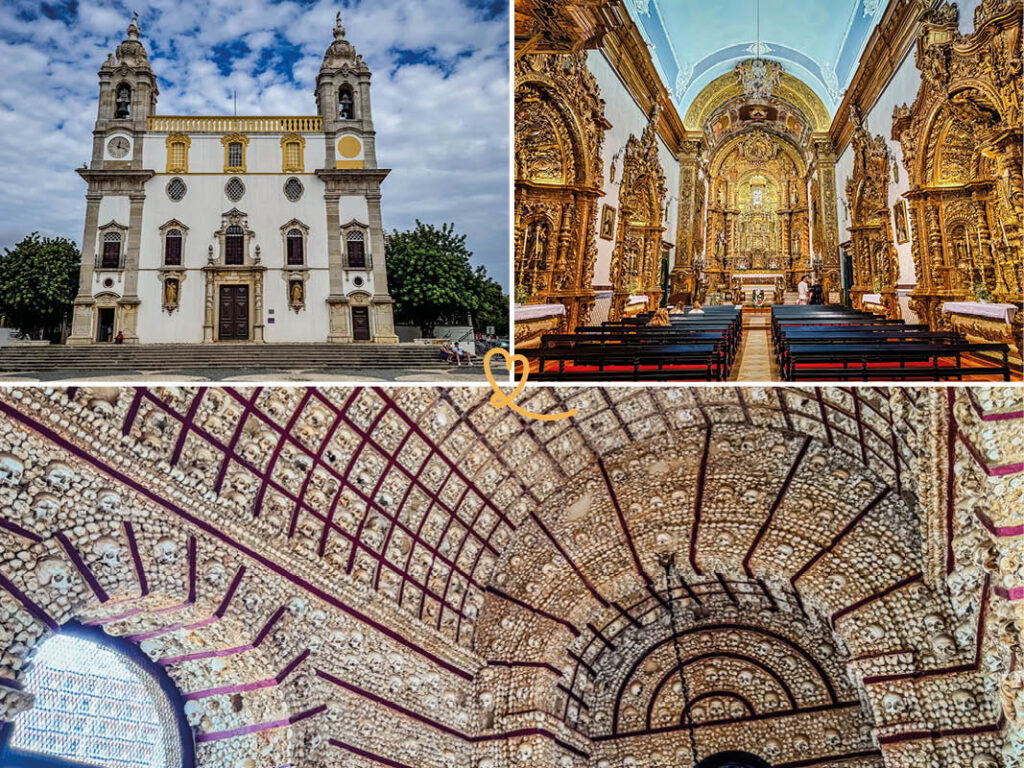
Would you like to visit Faro? Don’t miss theIgreja do Carmo and its fascinating Capela dos Ossos de Faro! This 18th-century Baroque church boasts a beautiful white and yellow geometric façade and a richly decorated interior. But it was the macabre Chapelle des Os, built from the bones of over 1,000 Carmelite monks, that struck us most. A place that is both striking and meditative, where architecture dialogues with the notion of impermanence.
In this article, you’ll find some useful tips to help you prepare for your visit toFaro’s Carmelite Church and have a wonderful time!
This opinion is completely independent, based on our experiences. We visited the region anonymously, making our own choices and paying our bills in full.
Why visit the Igreja do Carmo and its Capela dos Ossos?
Is Faro’s Carmelite Church worth it? Our opinion:
Yes, Faro’sIgreja do Carmo and Capela dos Ossos are well worth a visit. The church is worth a visit for its majestic Baroque facade and its interior richly decorated with carved and gilded wood. But it’s above all its ossuary, the Capela dos Ossos (Chapel of the Bones), that makes this place truly unique. This small chapel, made up of over 1,000 human bones, offers both a macabre and spiritual experience.
This tour is undoubtedly one of Faro’s best activities!

Why are Faro’s Igreja do Carmo and Capela dos Ossos famous?
TheIgreja do Carmo is famous for 2 main reasons:
- Firstly, because it’sone of the Algarve’s most important historical monuments. Indeed, its impressive Baroque façade and richly decorated interior with carved and gilded wood, azulejos and other paintings and decorations make it an outstanding example of 18th-century Portuguese religious Baroque architecture.
- Secondly, and most importantly, Faro’sCapela dos Ossos is famous beyond the Algarve’s borders. This unique chapel, built from the bones and skulls of over 1,000 Carmelite monks exhumed in 1816, is a striking memento mori – a poignant reminder of the ephemeral nature of human existence.

Our favorite moments
Our visit to theIgreja do Carmo had many memorable moments:
- We were particularly impressed by the majestic Baroque façade that dominates Carmel Square,
- Inside, we were dazzled by the richness of the carved and gilded woodwork,
- But the most memorable moment was undoubtedly the discovery of Faro’s Capela dos Ossos, with its walls lined with carefully arranged human bones.

WHERE TO STAY IN Faro
Our favorites: neighborhoods and hotels
Best apartment hotel
Amália Boutique Suites & Studios – See prices, photos and availability
Best boutique-hotel
Roots Hotel – See prices, photos and availability
Best luxury hotel
3HB Faro – See prices, photos and availability

History in brief
Faro’sIgreja do Carmo is a major religious building in the Algarve, bearing witness to Portugal’s rich Baroque heritage. Founded in 1713 by Bishop D. António Pereira da Silva, we discovered that it was originally designed to house the Third Order of Our Lady of Mount Carmel. Its reconstruction, undertaken in 1747, enlarged the church and embellished its facade. Despite the destruction caused by the 1755 earthquake (more info here), work continued into the 19th century, with the progressive completion of the towers and the installation of a 9-bell carillon. Today, you’ll discover that the church is distinguished by its talha dourada decorations, azulejos and imposing Baroque façade.
Behind the church, the Capela dos Ossos de Faro, built in 1816, will probably impress you with its singular character. We learned that this ossuary was built from the bones of Carmelite monks exhumed from the town’s former cemeteries. Inside, skulls and tibias adorn the walls and ceiling, forming surprisingly symmetrical patterns. Fascinating and solemn at the same time, this chapel is one of Faro’s must-see places in Faro.

How to find us: Igreja do Carmo, Faro
Where is the Igreja do Carmo?
Faro’s Carmel Church is located in Carmel Square:
- In Faro’s old town
- Less than a 10-minute walk from Faro Marina and less than a 15-minute walk from Faro Cathedral.
- Close to must-see places in the Algarve capital

OUR ADVICE FOR RENTING A CAR IN THE Algarve
- Compare prices on our preferred platform: DiscoverCars – one of the best rated sites.
- Don’t take a car that’s too wide, as old towns have narrow streets and small parking spaces.
- For more choice, book early.

Read our tips (coming soon)
How to get there?
There are several options for getting to Faro Cathedral:
- The building is easily accessible on foot.
- If you take public transport, the ” R. Aboim Ascensão ” stop on the city’s transport network is the nearest. To plan your itinerary, please consult the route maps, timetables and fares here.
- You can choose a sightseeing bus tour. Hop-on-hop-off buses are a great way to visit all the sights quickly and easily. Book your Hop-On-Hop-Off pass now.

Parking
No parking is available directly on site, although it is possible to park in adjacent streets. The nearest covered parking lot is the “Saba da Pontinha” parking lot, about a 10-minute walk from the church. Alternatively, discover all our tips for parking in Faro.


Useful tips: duration, schedules, eating…
Best time to visit
We advise you to come during the week, as soon as the church is open , to enjoy the site in peace and quiet. The Capela dos Ossos de Faro is the main attraction of theIgreja do Carmo, attracting many visitors. Its small size means it quickly becomes overcrowded, which can detract from the experience. When the space is too crowded, visibility is reduced and the atmosphere becomes less immersive.
We recommendavoiding Sundays (mass at 9am) and religious holidays, which attract large numbers of worshippers and may restrict access to visitors. Finally, if you wish to photograph the monument, prefer early morning or late afternoon, when the low-angled light sublimates the reliefs of the Baroque façade and creates an atmosphere conducive to contemplation.

Length of visit and main difficulties
Allow between 30 and 45 minutes to visit theIgreja do Carmo and its Chapel of the Bones. This will give you time to admire the exterior façade, contemplate the details of the choir and the gilded altars inside, and of course discover the fascinating Capela dos Ossos.

Advice on how to visit
To make the most of your visit, we suggest a logical itinerary to maximize your experience:
- Start by exploring the baroque façade of theIgreja do Carmo, with its twin towers and characteristic 18th-century ornamental details. Take time to admire this imposing architecture from the Place du Carmel.
- Then, step inside the church to contemplate the richness of the carved and gilded wooden altars, as well as the magnificently decorated vaults. You’re sure to be impressed by the opulence of this sacred space.
- Continue on to the museum area in the former sacristy, where a variety of religious objects and artistic representations are on display.
- Finally, head for the back garden to discover the Capela dos Ossos, the highlight of the visit. This macabre ossuary offers a unique and memorable experience.
- Finally, take a pleasant stroll through Faro’s old town, with its cobbled streets and historic monuments.

A LITTLE MORE patience
All the photos, maps, information and addresses you need to make your stay in Portugal a success will soon be available in a single ebook!
If you would like to be informed when our guide to Portugal is published, please register:
Schedules and rates
Opening hours: theIgreja do Carmo and its Chapel of the Bones are open every day.
- in winter: Monday to Friday, 9 a.m. to 1 p.m. and 3 p.m. to 5 p.m.
- summer: Monday to Friday, 9 a.m. to 1 p.m. and 3 p.m. to 6 p.m.
- Saturday, 9 a.m. to 1 p.m.
- on Sundays there’s mass at 9 a.m. (so you might want to avoid a visit at that time)
Price: €2.

Guided tours
There are no regular guided tours of the church.
However, you can opt for a guided tour of the city, which will give you historical explanations of the Igreja do Carmo and Faro’s other buildings. See availability and book your tour

Catering
There are no catering facilities on site. On the other hand, you’re right in the center of town, close to a wide range of establishments. Discover our favorite restaurants in Faro, to enjoy before or after your visit.

Architectural observation of Faro’s Carmelite Church
The Baroque façade and symmetrical towers
The Baroque façade of theIgreja do Carmo is a remarkable example of 18th-century Portuguese religious architecture. Founded in 1713 under the reign of King John V, we immediately noticed that it is distinguished by its majestic twin towers, which harmoniously frame the main façade. You’re bound to notice the perfect symmetry of the steeples, which rise elegantly into the sky. The one on the west side has a 9-bell carillon. Before entering, take the time to observe the main doorway: it is flanked by 2 Corinthian columns topped by pyres, with twisted shafts. On either side, there is a niche under a baldachin with statues of St Elijah and St Teresa.

We noticed that the ornamental details dotted around the façade reflect the richness and refinement of the Portuguese Baroque style. This opulence was apparently influenced by the wealth brought by gold from Brazil, then a Portuguese colony. In particular, it helped finance the reconstruction of the building after the devastating earthquake of 1755 (more info here).
On a sunny day, the light-colored limestone used for construction contrasts delicately with the blue of the Algarve sky, while the yellow details recall its baking sun. You’ll also notice the small number of ornate windows that let light into the building, a sign of a sunny region. We’ve mentioned the building’s symmetry, but have you noticed the little irregularities that hide behind it? Watch carefully and have fun spotting them, just like in a difference game!

Carmel Square
Carmel Square provides the perfect backdrop for the majestic façade of theIgreja do Carmo. This spacious, light-filled esplanade allows you to stand back and admire the building’s imposing Baroque architecture in all its splendor. We loved the lively atmosphere of this square, a real lively place in the heart of Faro’s center.

On the floor, you’ll notice the traditional“calçada portuguesa“, a typically Portuguese paving pattern in black and white geometric motifs. It enhances the church’s facade by contrasting styles. As you stroll through the square, take note of the two coats of arms on the ground: that of the city of Faro and another linked to theIgreja do Carmo. These emblems testify to the historical and cultural importance of the site for the capital of the Algarve.

Visit the interior of the Igreja do Carmo
The choir and altars in carved and gilded wood
TheIgreja do Carmo has a single nave with a choir and 4 side chapels. It reveals a decorative wealth that bears witness to Portugal’s prosperity in colonial times. Indeed, as soon as we entered, we saw the azulejos again, and were struck by the abundance of meticulously carved gilded wood adorning the chapels and altar. Did you know? This type of decor is called“talha dourada“. It is characteristic of Portuguese Baroque.

If you look up, you’ll notice the barrel vault, painted white and blue. It seemed to echo the sky. Its clarity contrasts with the gilded wood. It is enhanced by stucco work that we felt perfectly captured the light penetrating through the few stained-glass windows.
As you approach the chapels, you’ll notice the many sculptures of angels, cuddled up in gilded wood scrolls. These masterpieces of cabinet-making are some of the finest examples of Portuguese Baroque art we’ve seen on our travels in the Algarve!

Exhibition of religious objects and art
On the way to the Capela dos Ossos, we discovered a small museum space in the former sacristy. Here you can see a small collection of religious objects: statues, paintings and representations of Christ at the various stages of the Stations of the Cross…

Although the exhibits piqued our interest, we were drawn to the beautiful coffered ceiling! Look up to admire its grotesque paintings. The natural light filtering through the windows sets it off perfectly. This space, interesting both for its architecture and for the objects on display, is an ideal intermediate stop between the main church and the more meditative experience of the Capela dos Ossos, which awaits you afterwards.

Discovery of Faro’s macabre Capela dos Ossos
Immersion in a surprising chapel made of human bones
After passing through the sacristy, you’ll arrive in the church’s rear courtyard. This quiet, herb-planted area is home to the famous Capela dos Ossos. This unusual chapel was built in 1816 from the bones of over 1,000 Carmelite monks exhumed from Faro’s cemeteries. The ossuary is without doubt the most striking feature of our visit to theIgreja do Carmo! All the more so as the small interior space makes for complete immersion.

This small whitewashed building impressed us with its macabre yet meditative atmosphere. As you cross the threshold, you’ll probably be struck by the sight of 1,245 human skulls and bones meticulously arranged in geometric patterns on the walls and ceiling. On the ground, you can see the tombstones that still bear the names of some of the people whose remains make up this singular construction. You’ll discover a more personal and human dimension to this surprising place.

Why build such an edifice?
Naturally, we wondered why the clerics of the time had decided to erect such an edifice. Don’t you? We discovered that this chapel is not an isolated case! In Faro, an altar made of human bones stands in the Cathedral courtyard. Further north, the town of Évora is also home to an imposing Capela dos Ossos, one of the city’s most emblematic monuments!

Our research has shown that the Capela dos Ossos was built for both practical and spiritual reasons, reflecting the concerns of the time. This ossuary was initially a pragmatic solution to the lack of space in Faro’s cemeteries. The remains of many Carmelite monks have thus found a final resting place, transforming a material necessity into a powerful spiritual symbol.
In the Christian tradition, such spaces invite reflection on the vanity of earthly pleasures in the face of the inevitability of death. As you contemplate these carefully arranged human remains, you may feel an invitation to meditate on your own mortality. The Capela dos Ossos thus transcends its initial function to become a powerful spiritual tool, reminding us of the impermanence of the human condition while paradoxically celebrating the eternity of the soul according to the Christian faith.

Subscribe to our Newsletter
- Get away from it all with Region Lovers’ beautiful destinations!
- Once a month
- Advertising-free
Frequently asked questions
Which museum to visit in Faro to better understand the history of the city and the Algarve?
We recommend a visit to the Museu Municipal de Faro, housed in a former 16th-century convent. It features archaeological collections from prehistoric to medieval times, including Roman mosaics and Islamic ceramics. The museum also exhibits religious works of art and 16th-century paintings.

What are the must-see sights in Faro?
Are you in the capital of the Algarve and wondering what to do in Faro?
The town is steeped in history. Roman heritage rubs shoulders with Moorish influences. We were seduced by this sunny town, which harmoniously combines historic vestiges and unspoilt nature.
Here are some of Faro’s must-see places and activities:
- Stroll through the historic center (Cidade Velha)
- Dive into history at Faro’s Municipal Museum
- Marvel at the azulejos of Faro’s Episcopal Palace
- Take a trip to the Ria Formosa Nature Reserve
- Discover Faro Cathedral
- Visit the Algarve Regional Museum
- Lazing on Faro Beach

What are the Algarve’s must-see historic monuments?
Wondering what to do and see in the Algarve? Located in the south of Portugal, the region is famous for its beacheslandscapes, caves and outdoor activities, but also for its historic monuments and pretty towns. Here are some of the Algarve’s must-see sights:
- Silves Castle: the largest castle in the Algarve, built by the Moors in the 11th century, with panoramic views over the Arade valley.
- TheChurch of São Lourenço d’Almancil: covered in azulejo tiles, this church is a unique Baroque masterpiece.
- Igreja Matriz de Alvor: Alvor’s main church, with ornate Manueline doors and gilded altars.
- Fortress of Sagres: located at the south-western tip of Europe, it is a symbol of the Age of Discovery.

PLAN YOUR TRIP TO THE algarve
- Best of
Things to do in the Algarve
Most beautiful landscapes (coming soon)
Most beautiful towns and villages
Algarve’s most beautiful beaches

- Practical advice
When to go? (coming soon)
How to rent a car in the Algarve (coming soon)
Driving tips (coming soon)
How many days?
Itineraries (coming soon)

- The must-dos
Ponta da Piedade (coming soon)
Benagil cave (coming soon)
Praia da Marinha
Dolphin watching (coming soon)
What to do in Lagos
What to do in Portimao
What to do in Albufeira
What to do in Faro