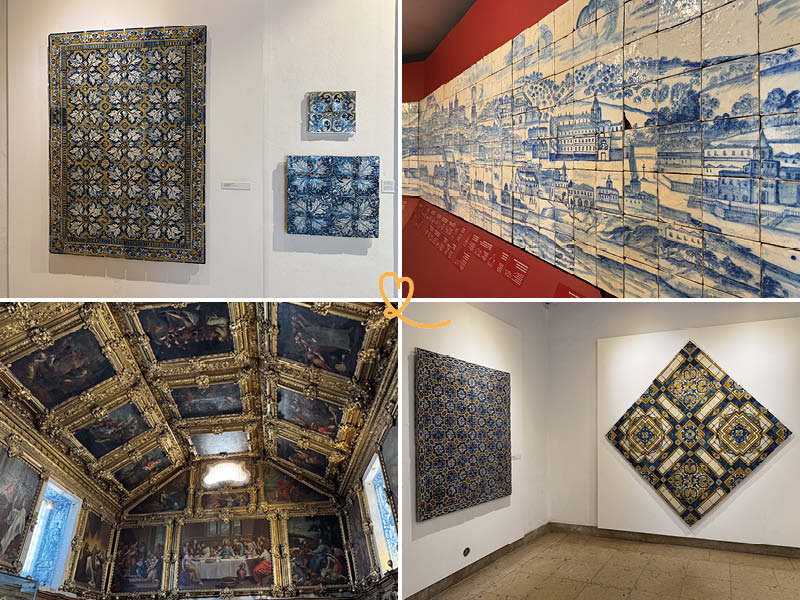
If you visit Lisbon, don’t miss the Museu Nacional do Azulejo! Occupying the former convent of Madre de Deus, this museum traces five centuries of the history ofazulejo, the art of painted earthenware tiles so characteristic of Portugal. We were captivated by the richness of the collections, from geometric Hispano-Moorish motifs to contemporary creations. The gilded Baroque chapel and the immense panorama of Lisbon before 1755 are enough to justify a visit to this exceptional site.
In this article, you’ll find a selection of useful tips to help you prepare for your visit to Lisbon’s Museu Nacional do Azulejo.
This opinion is completely independent, based on our experiences. We visited the region anonymously, making our own choices and paying our bills in full.
Why visit the Museu do Azulejo
Is the Museu do Azulejo worth it? Our opinion:
Absolutely! At the Museu Nacional do Azulejo, you’ll discover one of Portugal’s most emblematic arts: azulejos, the painted tiles that adorn many of the country’s facades. We particularly appreciated the diversity of the collection: from geometric Moorish tiles to large, narrative Baroque panels and contemporary creations.
The exceptional setting of the former convent adds to the charm of the visit, with its peaceful cloisters, sparkling golden chapel and interior gardens.
One of Lisbon’s best activities, this museum will appeal to craft enthusiasts and novices alike!

Why is the Museu do Azulejo famous?
The museum houses the country’s largest collection of azulejos. It traces the entire history of this emblematic Portuguese art form, from the earliest Hispano-Moorish influences of the 15th century to the contemporary creations that adorn Lisbon’s metro stations. The building itself, the former Madre de Deus convent founded in 1509, is a remarkable historical monument. Its baroque chapel, entirely covered in gilding and azulejos, dazzles visitors.

Our favorite
You can read more about our visit later, but on the top floor, we were stunned to see the Grand Panorama. This monumental 23-metre-long fresco, painted around 1700, is attributed to the Spanish painter Gabriel del Barco. It’s a deeply moving historical document, showing Lisbon in all its splendor just before it was destroyed by the earthquake of 1755. Have fun detailing the thousands of caravels on the Tagus and pinpointing the monuments you’ve visited in the city; for us, it’s the most precious ceramic “photograph” of Lisbon.

WHERE TO STAY IN lisbon
Our favorites: neighborhoods and hotels
Our selection coming soon
Hotel 1 – See prices, photos and availability
Our selection coming soon
Hotel 1 – See prices, photos and availability
Our selection coming soon
Hotel 1 – See prices, photos and availability

See our complete selection of the best hotels in Lisbon (coming soon)
History in brief
The history of the museum merges with that of the convent that houses it:
- 1509: Queen Leonor de Viseu founds the convent of Madre de Deus for Franciscan Poor Clare nuns.
- 1541: Construction begins on the new convent, including the tomb of the founding queen.
- 1690-1700: Installation of large azulejo panels in the church, including scenes from the lives of Saint Francis and Saint Claire.
- 1720-1746: Major decoration work on the upper choir and Saint-Antoine chapel, with their Baroque azulejos.
- 1755-1759: The Lisbon earthquake damages the Arc de Triomphe and the church ceiling. Restoration work immediately followed.
- 1871: Death of the last nun. The State acquires the convent and turns it into the Maria Pia Asylum.
- 1965: The Portuguese government installs the Museu Nacional do Azulejo in the convent buildings, as a dependency of the Museum of Ancient Art.
- 1980: The museum gains administrative autonomy and officially becomes Museu Nacional do Azulejo. The museum presents five centuries of Portuguese azulejos, from the 15th century to contemporary creations.

How to find us: Museu do Azulejo, Lisbon
Where is the Museu do Azulejo?
The Museu Nacional do Azulejo occupies the former convent of Madre de Deus, 4 Rua da Madre de Deus 4.
- In the Xabregas district.
- East of central Lisbon, about 3km from Praça do Comércio
- 2.5km from Alfama and close to Panteão Nacional

How to get there?
There are several options for reaching the museum by public transport:
- By bus, routes 742, 203, 210, 718 and 759 stop in front of the entrance.
From Praça do Comércio in the city center, take the 759, which gets you there in 15 minutes.
From Belém, line 742 makes the journey in 25 minutes. - By streetcar, there’s no direct line to the site, but you can take the famous streetcar 28 to Graça, then walk 20 minutes or take a bus.
- For cyclists, there’s a pleasant cycle path from the center of town along the Tagus River. Allow 20 minutes from Alfama, 30 minutes from Baixa. Gira self-service bicycle stations are located nearby, 300 meters from the museum.

Parking
You can also opt for the car. From the city center, you can reach the museum in just 10 minutes. Public parking is available in Rua de Xabregas, a 5-minute walk from the museum. Parking in the surrounding streets is generally available in blue pay zones on weekdays. On Sundays, parking is free throughout the neighborhood. If you’re visiting Lisbon for just a few days, we recommend you take public transport.
OUR TIPS FOR RENTING A CAR IN Portugal
- Compare prices on our preferred platform: DiscoverCars – one of the best rated sites.
- Don’t take a car that’s too wide, as old towns have narrow streets and small parking spaces.
- For more choice, book early.

Read our tips (coming soon)
Useful tips: duration, schedules, eating…
Best time to visit
The museum is popular, so we advise you to buy your tickets online to avoid the queues. Weekday mornings offer a quiet, uncrowded visit.

Length of visit and main difficulties
Allow at least 1h30 to visit the main collections.
We spent over 2 hours there, captivated by the richness of the collections and the peaceful atmosphere.
The museum is organized on several levels linked by staircases, but an elevator and access ramps facilitate circulation for people with reduced mobility. The tour involves a few steps between rooms, but the cloisters and gardens can be visited on the same level. Spacious rooms ensure smooth circulation.

Advice on how to visit
We recommend you follow the chronological itinerary proposed by the museum. It begins with Hispano-Moorish origins on the first floor, takes you through Baroque and Neoclassical evolution, then on to modern creations on the upper floors.
You finish with the Grand Panorama of Lisbon on the second level, creating a beautiful visual conclusion. The third floor is devoted to temporary exhibitions, and includes a bookshop and boutique.
Discover the cloisters and gardens at the end of your visit, before settling down in the cafeteria for a gourmet break.

A LITTLE MORE patience
All the photos, maps, information and addresses you need to make your stay in Portugal a success will soon be available in a single ebook!
If you would like to be informed when our guide to Portugal is published, please register:

Visiting with children
The museum offers game books for children, making the visit fun and interactive. Tactile reproductions of azulejos line the route: your children can touch them and get a practical understanding of tile-making techniques.

Schedules and rates
The museum is open Tuesday to Sunday, 10 a.m. to 6 p.m.
Here are the prices:
- Full adult price: €8
- Reduced rates for young people (13-25), seniors (+65) and families
- Free for children under 13
- The Lisboa Card gives free access to the museum and allows you to cut the queue.
To see the latest rates and find out about the temporary exhibition program, visit the official website here.

Guided tours
The museum offers guided tours in Portuguese only. Audioguides are available to download onto your smartphone in several languages, including French, English and Spanish. Booklets for adults detailing the main collections are available on request from reception. We found that the self-guided tour worked very well. The labels clearly explain the evolution of azulejo art over the centuries.

Catering
The museum cafeteria occupies a charming space overlooking an interior garden. It serves coffees, teas, traditional Portuguese pastries and a few light dishes. Prices remain reasonable, between €3 and €8. It’s the ideal place to take a break before or after your visit, in a peaceful atmosphere.

DISCOVER Lisbon
- Things to do in Lisbon (coming soon)
- Best hotels (coming soon)
- Best restaurants (coming soon)
- Best museum in Lisbon (coming soon)
- Itineraries (coming soon)

The former convent of Madre de Deus: a haven of peace
This museum is as magical for its collections as for its setting: the convent of Madre de Deus, founded in 1509 by Queen Leonor de Viseu.
An enchanted interlude through cloisters and gardens
The Grand Cloister of D. João III: Renaissance majesty
As soon as we entered the Grand Cloister of D. João III, we were struck by the nobility of the setting. Built from 1554 onwards, this open-air space is a jewel of Mannerist architecture, imposing in its grandeur and clean lines. Today, it serves as a showcase for part of the collections, and guides visitors to the upper floors. Before discovering the works of art, take the time to stroll around, to feel the spiritual vocation of the former convent.

Le Petit Cloître manuélin: hypnotic walls and a plant break
Further on, the atmosphere changes radically in the Petit Cloître, a much more intimate gem of Manueline architecture. Its magic lies in the azulejos that adorn its galleries: we were fascinated by the “diamond-point” geometric motifs and interlacing patterns typical of the 16th century, which create a hypnotic visual rhythm.

This haven of peace continues magnificently in the Winter Garden at the end of the visit. With its lush vegetation under a glass roof, it’s the ideal place to extend your visit in peace and quiet, far from the hustle and bustle of the city.

Five centuries of Portuguese azulejos: from Moorish to contemporary
The museum’s chronological tour traces the fascinating evolution of azulejo art in Portugal. Take the time to observe the stylistic transformations, technical innovations and changes in use of these decorative tiles.
The rise of azulejo: from the 15th to the 17th century
The first Portuguese azulejos imitated 15th-century Sevilla and Italian production, and the tour is a fascinating journey through time, starting with the first 15th-century azulejos. You’ll see the Moorish influence in these interlacing and star patterns in shades of green and yellow, achieved with metallic oxides. It’s fascinating to observe the transition to the Portuguese Renaissance: from the 1570s, Marçal de Matos’s workshop abandoned strict geometry for plant motifs.

Then came the 18th century, the real golden age: blue and white dominated large figurative panels depicting the Bible or everyday life with baroque theatricality. This transition enabled us to understand how Portugal appropriated this technique from elsewhere, transforming it into a distinctive national art.

From the Baroque to the present day: the evolution of azulejo art
Far from dwelling on the past, the museum proves that azulejo can reinvent itself. We were surprised by the modernity of the Art Nouveau and Art Deco sections, which geometrize shapes and reintroduce color. But what struck us most was the historical continuity: the tour ends with reproductions of the azulejos that now decorate Lisbon’s metro stations (Oriente, Jardim Zoológico). It’s vibrant proof that this ancestral art continues to shape the city’s visual identity before our very eyes.

Museum treasures
In addition to the overall beauty of the collection, which boasts over 7,000 works, certain pieces stand out for their exceptional character. In addition to the Grand Panorama, detailed in the “Coup de coeur” section, we were impressed by the following:
An exceptional Baroque heritage
The beating heart of the museum is theMadre de Deus Church. Prepare yourself for a visual slap in the face: this is the triumph of Portuguese Baroque, where gilding fills every inch of the building, contrasting with frescoes and blue azulejos. For an even more spectacular perspective, climb up to the Royal High Choir. From this tribune reserved for noble nuns, the view of the golden chapel is breathtaking. We loved this solemn space, where azulejos stand side by side with reliquaries and royal portraits.
The adjacent chapels are real jewels. Don’t miss the Chapelle Saint-Antoine for its 18th-century terracotta crib and typically Lusitanian decorative exuberance. Next door, the Nossa Senhora da Vida altarpiece (late 16th century) plays on a different register: that of illusion. With its 1,498 tiles, it creates trompe-l’œil diamonds of stunning depth around the Adoration of the Shepherds.

Unusual rooms
Our technical favorite is the Salle D. Manuel. Surprisingly, the 18th-century azulejos here are in relief! The mythological scenes of Diana or Neptune are not only painted, but also sculpted, giving the walls a striking depth.

Other must-see pieces include theStaircase of Saint Benedict dating from 1635, whose diamond-shaped azulejos depict grotesque scenes, and the Hunting Room with its picturesque country scenes dating from 1680. From monastic rigor to castle life, each space tells a fascinating facet of Portugal’s history.

Subscribe to our Newsletter
- Get away from it all with Region Lovers’ beautiful destinations!
- Once a month
- Advertising-free

Frequently asked questions
Does the Museu Naciocal du Azuleju offer temporary exhibitions?
The Musée National de l’Azulejo doesn’t just freeze history: it regularly comes to life with captivating temporary exhibitions on the top floor. It’s a great opportunity to discover how today’s artists are reinterpreting this age-old tradition, so check out the program on the website here.

Where can I buy tiles in Lisbon?
If you want to take a piece of Lisbon home with you without damaging its heritage, steer clear of the hawkers on Feira da Ladra (often with coins stolen from the facades!) and go to the experts. For certified, sublime antique pieces, Solar Antiques (Rua Dom Pedro V) and D’Orey are the absolute benchmarks for collectors. If you prefer something new and handcrafted, Fábrica Sant’Anna, in business since 1741, offers hand-painted marvels in Chiado. Finally, for a more “designer” and affordable option, our favorite is Cortiço & Netos: this brilliant store sells end-of-stock items from old factories from the 60s to 80s.

PLAN YOUR TRIP TO Portugal
- Best of
Things to do in Portugal (coming soon)
Most beautiful landscapes (coming soon)
Most beautiful towns and villages (coming soon)
Portugal’s most beautiful beaches (coming soon)

- Practical advice
When to go? (coming soon)
How to rent a car in Portugal (coming soon)
Driving tips (coming soon)
Itineraries (coming soon)
Where to stay in Portugal (coming soon)

- The must-dos
Things to do in Lisbon (coming soon)
Things to do in the Algarve
Things to do in Porto (coming soon)
Things to do in Sintra (coming soon)